Open-Source AI Accelerates: The Inference Challenges of Agentic Workloads

Open-source inference engines are accelerating under agentic workloads, making efficiency and cost the central challenges.
As AI applications shift from single-turn conversation to autonomous multi-step agentic execution, the inference layer has become critically important. Agentic tasks can involve dozens to hundreds of model calls, imposing strict demands on memory management, scheduling efficiency, long-context handling, and cost control. Open-source inference frameworks stand out for their customizability in this context. At the Alibaba Cloud Apsara Conference, engineer Kaichao You shared his outlook on open-source inference, reflecting a broader industry trend of deepening collaboration between leading cloud vendors and the open-source community. Scheduling optimization, long-context cost control, and standardized tool-calling support are the three core challenges on the path to mature agentic infrastructure.
Open-Source AI Enters the Agentic Era
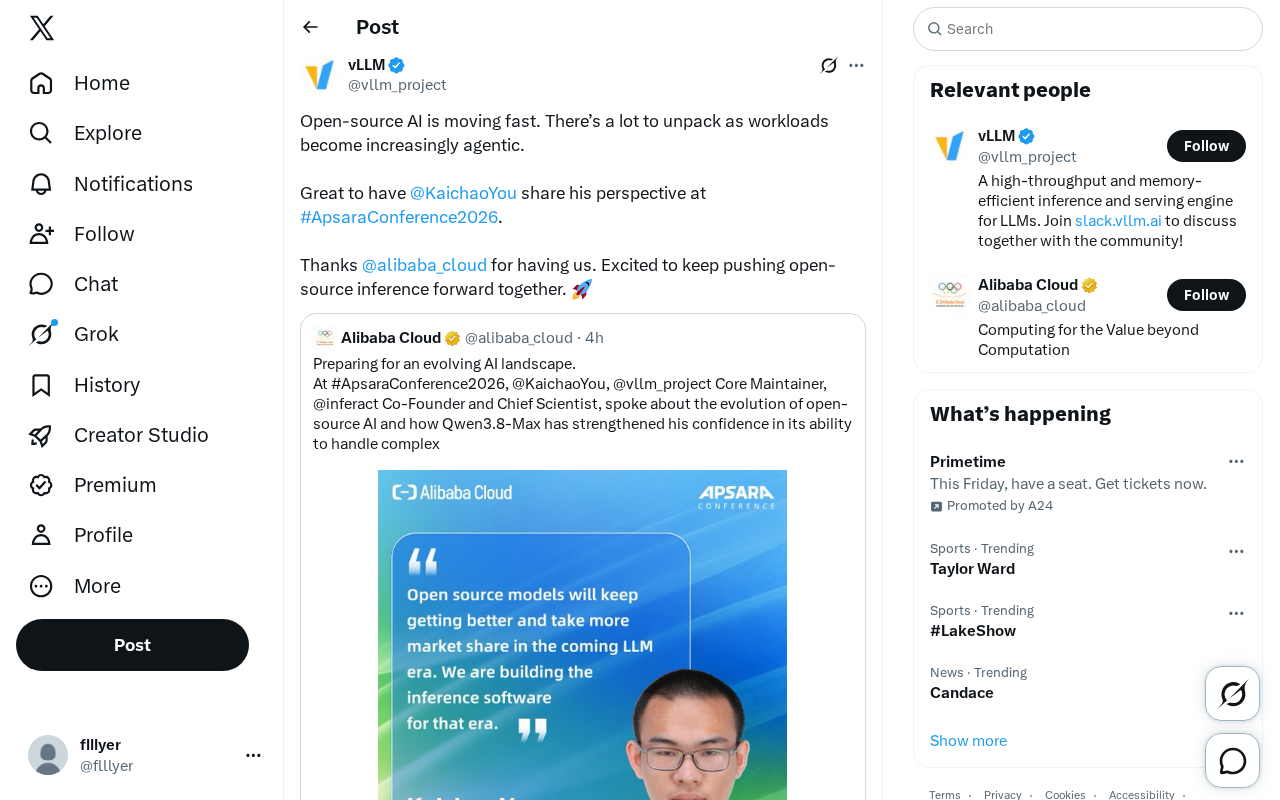
The pace of open-source AI development is clearly picking up — especially as workloads become increasingly "agentic" — and the technical challenges the industry faces are evolving along with it. This trend came into sharper focus at the recent Alibaba Cloud Apsara Conference, where AI engineer Kaichao You shared his views on the future direction of open-source inference.
Agentic workloads refer to AI systems that no longer simply respond to one-off requests, but instead autonomously plan, invoke tools, execute multi-step tasks, and interact continuously with their environment. This paradigm demands far more from underlying inference engines than traditional single-turn Q&A: longer contexts, higher call frequency, more complex scheduling, and tighter control over cost and latency.
Why Inference Has Become the Critical Battleground
As AI applications shift from "chatting" to "getting things done," the importance of the inference layer has been dramatically amplified. Completing a single agentic task may require dozens or even hundreds of model calls — meaning inference efficiency directly determines a product's viability and economics.
Open-source communities offer particular value here. Compared to closed ecosystems, open-source inference frameworks let developers optimize deeply for their own use cases — whether that's memory management, batching strategies, or adapting to new agentic paradigms. Advancing open-source inference is, at its core, about lowering the floor and raising the ceiling for the entire AI application ecosystem.
The core technical challenges inference engines face in agentic scenarios play out across several dimensions: KV Cache management — agentic tasks require maintaining long contexts across multiple steps, with memory usage growing linearly or even quadratically with context length, making efficient cache reuse a bottleneck; Continuous Batching — unlike traditional static batching, agentic requests vary wildly in length and completion time, making dynamic scheduling essential for maximizing GPU utilization; and Speculative Decoding — using a smaller model to predict tokens that a larger model then verifies, reducing per-call latency. Leading open-source inference frameworks such as vLLM, SGLang, and TensorRT-LLM are all competing and innovating around these dimensions. Understanding these underlying mechanisms helps clarify where different frameworks are and aren't suitable for real-world agentic deployments.
Signals of Industry Collaboration
This event also sent a clear signal: the collaboration between major cloud vendors and the open-source community is deepening. Alibaba Cloud, as the conference host, provided a platform for this technical exchange, and participants expressed their commitment to continue pushing open-source inference forward together.
This "vendor + community" model has real implications for the long-term health of open-source AI. Cloud vendors bring large-scale deployment experience and real-world production scenarios; the community contributes flexibility and the speed of innovation. Together, they have the potential to accelerate the maturation of agentic infrastructure.
Directions Worth Watching
Based on current trends, several areas deserve continued attention: scheduling optimization in inference engines for agentic scenarios, cost control under long-context and high-concurrency conditions, and how open-source frameworks can standardize support for tool calling and multi-step execution. These are the core questions that will determine whether open-source AI can truly handle the next generation of application workloads.
It's worth noting that the source material for this article is limited — primarily a social media post about a conference presentation — and further technical details await official disclosure.
Tool Calling (also known as Function Calling) is one of the core capabilities that distinguishes agentic models from ordinary conversational ones. It refers to a model's ability to recognize, during generation, when an external tool needs to be invoked (such as web search, code execution, or database queries), output a structured call instruction, and then continue reasoning once the tool returns its result. This capability places additional demands on inference engines: they must support interrupt-and-resume generation flows, structured output constraints (e.g., enforcing valid JSON output), and state management across multi-turn tool-calling chains. How open-source frameworks can support these interaction patterns with low latency and in a standardized way is a critical engineering challenge — and an important benchmark for assessing how "agent-ready" any given inference framework truly is.
Related articles

Chain of Thought Isn't Just for AI: How Humans Can Use CoT to Improve Thinking Quality
Chain of Thought isn't just a prompt trick for large models. Starting from a Hacker News discussion, this article analyzes why CoT works for human thinking too, breaks down actionable ways to transfer it, and highlights the key differences between human CoT and machine CoT.
Cloudflare Teams Up with OpenAI: Closi…
Cloudflare Teams Up with OpenAI: Closing the Loop from Vulnerability Discovery to Defense with AI
Cloudflare uses OpenAI Daybreak to investigate security vulnerabilities and generate reviewable remediation plans, while developers use Codex to boost coding efficiency and quality.

Orca Multi-Agent Orchestration in Practice: A Guide to Parallel Collaboration with Claude and Codex
Orca is Stable AI's free open-source agent workbench supporting 34 agents like Claude Code and Codex in parallel. Learn its Git worktree isolation, multi-model orchestration, and mobile management.