Open-Source AI Moves Off the Cloud: A Deep Dive into 10 Local Deployment Tools

10 open-source tools build a complete local AI stack, bringing inference, memory, and agents back to your own hardware.
A curated list of 10 open-source tools maps out the full path for running AI locally: Airllm, Lemonade SDK, and LocalAI handle large-model inference on consumer hardware; LeanCTX, CloudMem, and Beads manage context trimming and cross-session memory for coding agents; EgoLite enables on-device browser automation; Prime Agent adds self-improvement loops; and DeepSeek Resonix plus OpenAI Codex power long-running terminal coding tasks. The driving forces are privacy compliance, cost control, and operational autonomy — no data leaves the machine, and there are no cloud bills or rate limits.
Cloud AI Is Moving Back to Your Desktop
The core trend this week is clear: open-source AI is migrating from the cloud back to your own machine. Inference engines, memory layers, browsers, and even coding agents are increasingly choosing to run on your hardware — keeping data local, protecting privacy, and preventing runaway bills.
A tech blogger recently published a roundup of 10 open-source tools that can be deployed locally, covering the full stack from low-level inference to high-level agents. This article walks through that list with some added thoughts on real-world implementation. The core idea is simple: inference on-device, memory on-device, browser on-device, agents on-device — pick one project and install it on the machine you already own.
Inference Engines: Running Large Models on Small GPUs
Several tools on the list address the most fundamental challenge — how to run large models on everyday hardware.
Airllm (ranked #10) makes a bold claim: run a 70-billion-parameter model on a single 4GB GPU. It does this by streaming model layers from disk one at a time, processing only one layer at a go. It's not fast, but it's correct — and it doesn't require a credit card or subscription. At its core it's a Jupyter notebook, and the README explains disk computation, layer-by-layer processing, and cache computation clearly. For anyone with only an entry-level GPU who wants to experiment with real large models, this is a path around the cloud.
Lemonade SDK (ranked #9) comes from AMD and is a local LLM server. It serves open-weight models on GPUs and NPUs, with the ability to select the best device for each layer. The key point is that it exposes the same REST endpoints and OpenAI-compatible API as cloud services — meaning migrating from cloud to local often means changing just one line of client code. For teams with privacy compliance requirements, tools like this are particularly valuable: the model and data stay on the laptop, and latency is purely local.
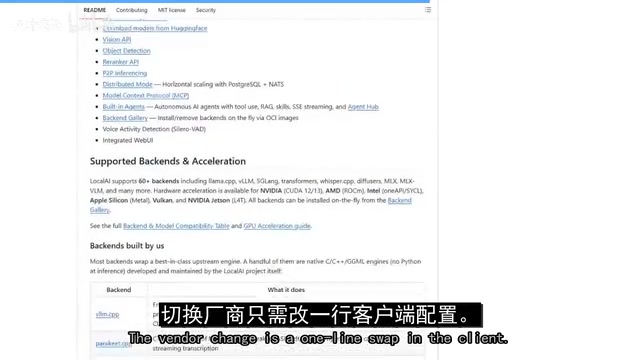
LocalAI (ranked #4) takes this idea to its logical extreme: an open-source AI engine that supports any model, any modality, any hardware — LLMs, vision, speech, image, video, all running on CPU, consumer GPU, or even no GPU at all. It also provides OpenAI-compatible access: one binary, one config file, one endpoint. When cloud quotas run out the night before a demo, spinning up embeddings, vision, speech, and chat all at once with LocalAI is genuinely convenient.
Understanding these tools requires some context on the resource bottlenecks of large model inference. A 70-billion-parameter model like Llama-70B stored in FP16 precision requires roughly 140GB of VRAM — far beyond what consumer GPUs offer. The two main strategies are quantization (compressing weights from 16-bit to 4-bit or lower, reducing VRAM requirements to around 35GB) and layer offloading. Airllm takes the latter to its extreme — treating VRAM as a cache and disk as main memory, reading only the weights for the current layer from disk at each step and immediately freeing them after computation. The tradeoff is speed: each layer inference involves disk I/O, yielding far lower throughput than keeping all weights in VRAM. But its significance is in breaking the hard barrier of "you must have enough VRAM to run a large model," giving entry-level hardware users access to real large models for experimentation. NPUs (Neural Processing Units) — integrated inference accelerators in modern CPUs like AMD's Ryzen AI series — represent another path that Lemonade SDK focuses on, offering lower power consumption and suitability for edge deployment.
Agent Memory and Context Management
A large portion of the list focuses on the "memory" problem for coding agents — which is precisely where agent deployment struggles most today.
LeanCTX (ranked #8) is a local context layer written in Rust. It observes what an agent has read, ranks and trims the context window, and retains only what the agent actually needs. When an agent reaches its 19th tool call with 83% of the window used and the next call threatening to truncate the system prompt, LeanCTX trims before each read — keeping the window from bloating and the bill from snowballing. Single Rust binary, no API key required, nothing uploaded.
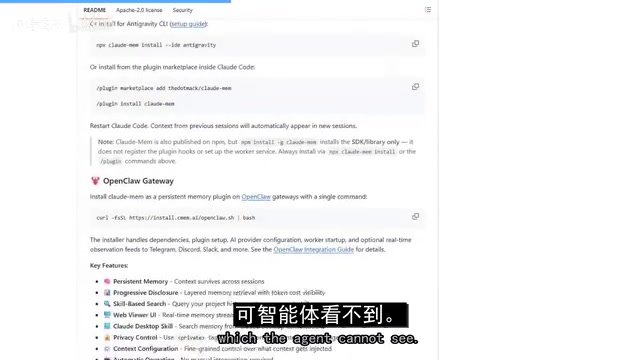
CloudMem (ranked #7) and Beads (ranked #5) both tackle cross-session memory. CloudMem writes structured memory files during a session and loads them automatically when the next session starts, letting an agent "pick up where it left off." Beads, from the Gastown ecosystem, replaces an agent's scattered scratch notes with a structured issue ledger — every state change is written as an issue with an ID, status, and parent-child relationship; the agent queries at the start of each step and closes issues on completion. A CLI plus a small data store keeps state entirely on-device.

The shared philosophy behind these tools is worth noting: rather than giving models larger context windows, give them a queryable, persistent external memory system. Memory is no longer an accumulation of conversation history, but a structured, retrievable asset.
The context window is one of the core constraints of today's large language models. The amount of text a model can "see" in a single inference pass is finite (measured in tokens, e.g., 128K tokens); content beyond that limit is truncated or forgotten. For coding agents spanning dozens of tool calls over hours at a time, this creates two cascading problems: functional failure — system prompts, historical decisions, or key file contents get truncated, causing the agent to repeat mistakes or forget its objectives; and cost spiral — each call requires stuffing an ever-longer history into the request, with billed token counts growing linearly. LeanCTX's "rank and trim" strategy is essentially heuristic information retrieval compression, dropping low-relevance historical content based on what matters to the current step. CloudMem and Beads take the opposite approach: externalizing information from the context window into structured storage and retrieving it on demand — fundamentally bypassing window capacity limits. This closely mirrors how human programmers use ticketing systems like Jira to manage task state rather than relying purely on memory.
Browser Agents and Self-Improving Agents
EgoLite (ranked #6) is a browser designed specifically for AI agents — essentially a Chromium fork. It runs your already-logged-in sessions and hands the right interface to the agent to operate — the agent clicks like a human, and you don't have to watch the whole time. The typical use case is an agent filing a ticket in an internal tool behind SSO, where the SSO cookie is yours and you don't want to hand it over. EgoLite lets the agent drive your locally authenticated browser, operating in visible tabs — you can watch the cursor move and forms fill, and take over with a single keystroke. Sessions, cookies, and audit logs all belong to you.
Prime Agent (ranked #2) from Prime Intellect is a self-improving RLM agent built for coding workflows and long-running autonomous tasks. It evaluates its own execution traces, ranks what worked and what didn't, proposes prompt modifications, then runs those modifications against an evaluation set — keeping changes that improve performance. The improvement loop lives in the repository; you write the evaluation set. Rather than waiting for the next release, it continuously gets better between deployments.
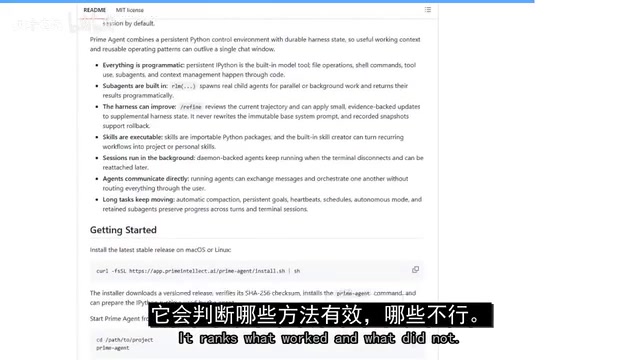
This points to a deeper direction: agents that don't just passively execute, but begin to self-optimize. Performance on day 30 is no longer the same as day 1.
Terminal Coding Agents Built for Long Sessions
The top two spots go to terminal coding tools, both optimized for the real-world pain of long-running sessions.
DeepSeekAd Resonix (ranked #3) is a terminal coding agent built natively for DeepSeek models, engineered specifically around "prefix cache stability." A common failure mode: you let an agent run overnight, come back, and find that cache hit rates collapsed at 3am — the agent re-read every file it had already seen, and the bill looks like a car repair invoice. Resonix keeps long sessions warm-cached, so the agent stays fast and cheap.
OpenAI Codex (ranked #1) tops the list. It's a lightweight coding agent that runs in the terminal — open-source, written in Rust, MIT licensed, with a built-in agent loop and tool framework. It connects to OpenAI, but the agent runs on your machine. When a migration script has been running for six hours, the cloud IDE is rate-limiting, and the diff review tool can't open a 28,000-line change, Codex runs directly on your machine: edits files, runs tests, reads traces, applies fixes — no rate limits, no uploads, no queues. The terminal is both editor and runtime.
The blogger's sharpest observation: the biggest lab intentionally put a coding agent on your machine — and that's the point. This is the clearest possible signal of the "open-source AI off the cloud" trend.
Prefix caching is the key concept for understanding the value of DeepSeek Resonix's optimizations. During large model inference, if the beginning of a request (the prefix) is identical to a previous one, the inference server can reuse previously computed KV cache (Key-Value Cache), skipping redundant computation for that prefix and significantly reducing latency and cost. For coding agents, system prompts and codebase context typically remain constant throughout a session — theoretically a perfect scenario for prefix caching. However, cache hits depend on strict consistency in request content — any formatting change, ordering perturbation, or content insertion in between causes a cache miss, reverting to full computation. Resonix's engineering focus is precisely on maintaining prefix stability throughout long-running agent loops, preventing log appending, tool output concatenation, and similar operations from corrupting cache structure — keeping overnight runs efficient and cost-predictable.
What This List Signals
Looking at all 10 tools together, a complete local AI stack has taken shape: at the bottom, Airllm, Lemonade, and LocalAI handle inference; in the middle, LeanCTX, CloudMem, and Beads manage context and memory; at the top, EgoLite provides browser-based interaction, Prime Agent enables self-optimization, and DeepSeek Resonix and Codex handle long-running terminal coding.
Three factors are driving this trend, and they're all pragmatic: privacy compliance (data never leaves the machine), cost control (no cloud bills, no rate limits), and controllability (sessions, cookies, and audit logs are yours). Local deployment no longer means sacrificing capability — in many scenarios it's becoming the more stable, more affordable, and more private choice.
Of course, local solutions have tradeoffs — Airllm's layer-by-layer streaming is slow enough to feel like "a Tuesday," and hardware requirements and operational complexity still exist. But for privacy-sensitive, long-running, or budget-constrained workloads, these tools offer real alternatives to the cloud. As the blogger puts it at the end: pick a repository you actually need to ship, install it on the machine you already own, and quietly give it a try.
Related articles

Chain of Thought Isn't Just for AI: How Humans Can Use CoT to Improve Thinking Quality
Chain of Thought isn't just a prompt trick for large models. Starting from a Hacker News discussion, this article analyzes why CoT works for human thinking too, breaks down actionable ways to transfer it, and highlights the key differences between human CoT and machine CoT.
Cloudflare Teams Up with OpenAI: Closi…
Cloudflare Teams Up with OpenAI: Closing the Loop from Vulnerability Discovery to Defense with AI
Cloudflare uses OpenAI Daybreak to investigate security vulnerabilities and generate reviewable remediation plans, while developers use Codex to boost coding efficiency and quality.

Orca Multi-Agent Orchestration in Practice: A Guide to Parallel Collaboration with Claude and Codex
Orca is Stable AI's free open-source agent workbench supporting 34 agents like Claude Code and Codex in parallel. Learn its Git worktree isolation, multi-model orchestration, and mobile management.