Open Source AI & Open Models Reading List: A Resource Guide from Beginner to Advanced
A guide to the open source AI reading list: clarifying open weights vs. open source and mapping a structured learning path.
This article examines an open source AI and open models reading list that gained traction on Hacker News, focusing on a key distinction: "open models" only means downloadable weights, while true "open source AI" requires publicly available training data, code, and full reproducible pipelines. Licenses are a critical but often overlooked factor, with different terms imposing vastly different restrictions on commercial use and redistribution. The article outlines four dimensions a mature reading list should cover — foundational theory, representative models, engineering deployment, and community governance — and advises readers to use such lists as ongoing reference indexes tailored to their own goals rather than materials to be read in one pass.
Open source AI is reshaping the entire artificial intelligence ecosystem. From the early days when closed commercial models dominated, to today's proliferation of open-weight models, developers and researchers have an increasingly urgent need for structured learning resources. A "Open Source AI & Open Models Reading List" that recently appeared on Hacker News has drawn community attention, offering a clear learning path for those who want to go deep in this space.
Why We Need an Open Source AI Reading List
Information in the open source AI space is highly fragmented. Papers are published on arXiv, model weights are hosted on Hugging Face, engineering practices are scattered across blogs and GitHub repositories, and the most valuable discussions are often buried in community forums. For beginners, the lack of a structured entry point makes it easy to get lost in the sea of resources.
A carefully curated reading list is essentially doing the work of "reducing information noise." It aggregates the most representative papers, the most practical tool documentation, and the most insightful analysis articles, allowing learners to follow a clear path rather than trial-and-erroring through search engines. This is why such resources continue to be popular in technical communities.
The Difference Between Open Models and Open Source AI
Many people confuse "open source AI" and "open models," but there are important practical differences between the two.
Open Weights ≠ Fully Open Source
"Open models" typically means that model weights can be freely downloaded and used — such as Meta's Llama series, various versions of Mistral, and others. But open weights don't mean fully open source — many such models have not published their complete training data, training code, or detailed training procedures.
Truly "open source AI" requires more: not only must model weights be open, but training data sources, data processing methods, training scripts, and complete reproducible technical details should also be disclosed. This distinction directly affects a model's auditability, reproducibility, and applicability in compliance-sensitive scenarios.
The founders of the open source software movement — the Free Software Foundation (FSF) and the Open Source Initiative (OSI) — have long held strict definitions of "open source": source code must be freely available, modifiable, and redistributable. When these standards are applied to AI, the scope of "source code" expands dramatically. The ingredients needed to train a large language model include at minimum: model architecture code, training datasets, data cleaning and preprocessing scripts, training hyperparameters and configurations, and the final model weights. Claiming to be "open source" by publishing only one of these elements (the weights) is contested both academically and legally. OSI formally published the Open Source AI Definition (OSAID v1.0) in 2024, explicitly requiring that open source AI systems provide sufficient data information for others to reproduce training — a standard that well-known "open models" like Llama 3 and Gemma do not meet under this strict definition.
Licenses Are the Key Variable
One easily overlooked but critically important dimension when reading these lists is the license. Different open models use very different licensing terms — some allow commercial use, some are restricted to research purposes, and some impose limitations based on the scale of the user. Understanding these differences is essential for any team planning to deploy open models in a production environment.
The current open model licensing landscape is extremely complex. Several common types are worth understanding in depth. Llama custom licenses: Meta designed a custom license for Llama 2/3, requiring products with over 700 million monthly active users to obtain separate authorization from Meta, and prohibiting the use of model outputs to train other large language models. Apache 2.0: One of the most permissive licenses, allowing commercial use, modification, and distribution — Mistral 7B, Falcon, and others use this license. CC-BY variants: Common for training datasets, with different sub-combinations (BY, SA, NC, ND) creating very different usage restrictions; the NC (non-commercial) variant cannot be used in production environments. RAIL (Responsible AI License): An emerging AI-specific license that permits open use while attaching behavioral clauses prohibiting certain harmful applications. Compliance teams evaluating open models need to review license text line by line, rather than making decisions based solely on the "open source" label.
What a Learning List Typically Covers
A mature open source AI reading list generally organizes content around several core dimensions.
Foundational Theory and Key Papers: Covering foundational research such as the Transformer architecture, pretraining and fine-tuning methods, and RLHF (Reinforcement Learning from Human Feedback). These form the bedrock for understanding how modern large models work.
Representative Open Models: Introducing the major open-weight model families and their technical characteristics, helping readers build an overall map of the current ecosystem.
Engineering Practices and Deployment: Including hands-on content such as model quantization, inference optimization, and local deployment solutions. For developers who want to actually run models, this section is often the most valuable.
Community and Governance Discussions: Covering topics like ethics, safety, and licensing debates around open source AI. As open models become more capable, the importance of these discussions is rising in parallel.
RLHF (Reinforcement Learning from Human Feedback) is the core alignment technique for modern conversational AI models, systematically described by OpenAI in the InstructGPT paper (2022). The basic process has three steps: first, supervised fine-tuning (SFT) of the base model so it learns to follow instructions; second, training a reward model using preference rankings provided by human annotators, teaching it "what makes a better answer"; and third, using the Proximal Policy Optimization (PPO) algorithm with the reward model as a signal to continuously update the language model's parameters. The main challenges with RLHF are the high cost of human annotation, the risk of the reward model being "fooled" (reward hacking), and the complexity of the pipeline that makes it difficult to reproduce. As a result, the community has developed several simplified alternatives, including DPO (Direct Preference Optimization) and RLAIF (replacing human feedback with AI feedback), all of which are implemented in open source training frameworks such as TRL and OpenRLHF.
How to Use These Resources Effectively
When faced with a large reading list, blindly reading from beginning to end is not the best strategy. A more effective approach is to first clarify your own goals — whether you want to understand the principles, deploy hands-on, or follow industry trends — and then selectively engage with the relevant sections.
For engineering-oriented readers, it's recommended to start with tool documentation and deployment practices, learning by doing. For research-oriented readers, starting with classic papers and gradually building a theoretical framework works better. The value of a reading list lies not in "finishing it," but in it becoming a reference index you can return to at any time.
It's worth noting that the AI field iterates extremely fast, and any static list faces the risk of becoming outdated. Therefore, use these lists alongside the latest community developments, treating the list as a starting point rather than an endpoint.
Conclusion
This open source AI reading list that gained attention on Hacker News reflects a genuine community need for systematic learning resources. The appeal of open source AI lies precisely in its openness — anyone can stand on the shoulders of those who came before and continue exploring. For those who want to enter this field, finding a reliable starting point is often more important than blindly accumulating information.
Related articles
The JPEG XL Debate: Why Technical Supe…
The JPEG XL Debate: Why Technical Superiority Struggles Against Ecosystem Reality
JPEG XL's technical superiority hasn't guaranteed adoption. We examine its battle with AVIF, Chrome's controversial support withdrawal, and why the best image format doesn't always win.
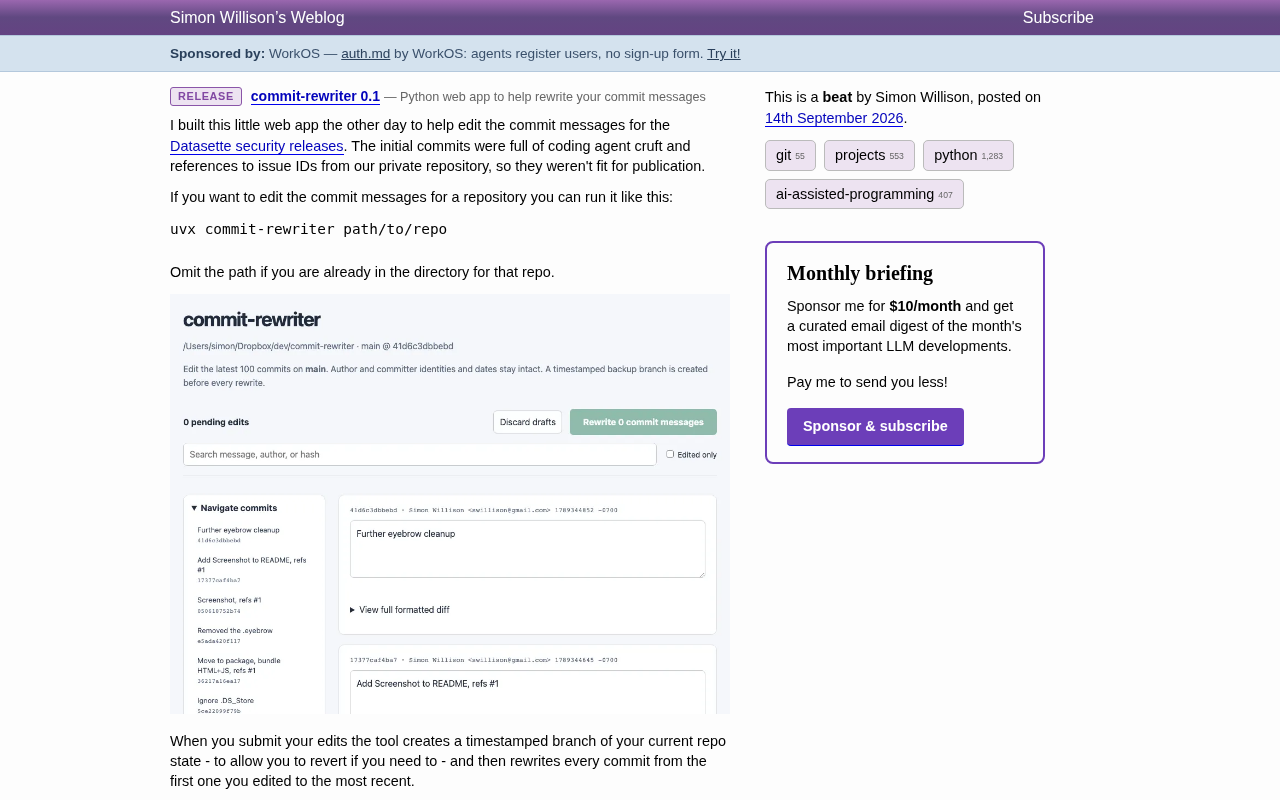
commit-rewriter 0.1: An Open-Source Tool for Batch Rewriting Git Commit Messages
commit-rewriter 0.1 is an open-source Git commit batch-rewriting Web tool by Simon Willison. Run it instantly with uvx to clean AI agent cruft and private refs, with timestamped backup branches for safe rollback.
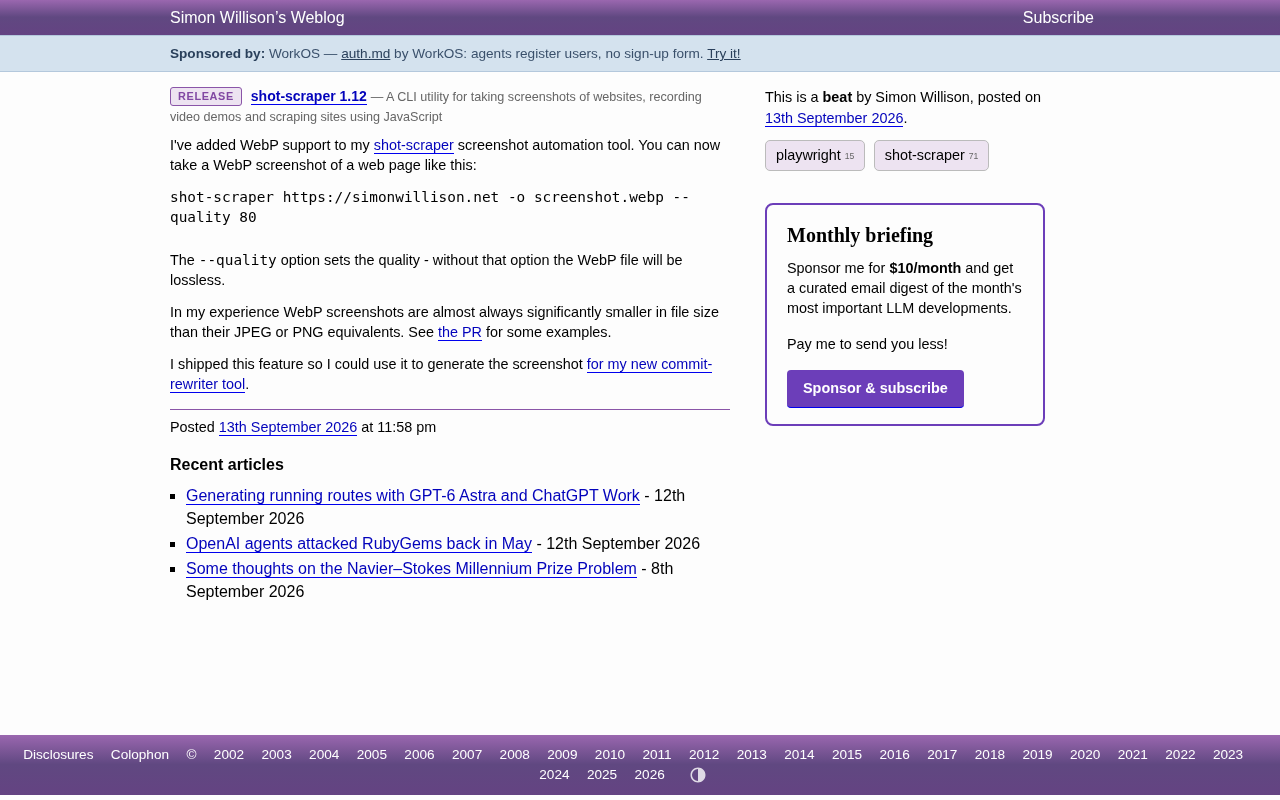
shot-scraper 1.12 Adds WebP Support: Dramatically Smaller Screenshot File Sizes
shot-scraper 1.12 adds WebP screenshot support with --quality control, delivering significantly smaller file sizes than JPEG and PNG for automated screenshot workflows.