Open-Source AI Turns Handwritten Bills into a Profit Engine: PaperToProfit Breakdown

Open-source PaperToProfit uses three-tier vision AI and TabPFN to turn handwritten South Asian street bills into business dashboards.
PaperToProfit is an open-source project by Sapnil M for Hacktoberfest that solves the pain point of handwritten bills at small South Asian eateries. It uses a three-tier vision AI cascade—Gemini Flash Vision, Llama 3.2 Vision on Groq, and local RapidOCR with 2D spatial clustering—to correctly pair dish names with prices. The forecasting layer integrates TabPFN-3.5 to reframe time-series as tabular features, enabling zero-shot 7-day revenue forecasts and Z-score anomaly detection. Built with FastAPI + SQLite + vanilla JS, all data stays local. Open-weight models cut closed-source API costs from $90–$150/month to near zero, making a $9–$15 monthly micro-SaaS subscription viable with over 95% gross margin.
When Handwritten Bills Meet Open-Source AI: An Overlooked Business Pain Point
At street-side tea stalls, small eateries, and family-run canteens across South Asia, owners end each evening facing 80 to 150 crumpled handwritten bills—stuffed in shoe boxes, pierced on iron spikes. These kitchen order tickets, scrawled in ballpoint on carbon-copy order pads, record a day's takings but almost never translate into any valuable business insight. Commercial POS systems cost $60–$180 per month, require dedicated hardware, and demand manual entry during busy hours—barriers that put them out of reach for these small operators. They run on gut feel: they don't know their true gross margin, can't reconcile cash against digital payments, can't tell which menu items are profitable "stars" and which are thankless "dogs," and their kitchen prep either goes to waste or runs short.
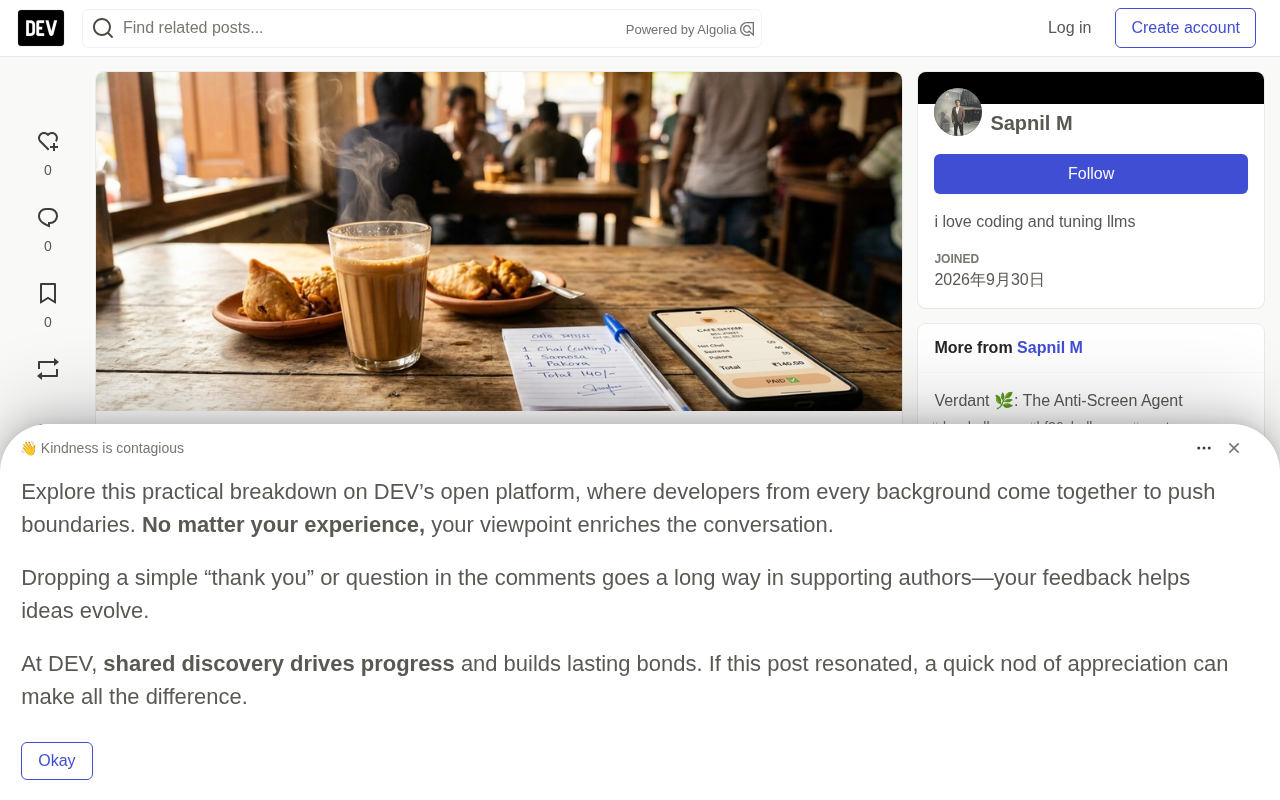
PaperToProfit is an open-source project aimed squarely at this gap. Submitted by developer Sapnil M for the Hacktoberfest open-source AI challenge, its core idea is eminently practical: let the owner snap a photo of the bills with a phone, let AI automatically recognize dishes, quantities, and prices, then generate a real-time financial dashboard and predictive sales recommendations. The project is open-sourced under the MIT license, with code hosted on GitHub.
A Three-Tier Vision AI Cascade: From Scrawled Handwriting to Structured Data
Recognizing faded ink and cursive abbreviations on carbon-copy paper is a nightmare for traditional OCR. PaperToProfit designed a three-tier fallback extraction pipeline that prioritizes accuracy while preserving offline usability.
Tier 1: Cloud Multimodal LLM
The first choice is the Google Gemini Flash Vision API, which in about 1.5 seconds can understand restaurant shorthand like "4 sp chai," "2 veg thali," "half chk biryani," and cope with interference from folded paper edges. The second tier is Llama 3.2 Vision running on Groq, a free open-weight cloud fallback that leverages LPUs for low-latency inference.
Multimodal LLM refers to large neural networks capable of handling multiple input modalities such as text and images simultaneously. In visual document understanding tasks, these models typically split images into patches and encode them as visual tokens, then feed them alongside text tokens into a Transformer decoder to directly output structured dish, quantity, and price information—no traditional character segmentation or template matching required. Gemini Flash Vision and Llama 3.2 Vision both belong to this category; the former is a closed-source cloud service, the latter an open-weight model. Their advantage lies in robustness to noise such as cursive writing, fading, and folded occlusion, at the cost of inference depending on network and compute.
Tier 3: Local Offline Spatial Clustering
When the network is unavailable, the system falls back to the local ONNX model RapidOCR, detecting text boxes on CPU. The developer built a dedicated 2D spatial clustering algorithm: grouping bounding boxes by vertical midpoint threshold, then sorting by horizontal coordinate, so that dish names on the left are correctly paired with quantities and prices on the right, with full support for Indian rupee symbols (₹, Rs., /-, INR) and comma-separated pricing formats. Uploaded phone photos are also automatically transposed by PIL according to EXIF orientation tags, avoiding recognition failures caused by rotation.
This "cloud-first, local-fallback" architecture strikes a balance between recognition accuracy and offline usability, and drives the marginal cost per bill toward zero.
RapidOCR is a lightweight OCR inference framework based on ONNX Runtime that wraps the inference capabilities of models such as PaddleOCR, enabling text detection and recognition on CPU with low latency. Spatial clustering here is not clustering in the machine-learning sense, but geometric rule-based layout analysis: carbon-copy order pads typically have a two-column layout, with dish names on the left and quantities and prices on the right; simply concatenating OCR output in order would cause mismatches. The algorithm first groups detection boxes into the same row by vertical midpoint threshold, then sorts by horizontal coordinate, restoring the "dish name—quantity—price" correspondence. This approach requires no training data and adapts to any layout by adjusting thresholds.
Few-Shot Forecasting with TabPFN: Predicting Without Training
Small restaurants typically have only tens to a hundred days of data; training time-series models like Prophet or ARIMA requires large numbers of data points and is prone to overfitting. PaperToProfit took a different path: integrating Prior Labs' TabPFN-3.5 tabular foundation model.
TabPFN's core advantage is in-context learning—zero-shot prediction on tabular data without a gradient training loop. The project reframes the time-series problem as tabular features: day of week, date index, recent moving averages, order volume, etc., then predicts sales for the next 7 days with upper and lower confidence intervals. At the same time, the system computes historical standard deviation and flags anomalous fluctuations using a |Z| > 1.6 threshold, translating statistical results into actionable prep suggestions—such as reminding the owner to stock more ingredients before the weekend rush.
This "foundation model as a service" approach sidesteps the awkwardness of traditional machine learning in small-sample settings, and gives a solo project forecasting capabilities that normally require a data science team to deliver.
TabPFN (Tabular Prior-data Fitted Network) is a tabular foundation model proposed by Prior Labs; its core idea is to pretrain a Transformer on millions of synthetic tabular tasks so that it learns to "perform Bayesian inference in context." At inference, you simply feed training samples as context and the rows to predict as queries, and the model outputs a predictive distribution in a single forward pass—no gradient updates needed. This allows it to maintain good accuracy even with only a few hundred rows, precisely matching the scenario of small restaurants with only tens to a hundred days of data. It should be noted that TabPFN has a limited context length, and the quality of feature engineering (such as moving averages and day-of-week encoding) still significantly affects final results.
Lightweight Full Stack and Privacy First: FastAPI + SQLite + Vanilla JS
Every engineering choice in the system revolves around "zero-latency local execution, zero vendor lock-in." The backend uses FastAPI to serve both REST APIs and frontend static assets on a single port; data persistence uses embedded SQLite, with all sales records and itemized bills staying on the user's device; the frontend is vanilla JavaScript with Chart.js and Lucide icons, supporting file browsing, phone camera capture (capture="environment"), drag-and-drop upload, and direct Ctrl+V clipboard image pasting.
Another benefit of this minimalist stack is low deployment friction: Windows users can double-click run.bat, or run a single uvicorn command, to open the full app at local 127.0.0.1:8000. For street-side shops unfamiliar with cloud services, this means data never has to leave the store.
Why Open Source Is a Matter of Life and Death for This Business
The project author did some very practical math: an average restaurant generates about 100 bills per day, 3,000 per month. Calling closed-source vision APIs like GPT-4o or Claude 3.5 Sonnet at $0.03–$0.05 per bill would mean an API bill of $90–$150 per month alone. But small restaurants have net profit margins of only 12%–15%, making this unaffordable. By switching to locally run open-weight models or free cloud quotas, the marginal cost per bill drops to nearly zero—which is what makes a micro-SaaS subscription of $9–$15 per month (about 300–500 rupees) viable with gross margins above 95%.
Privacy is another consideration. Small owners are extremely sensitive about daily cash drawers, tax figures, and supplier margins; uploading financial data to centralized closed-source platforms creates inherent trust friction. Local models plus an embedded database keep records from leaving the shop. Moreover, handwritten shorthand varies by region and is full of local slang—"cutting chai," "bun maska," "2 bt naan"—and closed-source models often hallucinate or censor these abbreviations, whereas an open-source pipeline lets developers freely inject prompts and fine-tune domain vocabulary.
Real-World Validation and Productization Directions
The author tested with a real old handwritten bill from his father's shop, not synthetic data. After the photo was input, in under 2 seconds the multimodal vision engine parsed the faded handwriting, item names, quantities, and prices, automatically filling editable receipt cards and completing the summary. His father's feedback was direct: after a busy day, having to use pen, paper, and calculator to total up crumpled bills is tiring and error-prone; snapping a photo with a phone that reads the numbers, archives them, and tells you how much you actually earned is a real relief.
Real users also raised two clear needs: one-click generation of a daily WhatsApp report at closing time, and voice announcements plus regional language switching. These feedback points all point in the same direction—the tool must be less hassle than handwriting, not add new operational burden.
Menu Engineering and Financial Dashboard: Turning Data into Decisions
Beyond recognition and forecasting, PaperToProfit also includes the classic BCG menu matrix from restaurant management. Based on sales volume and profit margin, the system automatically classifies each dish into one of four quadrants: Stars (promote), Dogs (cut price and restructure), Puzzles (upsell), and Eliminate (remove from menu). Combined with real-time gross margin, food cost (COGS), average ticket size, 14-day revenue trajectory, cash vs. UPI payment split, and an hourly prep-peak heatmap, owners can see for the first time "which dish is actually making money."
All verified bills go into a local SQLite ledger, with one-click CSV export for tax filing and bookkeeping. The project also provides a Dockerfile for technically capable users to deploy in containers.
BCG menu matrix derives from the Boston Consulting Group's growth-share matrix, adapted by the restaurant industry into a two-dimensional classification tool with "sales volume" on the horizontal axis and "profit margin" on the vertical axis. Star dishes have high sales and high profit—maintain quality and promote them; dog dishes have low sales and low profit—consider removing or restructuring; puzzle dishes have high profit but low sales—suitable for upselling via set menus or recommendations; plowhorse dishes have high sales but low profit—need cost optimization or price increases. The value of this matrix lies in turning scattered sales data into prioritized menu adjustments, but note that it relies on accurate cost accounting; otherwise the profit-margin axis will be distorted.
Conclusion: The Market Silicon Valley Ignores Is Exactly Open-Source AI's Opportunity
PaperToProfit's value is not in technical showmanship, but in combining multimodal recognition, tabular foundation model forecasting, and lightweight full-stack engineering into a product that can be profitable at under $200 per year, serving the street-side economy that commercial software has long ignored. It proves that open-weight models can support, on a cost-structure basis, businesses previously deemed "too low-ticket to do." The project is still at the challenge submission stage; forecasting accuracy, multilingual handwriting recognition, and large-scale deployment all await validation with more real data. But the direction it points to is clear enough: when AI's marginal cost approaches zero, even the most inconspicuous piece of paper can become business intelligence.
One-line Summary
Open-source project PaperToProfit uses a three-tier vision AI and TabPFN forecasting to turn handwritten street-side bills in South Asia into business dashboards.
Paragraph Summary
PaperToProfit is an open-source project submitted by developer Sapnil M for Hacktoberfest, aimed at solving the pain point that handwritten bills at small street-side restaurants in South Asia cannot be turned into business insights. The system uses a three-tier vision AI cascade: Gemini Flash Vision first, Llama 3.2 Vision on Groq as fallback, and local RapidOCR with a 2D spatial clustering algorithm offline to correctly pair dish names with prices. The forecasting layer integrates the TabPFN-3.5 tabular foundation model, reframing the time-series problem as tabular features to enable zero-shot 7-day revenue forecasts and Z-score anomaly detection. Engineering-wise it uses FastAPI + SQLite + vanilla JS, keeping all data local. The $90–$150 monthly cost of closed-source APIs is reduced to near zero by open-weight models, making a $9–$15 monthly micro-SaaS subscription viable with gross margins above 95%.
Related articles

Python 3.15 New Feature: Is the sentinel Type Better Than None?
Python 3.15 adds the sentinel type, using named unique sentinel objects to replace None and bare object(), resolving confusion among missing values, explicit emptiness, and invalid input while avoiding type hint failures.

Deep Learning's Three Architectures and the Universal Approximation Theorem: A Complete Guide to MLPs, CNNs, and Transformers
Explaining the inductive bias differences among MLP, CNN, and Transformer, the existence meaning of the Universal Approximation Theorem (UAT), and the role of Taylor expansion in approximation analysis, while clearing up common misconceptions.

GitLab Emergency Patch Release: Analysis of Critical Security Fixes
GitLab releases critical patch 19.5.1, sparking 355 points of discussion on Hacker News. This article analyzes the background, upgrade steps for self-hosted instances, and verification points to help DevOps teams respond quickly to security updates.