Open Source Initiative Shifts Toward Political Activism: OSI Mission Change Sparks Controversy

The OSI adds policy advocacy to its core mission, seen as a shift from a technical standards body to political activism.
Based on an analysis by the YouTube channel Lunduke Journal, the article discusses the changing positioning of the Open Source Initiative (OSI). Long responsible for reviewing whether licenses meet the Open Source Definition, the OSI has now incorporated policy advocacy into its core mission and signed the UN Open Source Principles declaration. The video criticizes Principle 8 for requiring signatories to align with UN system needs, and the RISE framework for differential treatment based on race, gender, and other identity characteristics. The article also groups the OSI with the politicization tendencies of organizations such as Mozilla, Codeberg, GNOME, and KDE, arguing that this is changing the nature of the open source community and may affect practical matters such as license review. It notes that the interpretation comes from a single video source, the OSI has not responded in detail, and there is disagreement within the community.
From License Guardian to Political Actor
The Open Source Initiative (OSI) has long been regarded as the guardian of the Open Source Definition, responsible for reviewing whether licenses meet open source standards. However, according to an analysis by the YouTube channel Lunduke Journal, the OSI is shifting its mission from technical governance toward political activism. The channel points out that the OSI has signed the United Nations Open Source Principles declaration and explicitly incorporated policy advocacy into its core mission, marking a fundamental shift in its positioning.
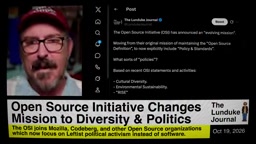
The host of Lunduke Journal (a former Linux Journal editor) expressed concern about this change in the video. He argues that the OSI's original role was to maintain the Open Source Definition—and although that definition itself has ambiguities, it at least focused on the core needs of the technical community. Today, the OSI's mission statement includes policy advocacy, particularly cooperation with the United Nations, making it look more like a political organization than a technical standards body.
The Open Source Definition (OSD) was derived by the OSI in 1998 from the Debian Free Software Guidelines and contains ten clauses used to determine whether a license can be called "open source." It only constrains the terms of the license itself (such as allowing free redistribution, providing source code, and permitting derivative works) and does not impose requirements on users' identity, purpose, or political stance. The OSI's license review process uses this as its criterion, and those that pass receive the "OSI Certified" mark. Precisely because the OSD is regarded as a relatively objective technical criterion, the OSI has long played the role of a standards arbiter rather than an advocacy group—which is also the reference point for the criticism of "departing from technical neutrality" in this controversy.
Controversy Over the UN Principles and the RISE Framework
The video focuses on the UN Open Source Principles declaration signed by the OSI. The declaration contains eight principles, some of which critics consider politically biased. For example, Principle 4 calls for "promoting inclusive participation, supporting and facilitating diverse and inclusive contributions," while Principle 8 calls for "supporting the development of solutions that meet the needs of the UN system and its evolution." Lunduke Journal argues that Principle 8 essentially requires signatory organizations to comply with UN directives, which exceeds the reasonable scope of a technical organization.
Even more controversial is the RISE framework (Recognize, Incentivize, Support, Empower). According to the video's interpretation, RISE requires organizations to "recognize the contributions of underrepresented or marginalized groups" and "incentivize diverse employees," which is criticized as differential treatment based on characteristics such as race and gender. The host claims this amounts to discriminating against "non-diverse" groups (i.e., straight white men) and accuses the OSI of openly supporting such policies.
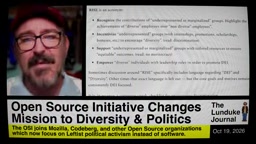
A note here: the above interpretation comes from a single video source, and the OSI has not yet responded in detail. There is disagreement within the open source community: supporters believe these principles help promote fairness and inclusion, while opponents worry they depart from technical neutrality.
The RISE framework is not an open source license clause but a set of organizational-level diversity, equity, and inclusion (DEI) operational guidelines, whose four letters correspond to recognizing contributions, providing incentives, offering support, and empowering. Such frameworks are common in the HR and community governance practices of tech companies and foundations, typically including measuring representation data, establishing mentorship programs, and providing resources for marginalized groups. The focus of the controversy is whether "differentiated measures based on group identity" constitute reverse discrimination, and whether a technical organization whose core function is license review needs to adopt such organizational governance norms. It should be noted that the video's paraphrase of RISE's specific provisions is selective; readers who want to assess its reasonableness should consult the original texts published by the OSI or the relevant advocacy parties.
The Politicization Trend of Open Source Organizations
Lunduke Journal places the OSI's changes in a broader context. The video mentions that Mozilla declared itself a "global activist group" two years ago and openly opposes capitalism, patriarchy, and more. Codeberg has also explicitly stated, "We are not a neutral space; Codeberg is political." In addition, organizations such as GNOME, KDE, the Software Freedom Conservancy, Fedora, and NixOS are also said to show similar tendencies.
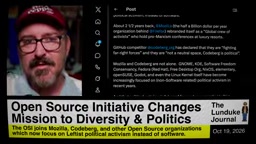
The host argues that these organizations are shifting from technical communities toward political activism, with the OSI and Mozilla being particularly prominent. He questions whether the OSI should still keep the name "Open Source Initiative," since its core mission is no longer technical standards maintenance. However, this view represents only the personal stance of the video's author, and some voices in the open source community believe that technical organizations paying attention to social issues is a natural result of the times.
Potential Impact on the Open Source Ecosystem
The video concludes by discussing the impact of this shift on the open source ecosystem. The host points out that as organizations such as the OSI and Mozilla take clear political stances, many developers and users are beginning to ignore them. Mozilla's Firefox browser market share has fallen below 2% and is gradually becoming marginalized in the Linux community. He believes this actually allows developers to focus more on writing code without being influenced by these organizations.
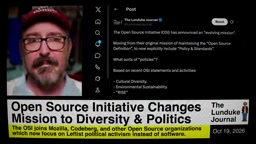
However, whether this "ignore" strategy is sustainable remains to be seen. As the official steward of the Open Source Definition, the OSI's policy stance may affect practical matters such as license review. The open source community needs to find a balance between inclusiveness and technical neutrality, and the OSI's mission change will undoubtedly spark broader discussion.
Conclusion
The OSI's mission adjustment reflects the growing politicization of the open source world. Whether one supports or opposes it, this change deserves the technical community's attention. For developers, understanding the evolution of these organizations' stances helps them make more informed choices when participating in open source projects.
Related articles

Workbuddy for Absolute Beginners: How a Desktop AI Agent Fits Into Real Workflows
A beginner's guide to the Workbuddy desktop AI agent: installation, claiming credits, file management, and building automated workflows—compared with CodeX for fit and cost, helping professionals shift from AI question-askers to AI managers.

OpenAI's New Agent Stack: Computer Use, Decisions API, and Ultra-Fast Workflows
OpenAI Dev Day unveiled a new agent stack: Computer Use outperforms humans, Decisions API delivers ultra-low-latency classification via Luna, Agents API opens the same Computer Use capabilities, and GPT-6.1 Sol costs only one-seventh of Astra. Core updates, benchmark data, and developer insights.

Liang Wenfeng Open-Sources DeepInfo Inference Framework, Takes On U.S. Ban
DeepSeek open-sources its DeepInfo inference framework after its models, featuring GPU/CPU cross-pipelining, small-model prediction with large-model verification, and full Huawei Ascend and NVIDIA chip support—facing the U.S. federal ban head-on. This article analyzes its significance for AI deployment and open-source strategy.