Open-Source Multi-Agent Runtime OpenBot: Integrating LangMem and LangSmith
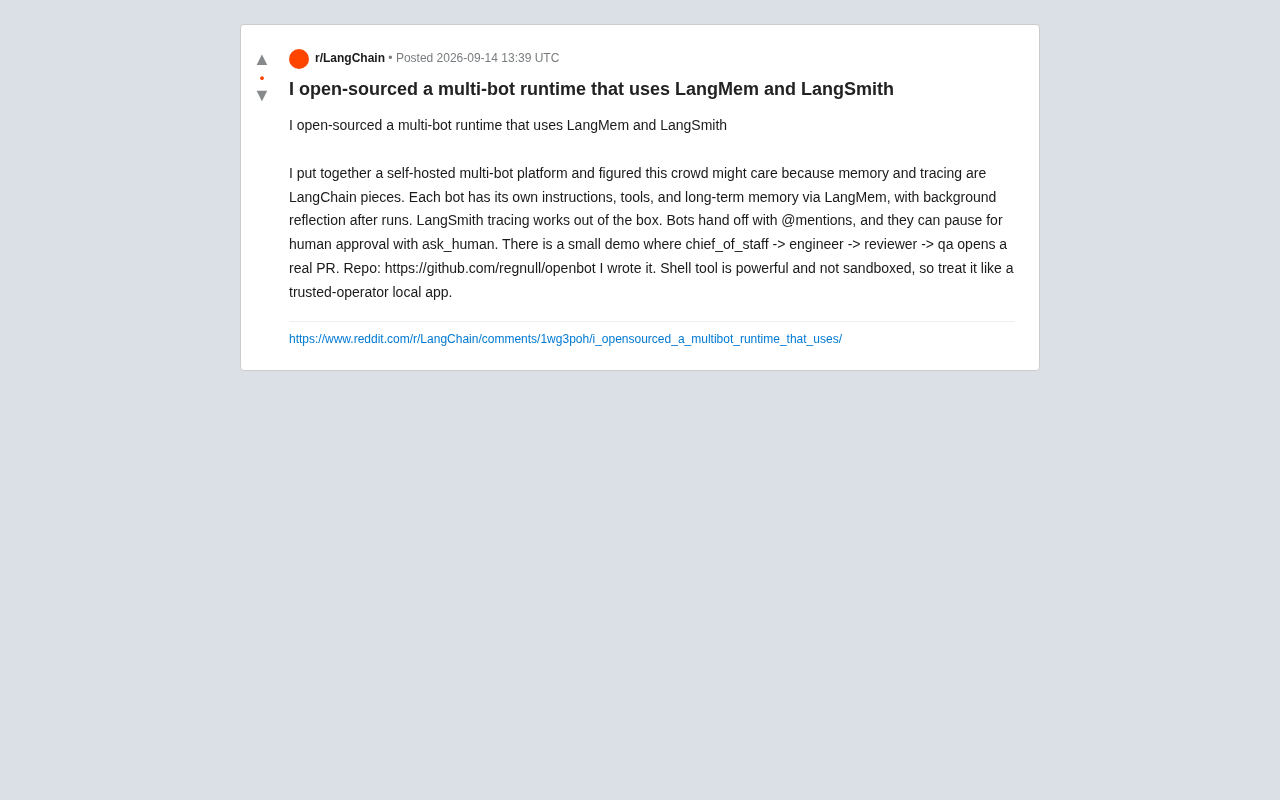
OpenBot is an open-source self-hosted multi-agent platform integrating LangMem memory and LangSmith tracing with human-in-the-loop control.
OpenBot is a self-hosted multi-bot runtime open-sourced by developer regnull. Each bot gets its own instructions, tools, and LangMem-powered long-term memory, with a background reflection mechanism that lets agents accumulate experience across sessions. Bots hand off tasks via @mentions and pause for human approval at critical steps via ask_human. A demo pipeline of chief_of_staff→engineer→reviewer→qa can open a real Pull Request. LangSmith tracing works out of the box, solving observability challenges in complex multi-agent workflows. Note: the built-in Shell tool is not sandboxed and should only be used in trusted local environments.
Developer regnull recently shared his open-source multi-bot runtime project OpenBot on Reddit. It's a self-hostable multi-agent platform whose standout feature is deep integration with LangMem long-term memory and LangSmith tracing — both part of the LangChain ecosystem.
What Is OpenBot
OpenBot is designed so that each bot has its own distinct identity — its own instructions, tools, and LangMem-powered long-term memory. This means different bots can take on different roles and responsibilities, rather than sharing a single shared context.
The author highlights a "background reflection" mechanism: after each task run, the bot asynchronously reviews its own execution and consolidates valuable insights into long-term memory. This design allows agents to accumulate experience across sessions, rather than starting fresh every time.
Multi-Agent Collaboration
One of the most interesting aspects of OpenBot is how bots collaborate. Multiple bots hand off tasks to one another via @mentions, a pattern borrowed from how human teams communicate in collaboration tools — intuitive and easy to track.
Going further, the system includes a built-in ask_human mechanism that lets a bot pause execution at a critical step and wait for human approval before proceeding. This human-in-the-loop design is especially important for high-risk operations in production environments, guarding against the risks of fully autonomous agent decision-making.
The author provides a concrete demo scenario: a pipeline of chief_of_staff → engineer → reviewer → qa that can actually open a real Pull Request. This chain simulates a complete software team workflow from task assignment to code delivery, demonstrating the real-world potential of multi-agent collaboration in development pipelines.
The Value of LangMem and LangSmith
Much of the attention OpenBot has received in the LangChain community comes from how it leverages two key components. LangMem provides each bot with persistent long-term memory, and combined with background reflection, it gives agents the ability to "learn" and "accumulate" knowledge over time.
LangSmith tracing works out of the box. Debugging and observability have always been pain points for multi-agent systems — when multiple bots hand off tasks and make nested calls, tracing the execution chain becomes extremely difficult. The native LangSmith integration lets developers visualize the entire collaboration flow and quickly pinpoint issues.
LangMem is a long-term memory management framework from the LangChain team, designed specifically for AI agents. Its core mechanism stores information generated during conversations or tasks in a structured way to a persistence layer (such as a vector database or relational database), then retrieves it on demand via semantic search in future sessions. Unlike simple conversation history concatenation, LangMem supports CRUD operations on memories and automatic summarization, enabling efficient use of historical information within a limited context window. The "background reflection" mechanism in OpenBot is a classic LangMem use case: the reflection process triggered asynchronously after a task acts as a low-cost memory consolidation pass, distilling key decisions, lessons learned, or domain knowledge from the current run into structured memory entries for the same bot to prioritize in future tasks.
LangSmith is LangChain's companion observability and evaluation platform. It automatically records the inputs, outputs, latency, token usage, and tool call chains for every LLM call, presenting the complete execution trace visually. In multi-agent scenarios, a single user request can trigger dozens of LLM calls and cross-bot handoffs. LangSmith's tracing feature lets developers reconstruct the full call tree without manual instrumentation, dramatically reducing debugging overhead.
Don't Overlook the Security Warning
The author included an honest and important caveat: the built-in Shell tool is powerful, but not sandboxed. He therefore recommends treating it as a "trusted-operator local app."
This is worth noting for any developer who wants to try it out. An unsandboxed Shell execution capability means a bot could theoretically run arbitrary commands on the host machine. If deployed in an uncontrolled environment or connected to untrusted input sources, this could pose serious security risks. As agent systems become increasingly autonomous, permission boundaries and execution isolation are unavoidable topics.
Sandboxing refers to restricting a process's access to system resources — such as the filesystem, network, or privileged operations — through OS-level isolation mechanisms like containers, virtual machines, seccomp filters, or chroot environments. In AI agent scenarios, sandboxing Shell tools is particularly critical: large language models are inherently vulnerable to prompt injection attacks, where an adversary could craft malicious input to trick a bot into executing dangerous commands. Common mitigations include running bots inside Docker containers with strictly limited volume mounts and network access, using lightweight sandbox runtimes like gVisor, or replacing Shell tools with safer, feature-restricted alternatives. For OpenBot's current use as a local development tool, the risk is manageable — but if you plan to open it to multiple users or connect it to external data sources, sandboxing should be a mandatory prerequisite before going live.
Takeaways for Multi-Agent Development
While OpenBot is an individual open-source project, it reflects several emerging trends in AI Agent development: role-based division of labor, cross-session memory, human-in-the-loop approval mechanisms, and reliance on observability tooling. These are precisely the key ingredients for building reliable multi-agent systems.
For developers looking to build self-hosted agent platforms, OpenBot offers a practical reference implementation — especially for those who want to deeply understand how LangMem memory management and LangSmith tracing work together. Of course, before putting it into real use, make sure to address the Shell tool sandboxing issue first.
Related articles
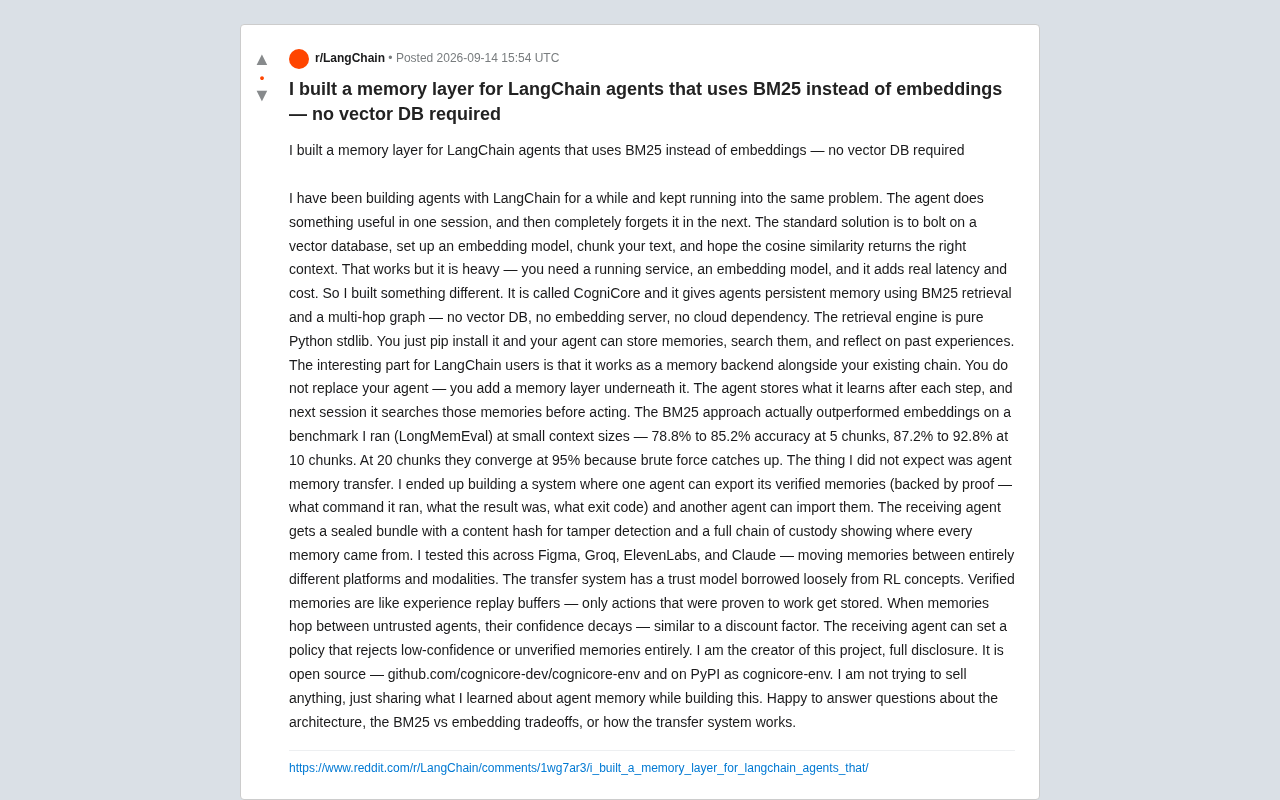
Ditch the Vector Database: Building a Memory Layer for LangChain Agents with BM25
CogniCore replaces vector databases with BM25 retrieval for LangChain agent memory, outperforming embeddings in small-context benchmarks with zero external dependencies.
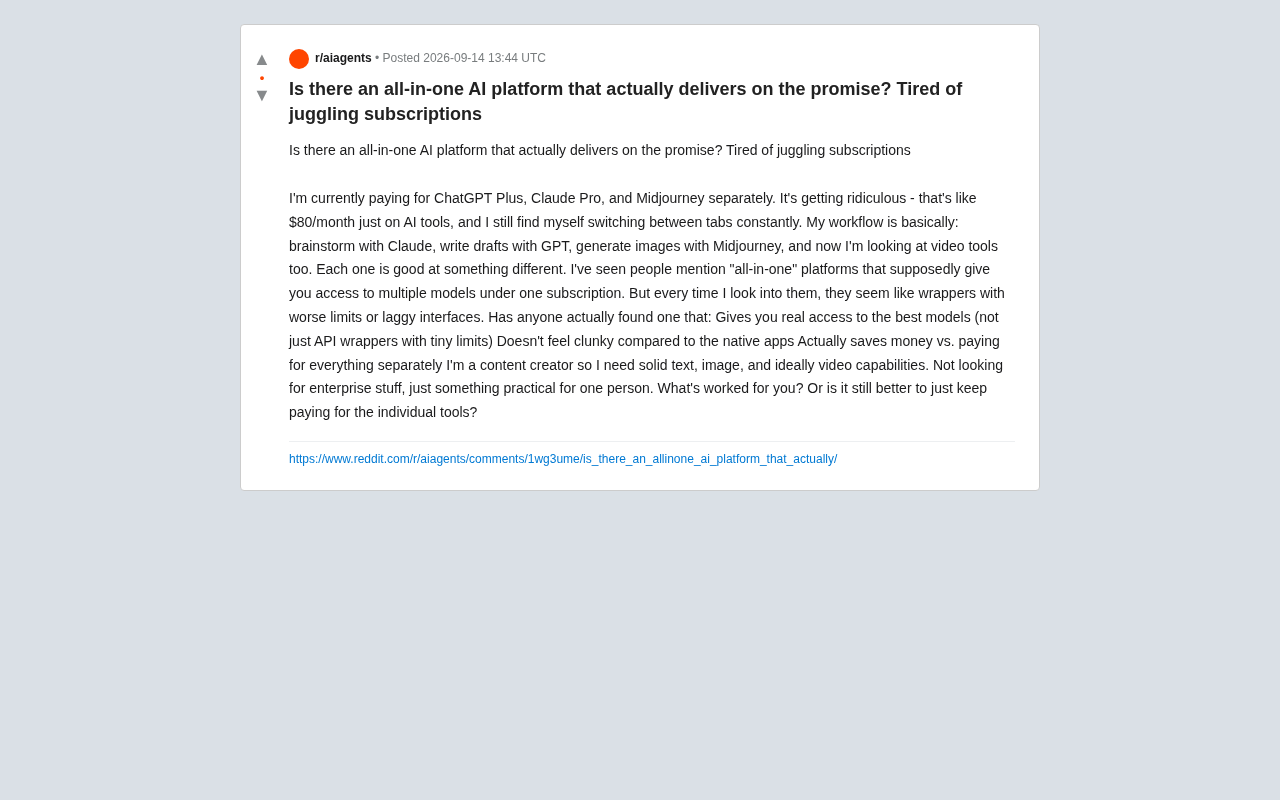
Are All-in-One AI Platforms Actually Worth It? A Practical Guide to Escaping Subscription Overload
Tired of paying for ChatGPT, Claude, and Midjourney separately? We break down whether all-in-one AI platforms are actually worth it — and what a smarter subscription stack looks like.

Volkswagen Mission Efficiency: The World's Lowest-Drag EV Breaks Multiple Efficiency Records
Volkswagen's Mission Efficiency prototype claims the world's lowest drag coefficient, built on MEB+ platform with ID. Polo and ID. Cross components. Here's what it means for EV efficiency.