Open-Source RTS Game Battle Drones Gets Steampunk Makeover from French Developer

Battle Drones, open-sourced under Apache 2.0, was rewritten into a French steampunk fork called Panache in less than a day.
Less than a day after developer Simon Willison released the mobile RTS game Battle Drones under the Apache 2.0 license, a French-language fork called Panache appeared. The fork moves the setting to roughly 1900 France during the "Belle Époque," redesigns sci-fi units like the blue mecha Goliath into golden steampunk designs, adds airships, biplanes, new building color schemes, an animated intro, and French-style music, while largely retaining core gameplay. The article argues that the permissive license was the prerequisite for rapid derivative creation, and completing a full art and animation replacement within a day likely involved generative AI tools (speculative). The fork and original form a complementary rather than replacement relationship, and the original author is welcoming.
How Fast Can Open-Source Games Be Remixed?
According to developer Simon Willison's personal blog, he released a mobile real-time strategy (RTS) game called Battle Drones under the Apache 2.0 license one day, and the very next day a French-language fork appeared. This fork, named Panache, relocated the game's setting to roughly 1900 France during the "Belle Époque" and added an animated intro.
This isn't a simple reskin — it's a re-creation with a clear artistic direction. For those interested in open-source games, indie development, and AI-assisted creation, this case offers a window into observing: once code and assets are open, at what speed and in what direction will the community rewrite a work?
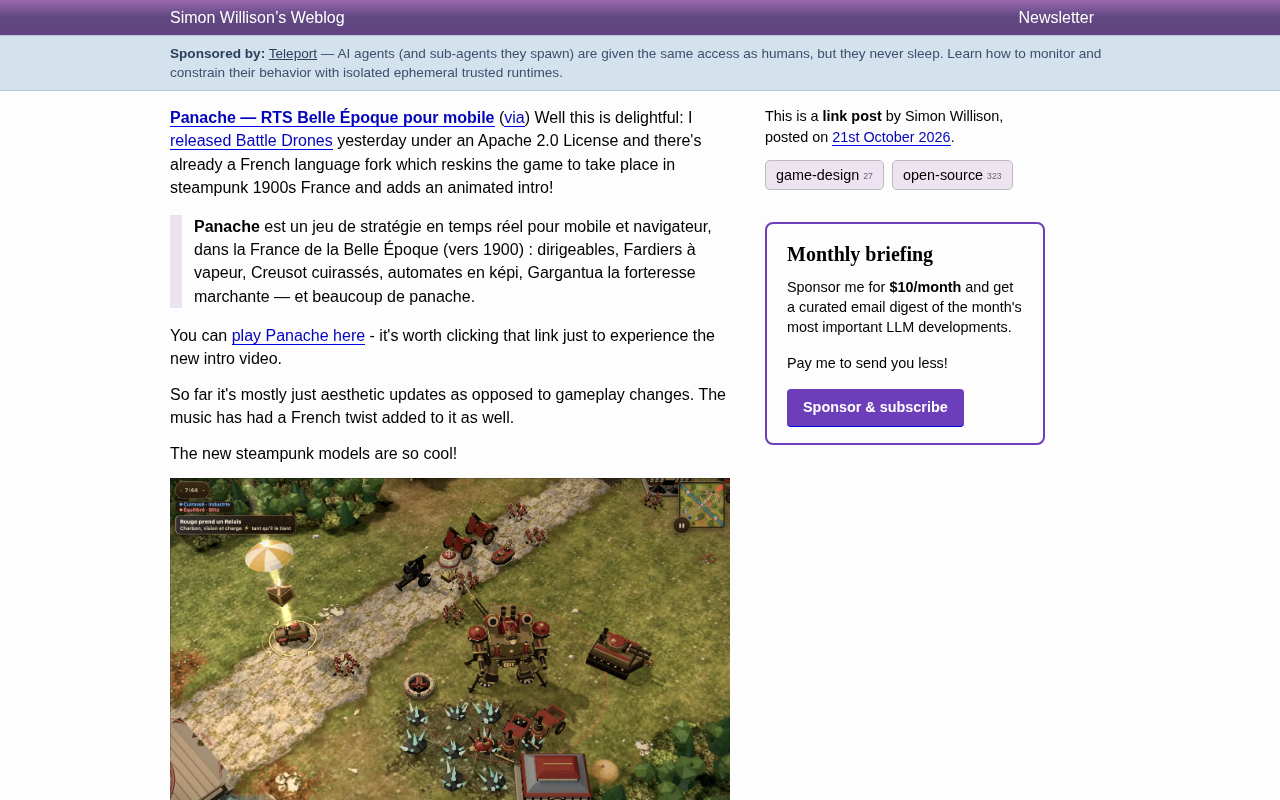
What Panache Changed: From Sci-Fi Mecha to French Steampunk
Complete Overhaul of Worldview and Visuals
According to the Panache project homepage, this is a real-time strategy game for mobile and browser set in Belle Époque France, where players can command airships, steam transports, armored Creusot units, military-capped automatons, and a mobile fortress named Gargantua. The author himself emphasizes in the introduction that the game has "a lot of panache" — a French word meaning flair and spirit, which also echoes the work's title.
The visual changes are quite thorough. Comparison images in Simon Willison's article show that in the original Battle Drones, the Goliath is a blue mecha with shoulder-mounted missile launchers, following the classic sci-fi robot style; in the Panache version, the same unit has been transformed into a golden steampunk design with obvious early 20th-century French aesthetics. New buildings use gold and red color schemes, and airships and biplanes appear in the scenes.
Animated Intro and Music
Simon Willison specifically mentions that the new intro video alone is worth clicking the playable link for. Besides the animation, the game music also features French-style adaptations. These are atmospheric enhancements rather than gameplay adjustments.
According to the original article, the current changes are "primarily art updates, not gameplay changes." This is important: it shows that the fork's author prioritized establishing the work's identity rather than reworking game mechanics.
Model Pages Allow Direct Comparison
Both projects provide model showcase pages, allowing item-by-item comparison between the original Battle Drones and the Panache version. This practice of making asset pages publicly available further lowers the barrier to derivative creation and allows onlookers to intuitively see the extent of changes.
What This Case Demonstrates
The Practical Effect of Apache 2.0
Simon Willison adopted the Apache 2.0 license when releasing Battle Drones. This license allows commercial use, modification, and redistribution, requiring only that copyright and license notices be preserved. From the results, it spawned a complete fork in less than a day — including new art assets, animation, and music adaptations.
The choice of license here is not a formality. If more restrictive terms had been used, Panache would likely not have appeared in this form. For indie developers wanting to leverage community power to extend their work's reach, this is a signal worth noting.
Apache 2.0 is a permissive open-source license released by the Apache Software Foundation, belonging to the same permissive license family as MIT and BSD. It allows users to freely use, modify, and redistribute software, including for commercial purposes, with the only core obligation being to retain original copyright notices, license text, and annotate changes in modified files. Compared to copyleft licenses like GPL, Apache 2.0 does not require derivative works to be open-sourced under the same license, so fork authors can freely choose their own release method. Additionally, it includes an explicit patent grant clause, giving users a free license to contributors' patents, which is more favored than MIT in commercial adoption scenarios. Because of its few restrictions and clear legal boundaries, Apache 2.0 is often used for projects intended for widespread reuse and derivative development.
AI-Assisted Development Drastically Lowers the Cost of "Reskinning"
You may not have noticed, but neither the original article nor the fork page details what tools the Panache author used. However, judging from the time span (about one day) and the output content (entirely new unit models, buildings, animation, music adaptations), traditional fully manual art workflows would struggle to support such speed. Combined with the current widespread practice of using AI-generated assets in indie development, it's reasonable to infer that generative tools played an important role. However, this is speculation — the original material does not confirm it.
Typical uses of generative AI in game asset production include: using text-to-image models (like Stable Diffusion, Midjourney) to batch-produce concept art and textures for units, buildings, and scenes; using image-to-image or ControlNet to replace art styles while maintaining original composition and proportions, which is especially efficient for "giving the same unit a new skin"; using image upscaling and repainting tools to unify resolution and art style; using text-to-music tools to create stylized soundtracks; and using video generation or frame interpolation tools to create animated intros. The common feature of these tools is extremely low marginal cost — the price of the first image and the hundredth image is nearly the same, making them particularly suitable for small fork projects to roll out complete art replacements in a short time. However, generated assets usually still require manual selection, retouching, and style unification, and commercial licensing terms vary by tool, so each needs to be confirmed before use.
The Relationship Between Fork and Original Is Complementary, Not Replacement
Panache retains the original's core gameplay, only replacing the presentation. This means the two versions can coexist: players who prefer sci-fi mecha style stay with Battle Drones, while those who prefer steampunk and European flair turn to Panache. For the original author, the fork is not a threat but a free demonstration of worldview expansion.
Simon Willison's exclamation at the end of his article — "The new steampunk models are so cool" — also shows the original author welcomes this re-creation.
In open-source development contexts, fork refers to copying an independent version from a codebase and evolving it separately. It may be a community exploration to experiment with new directions, or it may evolve into a long-term parallel project. Unlike "patches," a fork has its own maintainers and release cadence, and can freely decide whether and how to merge upstream updates. A common collaboration pattern is: the fork author contributes changes like art replacements back upstream as PRs, or the upstream syncs gameplay fixes to the fork. To avoid fragmentation, mature projects typically separate replaceable assets (art, localization, music) from core logic, so forks only need to override the asset layer — this is precisely the structural prerequisite that allows Battle Drones and Panache to coexist at low cost.
How to Experience It
Panache can be played directly in the browser, and the project also targets mobile. The original Battle Drones is likewise released as open source. Model pages for both projects can be browsed online, suitable for developers who want to study asset structure or plan their own fork.
For Chinese developers, the practical takeaway from this case may be: choose a permissive open-source license, organize assets into a replaceable structure, and maintain clear project documentation — these three things together allow a work to continue growing after release.
One-line Summary
Battle Drones, open-sourced under Apache 2.0, was rewritten into a French steampunk fork called Panache in less than a day.
Paragraph Summary
Less than a day after developer Simon Willison released the mobile RTS game Battle Drones under the Apache 2.0 license, a French-language fork called Panache appeared. The fork moves the setting to roughly 1900 France during the "Belle Époque," redesigns sci-fi units like the blue mecha Goliath into golden steampunk designs, adds airships, biplanes, new building color schemes, an animated intro, and French-style music, while largely retaining core gameplay. The article argues that the permissive license was the prerequisite for rapid derivative creation, and completing a full art and animation replacement within a day likely involved generative AI tools (speculative). The fork and original form a complementary rather than replacement relationship, and the original author is welcoming.
Related articles

Chain of Thought Isn't Just for AI: How Humans Can Use CoT to Improve Thinking Quality
Chain of Thought isn't just a prompt trick for large models. Starting from a Hacker News discussion, this article analyzes why CoT works for human thinking too, breaks down actionable ways to transfer it, and highlights the key differences between human CoT and machine CoT.
Cloudflare Teams Up with OpenAI: Closi…
Cloudflare Teams Up with OpenAI: Closing the Loop from Vulnerability Discovery to Defense with AI
Cloudflare uses OpenAI Daybreak to investigate security vulnerabilities and generate reviewable remediation plans, while developers use Codex to boost coding efficiency and quality.

Orca Multi-Agent Orchestration in Practice: A Guide to Parallel Collaboration with Claude and Codex
Orca is Stable AI's free open-source agent workbench supporting 34 agents like Claude Code and Codex in parallel. Learn its Git worktree isolation, multi-model orchestration, and mobile management.