Open-Source Tool aobs: Preventing AI Agents from Repeatedly Performing High-Risk Operations

Open-source tool aobs verifies high-risk agent tool calls against real business records, blocking duplicate side effects and adding CI policy gates.
A developer on Reddit has released the open-source tool aobs (Apache-2.0, Python) to address the problem of AI agents automatically retrying high-risk tools (refunds, emails, record deletions, deployments, etc.) and causing duplicate side effects. The core approach is to intercept high-risk tool calls, verify against real business records rather than model parameters, require human approval when a threshold is exceeded, and ensure no duplicate side effects across retries and process restarts. The project supports OpenAI-compatible clients, Anthropic, and LangChain/LangGraph; traces can be exported to OpenTelemetry; and it provides TOML policy-driven CI gates (a GitHub Action that outputs PASS/FAIL with evidence). The author notes that the project is in the Alpha stage, and that the implementation cost lies mainly in integrating with existing order and accounting systems.
Title
Open-Source Tool aobs: Preventing AI Agents from Repeatedly Performing High-Risk Operations
Meta Description
Introducing the open-source tool aobs: a guardrail layer for high-risk operations by AI agents. It blocks duplicate refunds, emails, record deletions, and more through real-record verification, and supports threshold-based approval, OpenTelemetry tracing, and CI policy gates (TOML + GitHub Action).
Article Content
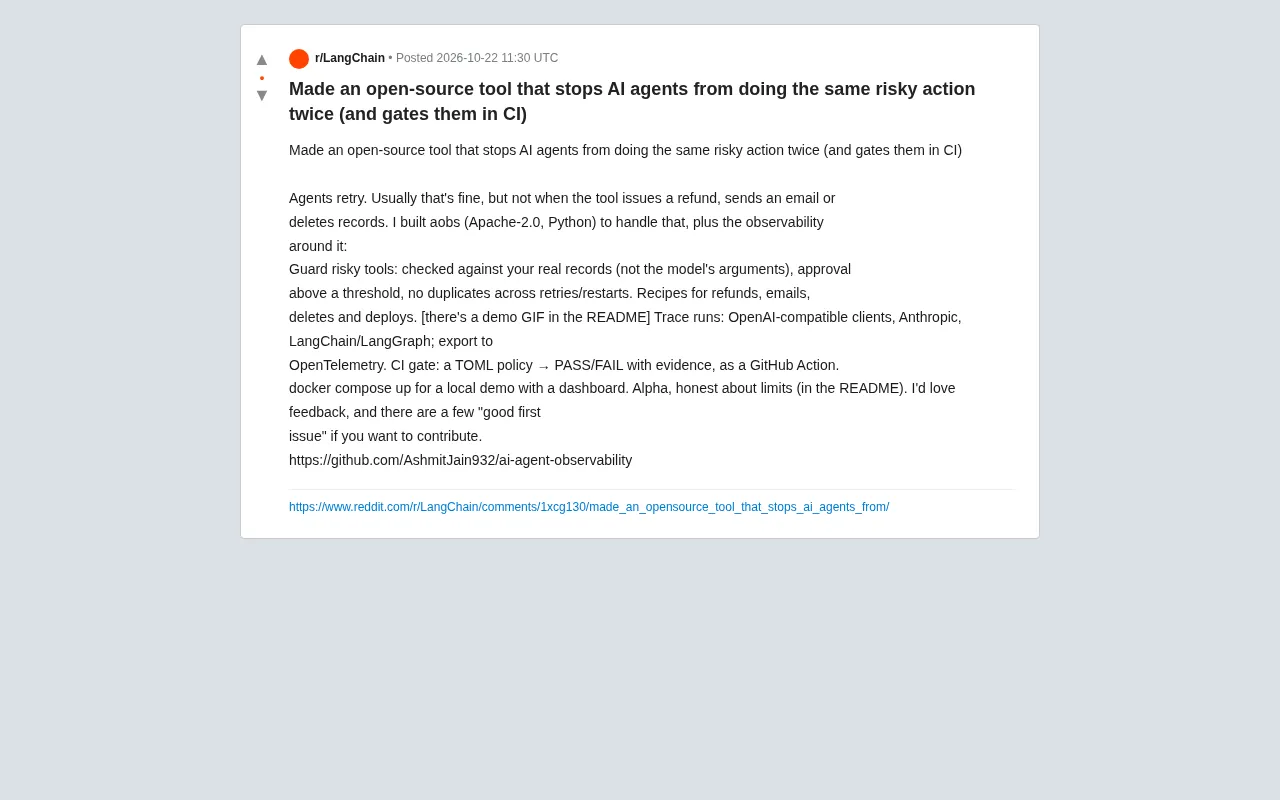
AI agents automatically retry when tool calls fail, which is usually harmless—but it's a big problem if what they're retrying is a refund, an email, or a record deletion. A developer on Reddit has released an open-source tool called aobs (Apache-2.0, Python) specifically designed to solve the problem of duplicate execution and runaway approvals for agents on high-risk tools, while also adding observability and CI gates on the side.
According to the post, aobs's core approach is: intercept high-risk tool calls, verify against real business records (rather than the parameters the model itself provides), require human approval when a threshold is exceeded, and ensure no duplicate side effects across retries and process restarts. The project also provides "recipes" for scenarios such as refunds, emails, deletions, and deployments, with a demo GIF in the README.
Why Agent Retries Turn into Incidents
Agent frameworks generally treat "tool call failure" as a recoverable error and therefore retry automatically. That's fine for query-type tools, but for operations with side effects, a retry means duplicate orders, duplicate refunds, or duplicate emails. What's trickier is that the parameters the model provides may have already "drifted"—it might turn a single refund retry into two requests with different amounts, so deduplicating based on parameters alone isn't reliable.
aobs's approach is to switch the basis for judgment from model parameters to real records: it checks whether the operation has actually already occurred in the business system, thereby identifying and blocking duplicates. This design direction is commendable because it acknowledges the untrustworthiness of model output and places the safety boundary at the system layer rather than the prompt layer.
Idempotency is a fundamental concept in distributed systems: performing the same operation once or multiple times has the same effect on system state. For example, a query operation is naturally idempotent, whereas "add 100 yuan to the account balance" is not. Common techniques for achieving idempotency include idempotency keys, unique constraints, state-machine deduplication, and server-side recording of operation credentials. In agent scenarios, tool calls inherently lack idempotency guarantees, so idempotent semantics need to be added at the system layer for operations with side effects. aobs's emphasis on "no duplicate side effects across retries and process restarts" is essentially providing an idempotency safeguard mechanism for tool calls. Understanding this helps evaluate what prerequisites are needed when integrating the tool with business systems.
Toolchain Coverage and Observability
The project has done considerable work on integrations: it supports OpenAI-compatible clients, Anthropic, and LangChain / LangGraph; execution traces can be exported to OpenTelemetry for easy integration with existing monitoring systems. There's also a local demo started with docker compose up, complete with a dashboard, which lowers the barrier to entry.
For teams already using OTel, this "don't reinvent the wheel" integration approach is fairly friendly—security interception and distributed tracing share a single data pathway, so you don't have to switch back and forth between two systems when troubleshooting.
OpenTelemetry (OTel) is an open-source observability standard under the Cloud Native Computing Foundation (CNCF) that unifies the data models and collection protocols for traces, metrics, and logs. It is not a monitoring backend itself; rather, it exports telemetry data to systems like Jaeger, Prometheus, and Datadog through SDKs and the Collector. For agent applications, the value of OTel lies in bringing a single tool-call chain (model inference → parameter generation → tool execution → result write-back) into the existing monitoring system, thereby pinpointing failure points and latency bottlenecks. aobs's choice to export OTel traces rather than build its own dashboard means it prefers to integrate with existing operations infrastructure rather than create a separate, isolated observability system.
CI Gates: Shifting Policy Checks Left
In addition to runtime protection, aobs also provides CI gates: policies are defined in TOML, PASS/FAIL results with corresponding evidence are output, and it runs as a GitHub Action. This means compliance checks on agent behavior can enter the code review process, rather than waiting until something goes wrong in production to trace it back.
Turning policies into files and making judgment results auditable evidence is a key step toward engineering maturity for this kind of tool. For regulated industries or teams with strict internal change processes, this layer may be more valuable than runtime interception.
Policy as Code refers to incorporating compliance and security policies as machine-readable configuration files (such as TOML, YAML, or Rego) into version control and having automated processes execute and audit them. Compared with traditional manual checks, its advantages are that judgment results are reproducible and traceable, and it can be embedded in CI pipelines to block non-compliant changes before code is merged. aobs's use of TOML to define policies for agent tool calls and output PASS/FAIL with evidence is a concrete application of this concept to AI agent governance. It's worth noting that the effectiveness of policy as code depends heavily on the completeness of the policies themselves and how frequently they are maintained; otherwise it can easily become a mere formality.
Limitations to View Rationally
The author explicitly notes that the project is in the Alpha stage and honestly documents its limitations in the README. For a personal open-source project, this candor is a plus, but it also signals to users that it should not be used directly for financial operations in production environments in the short term. In addition, deduplication depends on integration with real business records, which means the implementation cost lies mainly not in the tool itself but in the integration and rework required for existing order and accounting systems.
The project also leaves several "good first issues" open and welcomes community participation.
Summary
The reliability problem for agents is shifting from "can it do it right" to "will doing it wrong cause losses." aobs represents a pragmatic line of thinking: rather than pursuing a model that never makes mistakes, set up guardrails at the system layer—real-record verification, threshold-based approval, idempotency guarantees, OTel tracing, and CI policy gates. Whether this combination works well depends on how closely it fits with business systems, but the direction is worth watching.
Project URL: https://github.com/AshmitJain932/ai-agent-observability
One-line Summary
Open-source tool aobs verifies high-risk agent tool calls against real business records, blocking duplicate side effects and introducing CI policy gates.
Paragraph Summary
A developer on Reddit has released the open-source tool aobs (Apache-2.0, Python) to address the problem of AI agents automatically retrying high-risk tools (refunds, emails, record deletions, deployments, etc.) and causing duplicate side effects. The core approach is to intercept high-risk tool calls, verify against real business records rather than model parameters, require human approval when a threshold is exceeded, and ensure no duplicate side effects across retries and process restarts. The project supports OpenAI-compatible clients, Anthropic, and LangChain/LangGraph; traces can be exported to OpenTelemetry; and it provides TOML policy-driven CI gates (a GitHub Action that outputs PASS/FAIL with evidence). The author notes that the project is in the Alpha stage, and that the implementation cost lies mainly in integrating with existing order and accounting systems.
Related articles

Fifty Years Studying Power: Robert Caro's Writing and Insights on Power
Robert Caro reflects on 50 years studying power: Lyndon Johnson's persuasion and leverage, Robert Moses's transformation from idealist to ruthless builder, the dilemmas of large-scale construction, and his methods of compressing themes and solitary focus in biography writing.

Can a $20,000 Robot Do Your Chores? The Test Results Are Surprising
A YouTube test video shows how a $20,000 robot responds to commands like washing dishes, turning off lights, taking out trash, and feeding the dog. This article analyzes its real capability boundaries, the state of voice interaction technology, and how far household robots are from mainstream adoption.
The Complete Guide to Running AI Models Locally: Inference Engines and Tool Stack Explained
A systematic breakdown of the complete local LLM tool stack: from PyTorch and GGML compute libraries to llama.cpp, vLLM, SGLang inference engines and Ollama, LM Studio wrapper layers, with benchmark data on performance differences and selection logic.