Open-Source Tool Billion Context: Unlocking Unlimited Context for AI Coding Agents
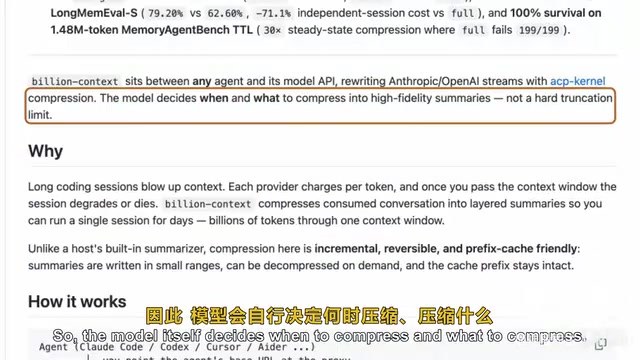
Billion Context uses reversible incremental compression to save long-session coding agents massive tokens, at the cost of verbatim recall accuracy.
Billion Context is a lightweight proxy between agents and model APIs. Through four tools—compress, decompress, search context, and status query—it lets the model incrementally and reversibly summarize completed history while maintaining 95%–97% prompt cache hit rates. Third-party benchmarks on DeepSeek V4.1 Flash show Context Bench F1 of 0.31, slightly above full-context's 0.29 with 58% lower cost; Long Memo Val scored 79.2% with 71% cost reduction; in a 1.48 million token test, full-context failed all attempts while it passed every time with roughly 30x compression. The trade-off: needle-in-a-haystack exact recall drops from 69% to 27%. Still at early version 0.1.21, it has limitations including main-branch auto-updates, no authentication, and the desktop Code tab bypassing the proxy. Best suited for long coding tasks where semantic preservation matters more than token cost sensitivity.
Long-running coding agents always crash when the context window fills up? Resending history every turn, driving up token bills? There's a project on GitHub called Billion Context that claims to let a single session last a month, process billions of tokens within a 100k window, and cut token consumption to one-fifth. It racked up about 3,700 stars and 300 forks in under three months. What does it actually do, and what pitfalls are hidden inside?
What Problem Does It Solve
When AI coding agents handle long tasks, conversation history keeps expanding. Once the context window fills up, the agent either crushes content into vague summaries or simply stops; and every request must resend the entire history, burning money on duplicate tokens.
Billion Context's approach is to add a lightweight proxy layer between the agent and the model API. You just point the agent's base URL at it, and requests flow through it first. It reads the conversation, compresses the completed portions, then forwards to the real model. Compatible with both Anthropic and OpenAI API formats, it theoretically works with any agent.
Compression Mechanism: Incremental, Reversible, Cache-Preserving
It doesn't crudely truncate when hitting the limit. Instead, it gives the model four new tools:
- compress: collapse a segment of messages into a detailed summary
- decompress: bring a specific segment back to view the original when details are needed
- search context: keyword search across all compressed content
- status query: show context usage and what else can be compressed
The model decides when and what to compress. Compared to an agent's built-in summarization, its compression is incremental—summarizing small scopes rather than summarizing everything at once—and the process is fully reversible.
More critically, caching. The official claim is that prompt cache hit rates stay stable at 95% to 97% during normal sessions, with compression overhead accounting for just 2% or less. Cached tokens are extremely cheap, so preserving the cache means saving money without losing speed.
Prompt Caching is a cost-reduction mechanism offered by mainstream model APIs: the server caches the repeated prefix portion of requests (system prompts, conversation history, etc.), and subsequent requests with an identical prefix are billed at a far lower rate than regular input tokens, while skipping redundant prefill computation to reduce latency. Anthropic and OpenAI both price cached hits and misses at different tiers, with cache reads typically costing about one-tenth of regular input prices.
For long-session agents, the key constraint of caching is that "the prefix must remain stable": once some middle segment of history is rewritten or truncated, all subsequent cache is invalidated and the next turn must be recomputed at full price. This is why brute-force summarization approaches often "save tokens but cost more." Billion Context emphasizes incremental compression and high hit rates precisely to affect only local prefixes while modifying history, preserving the vast majority of cache benefits.
Benchmarks: Cheaper and Slightly Ahead, But Don't Expect Verbatim Recall
The author attached a paper to the repository, covering four and a half months of real-world usage, 174,000 model calls, 18.76 billion input tokens, zero context window overflows, all completed on 200k models.
Third-party benchmarks ran on DeepSeekAd V4.1 Flash:
- Context Bench (coding agents exploring real codebases): Billion Context scored F1 0.31, beating full-context's 0.29; cost $4.61 versus full-context's $11.05, a 58% reduction
- Long Memo Val: scored 79.2% versus full-context's 83.2%, far above the best RAG approach's 62.6%, with 71% cost reduction
- 1.48 million token test: full-context failed all 199 tests, while Billion Context passed each time with roughly 30x compression ratio
The trade-off is clear. On needle-in-a-haystack exact retrieval of a specific quote, accuracy dropped from 69% to 27%. Summaries preserve core semantics, not verbatim text. For coding agents this is usually a worthwhile trade-off, but you should be aware of it.
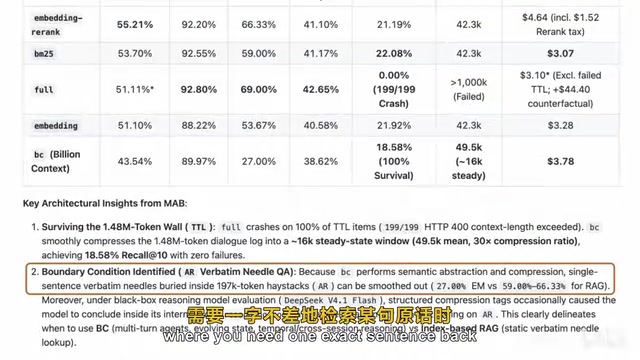
F1 score is a common composite metric for classification/retrieval tasks, taking the harmonic mean of Precision (how much of what was retrieved is correct) and Recall (how much of what should be retrieved was found), ranging from 0 to 1. Values like F1 0.31 and 0.29 seem low because such benchmarks typically apply strict criteria (requiring correct file, function, or code snippet localization); absolute values aren't intuitively meaningful—what matters is the relative comparison between the two.
Needle in a Haystack is a long-context stress test: a specific piece of information is buried at a random position in a very long text, and the model must accurately reproduce it. It tests verbatim-level retrieval ability, a different capability dimension from semantic understanding. Compression approaches rewrite the original text, so they naturally underperform on such tests—the 69% to 27% drop mentioned in the article reflects exactly this difference.
Getting Started: Three Integration Methods, Paired with Low-Cost Open-Source Models
Install and run npm install -g billion-context, specify a local directory with the prefix parameter, then use the billy command. Three ways to use it:
- Run
billy plugin installplus the client name to use it as a native plugin supporting OpenCode, KimiCode, and others - Directly run
billyplus the client name to launch the client through the proxy, no config changes needed - Start billy first, then prepend the proxy address to the base URL, suitable for other clients
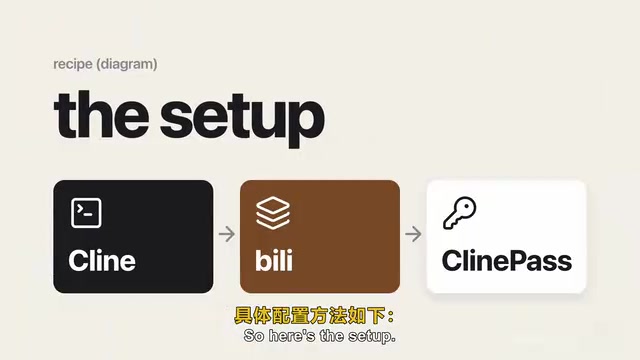
Pairing with Claude Pass (note: source material transliterates as Client Pass/Clumpass) is especially cost-effective. This is a $9.99/month subscription offering open-source coding models including DeepSeek V4.1 Flash, Kimi K3.1 Pro, GLM 5.3, Qwen 3.8 Max, and MiniMax M3.1 Flash, with rate limits 2-5x the usual, and it can also be used independently via an OpenAI-compatible API.
In Claude (source material transliterates as Client), select an OpenAI-compatible provider, enter the local proxy address plus the API address as the base URL, and set the model to claude-pass/deepseek-v4.1-flash. Every request is first compressed by Billion Context, then forwarded to Claude Pass. The repository lists it as an officially certified client.
It also works on desktop, suitable for running multiple parallel sessions, scheduling tasks, and importing Claude Code or Codex history to continue execution. The same subscription quota lasts longer because history is streamlined.
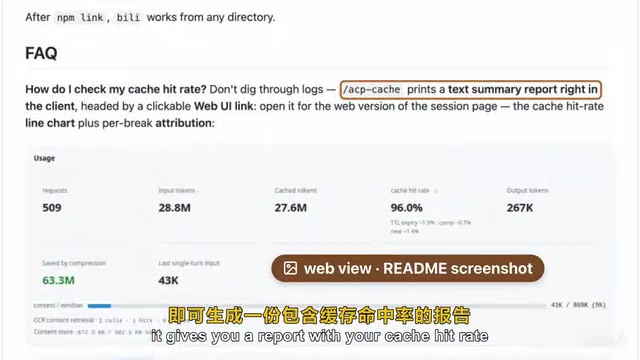
After launching, open the local dashboard in your browser to view the session list, real-time logs, and a config editor. In supported clients, entering a slash command generates a report including cache hit rates, tokens saved per compression, and what caused cache invalidation when hit rates dropped.
How It Fits into Multi-Agent Orchestration
The video author commonly uses PandaCode for graphical orchestration: an architect oversees the whole picture, dispatching specific tasks to independent workers, with Claude being one of the built-in runtime frameworks. The architect is the longest-lived session with the worst context bloat, and that's exactly where compression proves most useful. Since workers can run on OpenCode or KimiCode with the native billy plugin, the entire workflow stays lightweight.
Limitations You Must Know
- Iterating extremely fast, currently only version 0.1.21, auto-updating to the main branch by default, bugs can appear at any time—be sure to install the official release from npm
- Running with the host parameter has no authentication at all; only use it on trusted networks
- The desktop Code tab bypasses the proxy, so that portion won't be compressed
- Exact recall drops; retrieving distant verbatim text requires decompression first
- Official documentation is very long and technical; configuration takes time to study
Main branch auto-update is a double-edged sword in fast-iterating open-source projects. Tracking the main branch by default means every pull gets the latest commits, which may include insufficiently tested changes, breaking API changes, or even half-finished features, potentially causing a previously working workflow to suddenly fail. The safer approach is to install a versioned official release via npm and pin the version, manually upgrading only after confirming a new version is stable; production or multi-agent orchestration scenarios should especially avoid tracking the main branch directly.
Who Should Use It
If your agent's long tasks keep dying midway, or token costs are absurdly high, this proxy layer is worth a try: it lets the model compress its own history, segment it with tools that can be restored, while not breaking existing cache. Benchmarks on DeepSeek V4.1 Flash show it's cheaper than full context and even slightly better on coding tasks. Paired with a low-cost subscription and desktop client, it's a pragmatic solution for long-session coding agent scenarios today.
Related articles
 Tech Frontiers
MuJoCo: An Analysis of DeepMind's Open-Source General-Purpose Physics Simulator
An in-depth analysis of Google DeepMind's open-source physics simulator MuJoCo: high-performance C++ kernel, MJCF modeling format, contact solving principles, MJX GPU acceleration, and robot reinforcement learning use cases.
 Tech Frontiers
Claude API Quick Start: The Official Quickstarts Project Collection
Anthropic's official claude-quickstarts project collection helps developers quickly build deployable apps with the Claude API. Nearly 20k stars, Python-based, great for beginners and prototyping.
 Tech Frontiers
AI Agents Connecting Directly to APIs: Which Calls Can Be Safely Allowed?
AI agents can call any API, but the real challenge is deciding which calls can be safely allowed. This article analyzes allowance decisions from three dimensions—intent matching, least privilege, and controllable impact—and argues that the control layer should sit outside the agent, combined with audit traceability to build a trustworthy API call governance mechanism.