Open-Source WoW Bot in Action: Trash Mobs Cleared, Boss Strategy Still Pending

Private server repair EP11 shows a three-bot, two-player party clearing the early-to-mid dungeon, but boss strategy is still incomplete.
In Repair Log EP11, a Bilibili creator showcases gameplay: a five-person party of three bots and two real players successfully pushes through the early-to-mid sections of the "Rescue Thrall" dungeon, with routing, fighting back, and aggro management all normal—bots even coordinate with frost CC. But the final boss fight is chaotic because boss strategy (positioning, skill order, defensive and burst timing) isn't finished. The video also reveals most core game bugs are fixed, with the bot module as the current main focus. The author notes that "being able to fight doesn't mean fighting well"—trash mob and boss layers are different engineering stages, and the boss chaos is really a clear to-do list.
When Three Bots Join a Five-Man Party
In Repair Log EP11, a Bilibili creator released actual gameplay footage: a five-person party with three bots and two real players, aiming to clear the "Rescue Thrall" dungeon in Hillsbrad Foothills. Walking in from the dungeon entrance, the first half consists of ordinary light mobs, and the party pushes through steadily. After watching this segment, the site owner's assessment was just two words—"no problem": the route was correct, mobs didn't get stuck, and the bots fought back, held aggro, and kept up with the party.
To those unfamiliar with private server repair, this assessment sounds unremarkable. But the creator himself makes it clear: this kind of "normalcy" took a long time to achieve. Bots following the party, flanking to deal damage from behind, fighting back when attacked, and never standing idle in "ghost combat"—each of these is a problem the bot module must solve individually.
Private server repair: refers to third-party teams reverse-engineering, reconstructing, and maintaining the server-side of online games that have ceased official operation, enabling them to run again and provide game services. In MMORPGs like World of Warcraft, private server repair typically involves restoring large amounts of low-level code such as quest scripts, monster AI, dungeon mechanics, and skill logic—an enormous undertaking. Repairers must rebuild game logic from scratch or based on leaked code, then continuously test and adjust to bring game behavior as close to the official original as possible. The "repair logs" mentioned in this article are precisely a video series documenting this process.
Frost Control: Coordination Is the Real Threshold
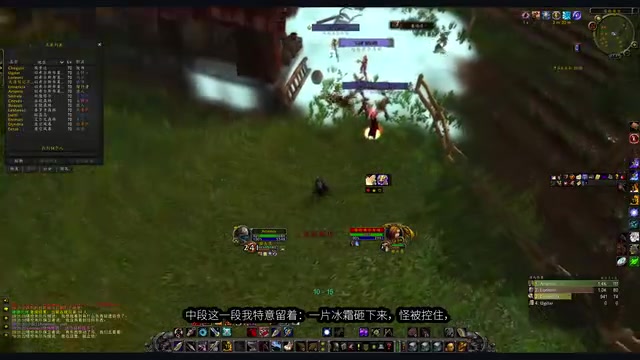
The creator deliberately kept this mid-section: a wave of frost comes down, mobs are controlled, and the party pushes in to attack. He mentions that such scenes rarely appeared before, because bots simply wouldn't coordinate this way.
The information revealed here goes deeper than the surface. Bots being able to fight mobs is one layer; coordinating with crowd control rhythm is another. CC skills mean teammates must understand the timing window of "the mob is frozen, now we can push in"—rather than each just running their rotation. From the footage, this layer is already working.
Crowd Control (CC): In MMORPGs, crowd control refers to temporarily limiting enemy actions through stuns, freezes, fears, and similar abilities, creating opportunities for the party to deal damage or reposition. CC skills usually have diminishing returns mechanics (consecutive applications of the same type of control on the same target have reduced duration), so teammates need to coordinate timing to avoid wasting them. In dungeon combat, CC is a critical element of team coordination, requiring players (or AI teammates) to understand combat rhythm and focus fire or execute tactical actions while control is active.
Why the Final Boss Is Chaotic: Not Mysticism, Just Unfinished Strategy
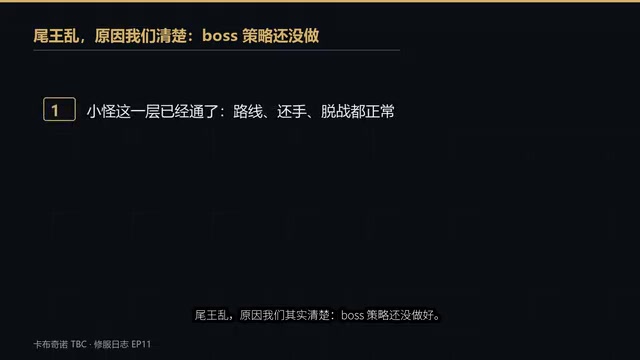
When it comes to the final boss segment, the creator himself admits it's "a bit chaotic." But he explains the reason very specifically: the boss strategy isn't done yet.
The trash mob layer is already working—routes, fighting back, and aggro management are all normal. But bosses are a different layer entirely: how to assign positioning, what order to use skills, when to mitigate damage, when to burst—all of these need separate tuning. The creator states plainly: "What we've done is trash mobs and routing; the boss part isn't finished yet."
This line—"being able to fight doesn't mean fighting well"—is the most honest part of the entire video. A dungeon being clearable and a dungeon being cleared well differ precisely by the engineering effort of the strategy layer.
Boss Strategy: In game AI, boss strategy refers to the decision-making logic written for specific boss encounters, including positioning assignments, skill cast order, defensive cooldown chains, and burst timing. Unlike ordinary trash mob AI, boss fights often involve complex phase transitions and mechanic handling, requiring AI to dynamically adjust behavior based on combat state. In private server repair, boss strategy is typically the last hurdle to overcome, because it requires AI not just to "fight" but to "coordinate" and "react"—involving extensive conditional logic and priority scheduling.
Repair Progress: Core Bugs Mostly Cleared, Bots Are the Main Battlefield
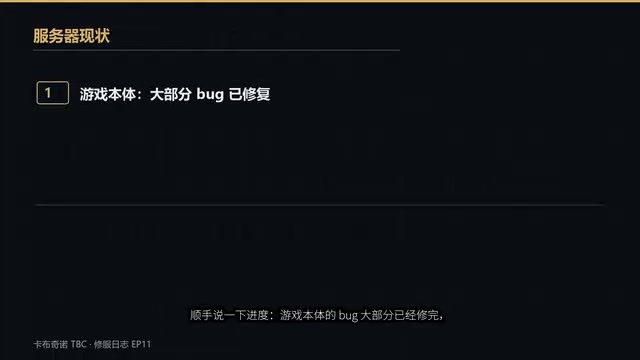
The creator also briefly covered overall progress: most of the game's core bugs have been fixed, and the bot module is currently the main work. This also explains why the video focuses its gameplay footage on teammate behavior—engine-level issues have converged, and the remaining hard nut is making bots play dungeons like humans.
For players who like to tinker themselves, the repository, group, and server addresses are all in the video description—feel free to follow along.
A Brief Observation
The easiest misunderstanding about open-source private server repair projects is treating "it runs" as "it's done." EP11 happens to lay out two stages for viewers to see: trash mobs and routing belong to the basic behavior layer, already validated; boss strategy belongs to the decision layer, still under construction. To evaluate whether a bot teammate is good, the criterion shouldn't be whether it can follow along and clear—it should be whether it makes correct timing judgments under specific encounter scripts. From this perspective, the chaos in the final boss segment isn't a failure—it's a clear to-do list.
One-line Summary
Private server repair EP11 shows a three-bot, two-player party clearing the early-to-mid dungeon, but boss strategy is still incomplete.
Paragraph Summary
In Repair Log EP11, a Bilibili creator showcases gameplay footage: a five-person party of three bots and two real players successfully pushes through the early-to-mid sections of the "Rescue Thrall" dungeon. Basic behaviors like routing, fighting back, and aggro management are normal, and bots even coordinate with frost CC. But the final boss fight is chaotic—the creator explains that boss strategy (positioning, skill order, defensive and burst timing) isn't finished. The video also reveals that most core game bugs are fixed, with the bot module as the current main focus. The author notes that "being able to fight doesn't mean fighting well"—trash mob and boss layers belong to different engineering stages, and the final boss chaos is really a clear to-do list.
Related articles

Prompt Engineering for Beginners: From Writing Prompts to Engineering Thinking
Starting from the essence and four functions of prompts, this article systematically explains the six-step process, four success criteria, learning value, and practical limitations of prompt engineering to help you build a complete understanding.

Anthropic Launches Nasdaq IPO: AI Giant's Listing and Risk Disclosures
Anthropic officially launches its Nasdaq IPO under ticker ANT, with market valuation expected to potentially exceed SpaceX's record. The prospectus devotes nearly 100 pages to AI risks, while first-half revenue grew over 14x but net losses widened sharply, reigniting the AI bubble debate.

Rust cURL Clone Uses 4,832 unsafe Blocks—Is the Memory Safety Myth Broken?
A Rust cURL clone uses 4,832 unsafe keywords, challenging Rust's memory safety narrative. We analyze what unsafe really means, compare Fil-C, and examine rewrite motives.