OpenAI Academy Turns Two: Progress and Challenges in Democratizing AI Skills
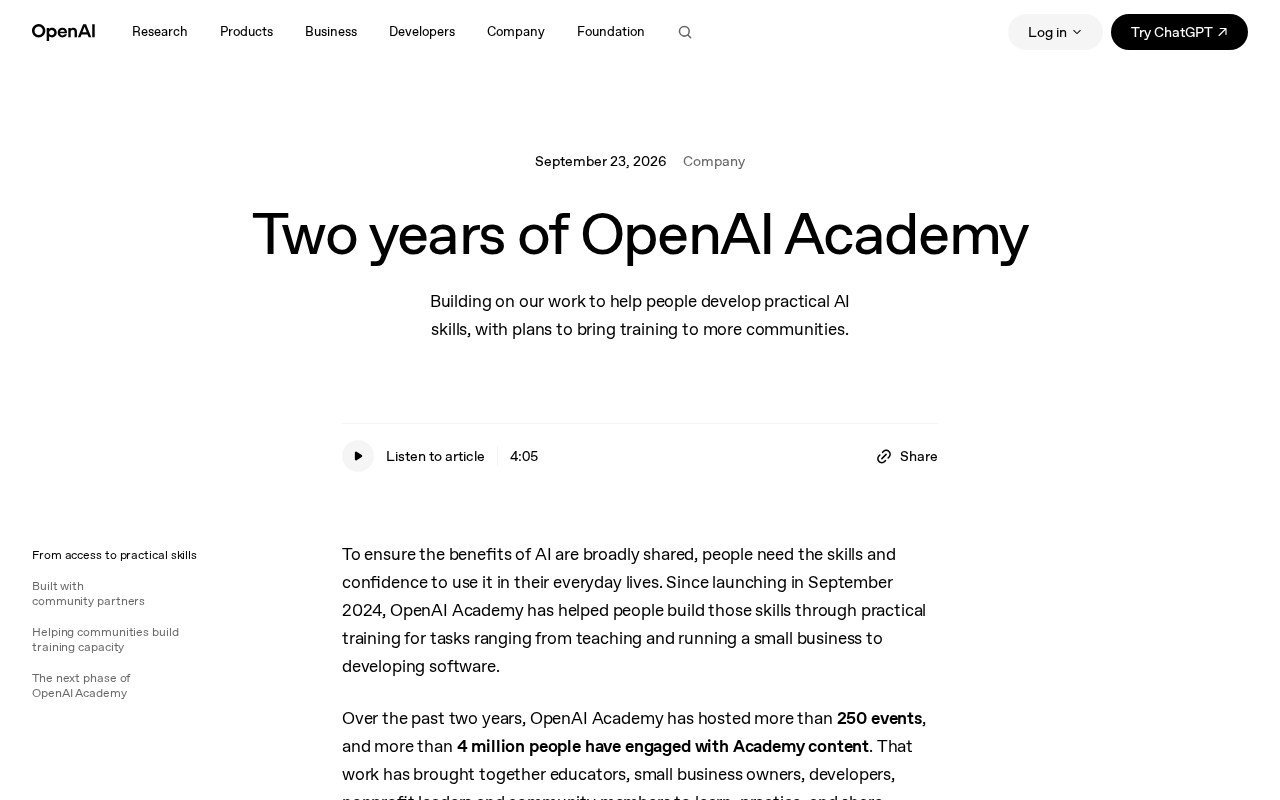
OpenAI Academy turns two, aiming to democratize AI skills — but real-world impact still awaits hard data.
OpenAI recently announced that its education initiative, OpenAI Academy, has reached its two-year mark, with a stated focus on bringing AI skills to broader communities. As generative AI reshapes work and daily life, AI proficiency is becoming unevenly distributed — tech workers and large-company employees have the advantage, while non-technical users and underserved communities risk being left behind. OpenAI Academy aims to close this gap, while also signaling a broader industry shift: top AI companies are evolving from pure tool providers into active educators and ecosystem builders. However, the current announcement lacks quantitative data on user scale, curriculum, or geographic reach, leaving the program's actual impact yet to be fully assessed.
OpenAI Academy Marks Two Years
OpenAI recently shared an update celebrating the two-year anniversary of its education initiative, OpenAI Academy, with a core focus on bringing AI skills to broader communities. As a platform dedicated to lowering the barrier to AI learning, this milestone reflects a broader trend over the past two years: AI education gradually expanding beyond the tech elite and reaching everyday users.
Based on publicly available information, OpenAI Academy is positioned to help people from diverse backgrounds understand how to use AI tools and grasp the underlying concepts — through structured resources and courses. This approach aligns with a growing consensus in the tech industry: democratizing AI capabilities is not just a technical challenge, but a matter of social equity and digital literacy.
Why AI Skill Democratization Matters
As generative AI rapidly permeates the workplace, education, and creative fields, proficiency with AI tools is becoming a foundational skill. Yet the reality is that AI skills are highly unevenly distributed — tech professionals and employees at large enterprises are often first to access and master these tools, while workers at small and mid-sized businesses, non-technical users, and communities in underserved regions risk being left behind.
Initiatives like OpenAI Academy matter precisely because they attempt to close this "AI skills gap." Bringing AI education resources to more communities means more people have the opportunity to understand what AI can and cannot do, learn how to craft effective prompts, and unlock AI's productivity value in their work and daily lives.
The "AI skills gap" is an extension of the Digital Divide concept into the generative AI era. The Digital Divide originally described disparities in internet access between different groups. Today, as the productivity value of AI tools becomes increasingly apparent, the nature of that divide has shifted from "can you get online" to "can you effectively use AI." Researchers refer to this layer as the "third-level digital divide" — one that goes beyond device and connectivity access to encompass inequality in skills and understanding. For non-technical users, the barrier often isn't the cost of the tools themselves, but rather how to understand a model's capability boundaries, how to construct effective prompts, and how to critically integrate AI outputs into real-world workflows. This is precisely where structured educational programs offer more value than scattered self-study content.
The Shift from Tool Provider to Educator
Notably, the fact that OpenAI — a company known primarily for its model capabilities — has committed resources to running an education program for two consecutive years reflects a broader evolution in the industry's role. Leading AI companies are no longer content to simply offer APIs and products; they are actively taking on responsibility for user education and ecosystem development.
There are multiple rationales driving this shift. On one hand, users who develop stronger skills can better realize the value of a product, improving retention and willingness to pay. On the other hand, building brand trust and community engagement through educational programs represents a meaningful long-term competitive moat. In this way, investment in education and commercial objectives form a kind of virtuous cycle.
This role transformation has precedents in the tech industry. Salesforce's Trailhead platform, AWS's cloud practitioner certification program, and Google's digital skills training initiative (Grow with Google) are all prime examples of large tech companies building ecosystem moats through systematic education. Since launching in 2014, Salesforce Trailhead has accumulated millions of learners and is widely credited as a key pillar supporting the vitality of the Salesforce CRM ecosystem. This "platform as educator" model demonstrates a positive flywheel effect between user capability and platform commercial value: the more proficient users become, the higher the switching costs, and the stronger the platform stickiness. If OpenAI Academy can achieve a similar scale effect, it stands to create a differentiated, non-technical barrier to entry in an increasingly competitive large language model market.
Limitations and Open Questions
It's worth noting that the publicly available information remains limited — the announcement references the "two-year anniversary" and a focus on "reaching more communities," but lacks quantitative data on user scale, curriculum structure, or geographic coverage. As a result, the actual reach and impact of OpenAI Academy will require more detailed disclosures before a meaningful assessment can be made.
For practitioners and learners who follow AI education, the continued operation of this initiative is a positive signal. But democratizing AI skills is a long-term endeavor. How broadly a single platform can reach — and whether it can genuinely connect with resource-constrained communities — remains something that only time and practice will tell.
Related articles

Chain of Thought Isn't Just for AI: How Humans Can Use CoT to Improve Thinking Quality
Chain of Thought isn't just a prompt trick for large models. Starting from a Hacker News discussion, this article analyzes why CoT works for human thinking too, breaks down actionable ways to transfer it, and highlights the key differences between human CoT and machine CoT.
Cloudflare Teams Up with OpenAI: Closi…
Cloudflare Teams Up with OpenAI: Closing the Loop from Vulnerability Discovery to Defense with AI
Cloudflare uses OpenAI Daybreak to investigate security vulnerabilities and generate reviewable remediation plans, while developers use Codex to boost coding efficiency and quality.

Orca Multi-Agent Orchestration in Practice: A Guide to Parallel Collaboration with Claude and Codex
Orca is Stable AI's free open-source agent workbench supporting 34 agents like Claude Code and Codex in parallel. Learn its Git worktree isolation, multi-model orchestration, and mobile management.