OpenAI Acquires Pierre Computer: Codex Capabilities Expand Further
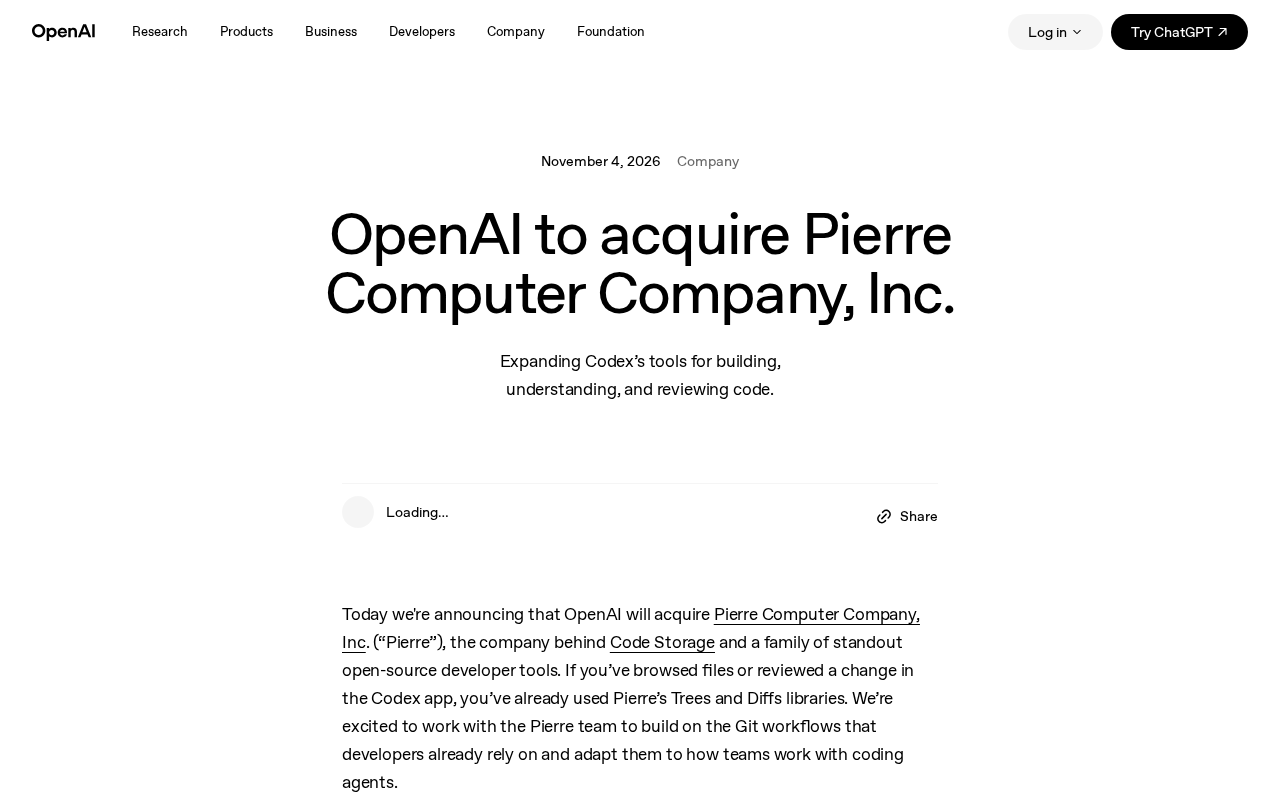
OpenAI acquires Pierre Computer to expand Codex's build, understand, and review capabilities.
OpenAI announced the acquisition of Pierre Computer Company, Inc., aiming to expand the toolchain Codex uses to build, understand, and review code. The article notes that these three verbs cover key developer-code interaction stages, with code review capability being the most notable addition—review requires understanding context, conventions, and history, making it harder than point code generation. The deal signals Codex's shift from a coding assistant to a full workflow tool. Short-term impact may show in tool integration and earlier quality checks for teams. Acquisition amount, team size, and timeline remain undisclosed.
OpenAI has announced it will acquire Pierre Computer Company, Inc., a move that directly targets capability upgrades for its code intelligence product Codex—expanding the toolchain for building, understanding, and reviewing code.
Key Facts About the Acquisition
According to OpenAI's official announcement, the goal of the acquisition is clear: strengthening Codex's ability to assist across the entire code lifecycle. The official wording is to "expand the tools Codex uses to build, understand, and review code."
These three verbs—building, understanding, reviewing—essentially cover the main stages of how developers interact with code. Codex was initially known for code generation, and the signal this acquisition sends is that OpenAI wants it to evolve from a "coding assistant" into a development tool that covers a more complete workflow.
Codex is OpenAI's code intelligence product line, built on large language models. It started primarily as a way to generate code snippets from natural language instructions, and later became available to developers through APIs and IDE plugins. Like tools such as GitHub Copilot, Codex is positioned as an assistant that helps developers write code, but OpenAI has been steadily expanding its boundaries—from simple completion and generation toward capabilities closer to real engineering workflows, such as explaining code, locating defects, and suggesting refactors. Understanding this is key to seeing why the acquisition focuses on the three verbs "build, understand, review": they correspond precisely to the three stages developers cycle through repeatedly in their daily work, rather than to any isolated feature.
Why "Code Review" Deserves Attention
Among building, understanding, and reviewing, the addition of the review stage is the most noteworthy. Code generation tools are already quite common, but tools that can participate in code review, spot potential issues, and explain the intent behind changes are far more valuable in team collaboration scenarios.
Review capability requires the model to understand not only syntax but also context, project conventions, and historical changes. Filling this gap through acquisition shows that OpenAI's investment in Codex is shifting from point solutions toward workflow integration.
Code review is the process in software engineering where other developers examine changes before code is merged into the main branch, with the goals of finding defects, ensuring stylistic consistency, and spreading knowledge. It is especially hard for AI because review often depends on cross-file context, a project's historical conventions, team preferences, and semantic judgments such as "does this change actually solve the problem it claims to solve"—information that is usually not contained in a single code snippet. By contrast, code generation only needs to produce snippets that are syntactically correct and functionally usable. Therefore, building review capability into AI tools essentially requires the model to understand repository-level context and historical changes, which is why many code AI products remain stuck at "generation" and struggle to enter "review."
Practical Impact on Developers
In the short term, the most direct impact of this acquisition may show up in how well Codex's tools are integrated. If Pierre Computer's technology can be folded into Codex, developers may be able to write, read, and review code in one continuous flow from a single entry point, reducing the cost of switching between tools.
For teams, stronger review capabilities also mean code quality checks can kick in earlier. This kind of capability is especially meaningful for engineering teams adopting AI-assisted programming—once generation speeds up, review often becomes the new bottleneck.
IDE (Integrated Development Environment) and CI (Continuous Integration) are two key scenarios where code intelligence tools are deployed. The IDE is where developers write code, and plugin-form AI assistants can provide real-time completion, explanations, and refactoring suggestions in the editor; CI is the build-and-test pipeline that runs automatically after code is committed, where AI can handle static checks, review comment generation, and similar tasks. Integrating building, understanding, and reviewing into a single product means the tool needs to cover both the "editing" and "post-commit" stages, rather than helping at only one of them. This also explains why the acquisition is described as "expanding the toolchain"—it points to product integration rather than an upgrade to a single model capability.
Position in the Competitive Landscape
Code intelligence is one of the most fiercely contested arenas among AI vendors today. Everyone is extending code generation capabilities into IDEs, code hosting platforms, and CI pipelines. By acquiring to fill in the review stage, OpenAI is packaging Codex from a model capability into a more complete product.
Official details on the integration timeline and product form have not been disclosed. What is certain is that Codex's tool boundaries are being deliberately broadened, and this acquisition is one step in that direction.
(This article is based on brief information from OpenAI's official announcement; the acquisition amount, team size, and integration details have not been made public.)
One-line Summary
OpenAI acquires Pierre Computer to expand Codex's ability to build, understand, and review code.
Paragraph Summary
OpenAI has announced the acquisition of Pierre Computer Company, Inc., with the stated goal of expanding the toolchain Codex uses to build, understand, and review code. The article notes that these three verbs cover the main stages of how developers interact with code, and that filling in code review capability is the most noteworthy—review requires the model to understand context, project conventions, and historical changes, making it harder than point code generation. The acquisition signals that Codex is shifting from a "coding assistant" toward a tool covering the full development workflow. In the short term, the impact on developers may show up in tool integration, while teams may be able to intervene in quality checks earlier, easing the problem of review becoming a bottleneck as generation speeds up. In the highly competitive code intelligence race, this is a step toward packaging Codex from a model capability into a complete product, though the acquisition amount, team size, and integration timeline remain undisclosed.
Related articles

DeepSeek Harness Quick Start Guide: From Installation to 5 Real-World Cases
What is DeepSeek Harness? Based on a Bilibili tutorial, this article covers how this AI Agents software works, installation and setup, four working modes, and five real-world cases: a 3D racing game, official website, music player, science animation, and self-developed plugin—plus token money-saving tips.

Breaking Down DeepSeek's Super-agent Architecture: How Router+Worker Solves the Multi-Session Management Bottleneck
An analysis of DeepSeek's Super-agent paper: how the Router+Worker two-tier architecture uses Fast Pass, Chain of Recall, and storage-compute separation to solve multi-AI-session management bottlenecks, and how much it truly alleviates the human attention bottleneck and what engineering trade-offs it makes.

19K Stars in 5 Days: Why DeepSeek's Open-Source AI Programmer Went Viral
DeepSeek's open-source AI programmer hit 19K GitHub stars in 5 days. Why it went viral: the agent boom, AI writing its own code, and the shift from Q&A tools to AI employees.