OpenAI Agents SDK Cost Visualization: See the Cost of Every Handoff Before You Run
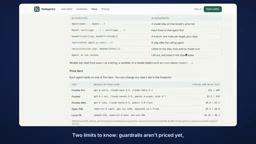
Node Agentry statically parses agent code into a cost-annotated graph, revealing high-end agents as the bill's main driver.
Node Agentry is a tool that parses OpenAI Agents SDK code locally in the browser, converting agent definitions into a graph with estimated costs, marking execution order, handoff branches, and per-run cost for each agent. It estimates on a "each agent runs once" basis, and guardrails are not yet priced. The example shows the refund agent accounts for about 90% of the monthly bill due to its high-end model; downgrading it cuts monthly cost from about $163 to about $21. The tool also offers a simulator and CI cost checks, moving cost governance before merge.
When building multi-agent systems, the most frustrating problem is often not that the logic fails, but that the bill spirals out of control. The OpenAI Agents SDK makes it easy to define roles like triage, billing, and refund, but the code doesn't reveal which model each agent uses, how many handoffs occur, or how much each run costs. A tool called Node Agentry aims to solve this: it directly reads the Python or JavaScript code where you define your agents, draws it into a diagram, and marks who runs first, who hands off to whom, and the estimated cost of each agent—all before anything runs.
From Code to Cost Graph: How Agents Are Priced
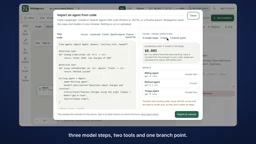
The entry point for Node Agentry is the Agent Cost Calculator. Paste in the code defining your agents, and the tool parses it locally in the browser—no upload, no execution. Take the official Agents example: a triage agent routes customers to either a billing agent or a refund agent. Triage and billing run on GPT-6 Luna, while the refund agent runs on GPT-6.1 Sol and carries two function tools—look up order and initiate refund.
After parsing, each agent becomes a step in the graph, priced according to its model; handoffs become branches after triage, with one path per downstream agent. Runner.run marks the agent that executes first, while agents invoked as tools are placed after the agent that uses them. Function tools run as code, so they incur no model cost and aren't drawn as separate steps.
The key to this mapping logic is that cost estimation is measured "per agent, per run." In other words, it calculates the one-way cost of running each agent once, not the full cost of a run that includes loops, retries, or multi-turn conversations.
In the OpenAI Agents SDK, a handoff is a mechanism by which one agent transfers conversation control to another agent. The handed-off agent can inherit the conversation history or carry its own system prompt and toolset. In the cost graph, handoffs appear as branches: each agent that could be handed off to forms a separate path, so a single user request may only traverse one of those paths. This is important to understand, because cost estimation is calculated as "each agent runs once," while in actual operation a request typically triggers only some of the handoff paths, depending on the routing logic.
Two Estimation Boundaries You Must Know
Before taking the numbers seriously, there are two limitations worth remembering. First, guardrails are not currently priced—if your system relies on guardrails for input/output validation, the actual cost will be higher than the chart shows. Second, each agent is calculated for only one round; the estimate reflects the cost of a single pass through the agent graph.
These two boundaries don't undermine the tool's core value—it answers "the structural distribution of costs," not "the precise bill." For determining which agent consumes most of the budget and which handoff can be eliminated, that's already enough.
Guardrails in the Agents SDK are a validation layer that runs independently of an agent's main logic, typically performed by another model or rules engine that checks inputs and outputs. Because guardrails don't participate in handoff relationships and don't appear as steps in the agent graph, the current cost model doesn't include them. If a system enables both input and output guardrails for every request, the actual cost may be significantly higher than the numbers in the chart—especially in high-concurrency scenarios, where the number of guardrail calls is proportional to the number of requests.
Example Bill: One Agent Eats 90% of the Cost
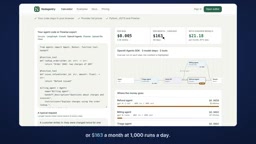
With the configuration in the example code, if each agent runs once, a single run costs about half a cent—roughly $163 per month at 1,000 calls per day. The distribution in the chart is telling: the refund agent accounts for almost the entire bill, about $149 per month; triage and billing each cost only a few dollars.
The reason isn't hard to understand—the refund agent runs on a stronger model and also carries two function tools. The real cost driver isn't the number of handoffs, but the call volume of one high-end model agent. This also means the direction for optimization is very clear: change that most expensive agent, not the graph structure.
Drop One Model Tier, and the Bill Falls from 163 to 21
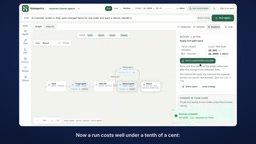
Dropping the refund agent from GPT-6.1 Sol to GPT-6 Luna lowers the monthly bill from about $163 to about $21. In the Improvements tab, the tool directly suggests this step—"downgrade the most expensive step"—and after applying it, re-simulating the same request brings the single-run cost to well below one-tenth of a cent, a reduction of about 90%. At the code level, you only need to change one line: set the refund agent's model to GPT-6 Luna.
But refunds involve real money flows, and the tool itself issues a warning: before switching, test the refund logic with the cheaper model. Cost optimization must not come at the expense of reliability in critical business processes—a prerequisite that any automated cost-reduction action must uphold.
The impact of model tier on cost is not linear; it is determined jointly by the input/output token unit price and the agent's call frequency. High-end models (like GPT-6.1 Sol in this article) usually have higher unit prices and may produce more output tokens due to stronger reasoning; lower-tier models (like GPT-6 Luna) have lower unit prices and shorter responses. When an agent handles high-frequency, core calls (such as refund processing), its cost share is amplified. Therefore, the reduction from "dropping one model tier" often exceeds the unit-price ratio, because the call volume base is large.
Simulator + CI Checks: Shift Cost Control Left
After importing into the canvas, the agent graph can run in the simulator without an API key. When a customer makes a refund request, the handoff logic selects the refund agent, the billing agent is skipped, and the entire run costs about half a cent—this chain validation itself is a real test of the cost model.
More noteworthy is the CI cost check: when a pull request makes agents more expensive, it flags it before merging. This moves cost governance from "looking at the bill after launch" to "looking at the diff before merge," placing it at the same gate as code review and security scanning. After logging in, each import is saved as a testable, publishable workflow that can be invoked via webhook or API. The tool itself is free and requires no registration.
What This Kind of Tool Really Means
The cost structure of multi-agent systems often defies intuition: the number of handoffs looks like the main variable, but what actually determines the bill is the model tier and the agent's call frequency. Node Agentry statically parses code into a priced graph, turning "how much will this architecture cost" from a post-launch financial question into a design-stage engineering question. It isn't precise—guardrails aren't priced, and each agent is counted for only one round—but it brings cost visibility to the right point in time: before running.
Related articles

From 0 to 1: Vibe Coding an AI Knowledge Base — A Practical Retrospective and Tech Stack Breakdown
A retrospective on building the AI knowledge base OilBook from scratch with Vibe Coding: Next.js+Neon stack, Oil Dev Skill workflow, Stripe paywall security, interview-style writing, AI-flavor control, and Vercel deployment.

GLM-5.4 Hands-On: Native Vision Meets a New Vibe Coding Workflow
Hands-on with Zhipu GLM-5.4: native vision tested across a 3D product demo, pure-code video generation, and remote-control Vibe Coding, compared with GPT-6.2 and Gemini Neon.

AI and Humans Claim to Prove the Riemann Hypothesis: Machine-Verified, Yet Nobody Can Understand It
Anthropic mathematician and AI Claude claim to prove the Riemann Hypothesis with 17 million lines of Lean code, machine-verified but unreadable by humans. This article analyzes the event, the zero proportion record from 41.6% to 67.2%, and the gap between machine verification and human understanding.