OpenAI Board Member Helen Toner: Why We Still Can't Trust AI CEOs

Helen Toner argues AI CEOs don't deserve full trust due to structural conflicts and information asymmetry, requiring institutional safeguards.
The article centers on Helen Toner's view that we cannot trust AI CEOs. Toner, executive director of Georgetown's CSET and a former OpenAI board member who participated in firing Sam Altman, argues the problem is structural rather than personal: CEOs face conflicting commercial and safety obligations and hold far more information than external overseers. The OpenAI turmoil exemplifies broken trust and fragile board oversight. She calls for stronger external regulation, transparency, board reform, and public participation.
Introduction: A Conversation About Trust
As AI technology advances rapidly, should we trust the CEOs who control the most powerful AI systems? This is a question Helen Toner has been thinking about for a long time. As executive director of Georgetown University's Center for Security and Emerging Technology (CSET), Toner is highly regarded in the field of AI safety and policy. She is better known as a former member of the OpenAI board, having participated in the sensational firing of Sam Altman.
Recently, Toner revisited the issue of AI trust on a podcast. She stated bluntly that we still cannot trust AI CEOs. This view sparked widespread discussion and forces us to re-examine the deeper dilemmas of AI governance.
Who Is Helen Toner?
Helen Toner is a well-known expert in AI safety and policy. She currently leads Georgetown University's CSET, which studies the national security implications of emerging technologies. Toner's career spans academia, policy, and industry, and she has a deep understanding of AI governance.
What brought her into the public eye was her experience on the OpenAI board. As a board member, she participated in the decision to fire CEO Sam Altman. The incident not only exposed cracks in OpenAI's internal governance but also triggered widespread discussion about the governance structures of AI companies. Toner has since publicly explained her position many times, emphasizing that the board's actions were based on concerns about OpenAI's mission.
CSET (Center for Security and Emerging Technology) is a research institution under Georgetown University's Walsh School of Foreign Service, founded in 2019. It focuses on the impact of emerging technologies such as artificial intelligence, quantum computing, and biotechnology on national security and international stability. The center is known for interdisciplinary research and policy recommendations, and its researchers frequently interact with the U.S. Congress, the Department of Defense, and policy circles in allied countries, giving it considerable influence in AI governance discussions. Toner's role as executive director means she is responsible for the center's daily operations and research agenda, which explains why she can bring both academic credibility and a policy-practice perspective to AI policy debates.
The Trust Crisis: Why Are AI CEOs Hard to Trust?
Toner's core argument is that the CEOs of AI companies do not deserve complete trust. This is not about personal character but stems from structural contradictions.
Conflicts of Interest and Concentrated Power
AI company CEOs carry multiple responsibilities: they must answer to investors and pursue commercial returns, while also claiming to ensure the safe development of AI. When safety and profit conflict, CEOs' choices are often worrying. Toner points out that this conflict of interest was fully manifested in the OpenAI incident. The board believed Altman was not candid enough on safety issues, while Altman received strong support from employees and investors.
More troubling is that CEOs understand AI technology far better than external regulators and the public. This information asymmetry gives CEOs enormous power without effective checks and balances.
Information asymmetry is one of the core concepts of the principal-agent problem. In AI companies, the CEO and core team have near-monopoly control over key information such as model capabilities, training data, and safety test results, while the board, regulators, and the public can only rely on voluntary disclosure. When disclosed content is filtered or polished, external oversight loses its factual basis. Toner's interpretation of the OpenAI incident is built on this logic: the question is not whether the board liked Altman, but whether the board received the complete information needed to fulfill its oversight duties. The more severe the information asymmetry, the greater the CEO's actual power, and the easier it is for institutional checks and balances to be rendered ineffective.
The Limits of Self-Regulation
Many AI companies advocate self-regulation and promise to put safety first. But Toner believes such self-regulation commitments are hard to credit. In the fiercely competitive AI race, companies often face enormous commercial pressure and may sacrifice safety to seize the market. She emphasizes that external regulation and independent oversight are essential.
The OpenAI Incident: A Microcosm of Broken Trust
The OpenAI board turmoil is the best footnote to Toner's view. In 2023, the board suddenly fired Altman on the grounds that he had not been candid in communications, hindering the board from fulfilling its duties. However, the decision triggered a strong backlash from employees and investors, and eventually Altman was reinstated and the board was restructured.
Toner has explained on multiple occasions that the board did not act out of malice but was concerned about Altman's leadership style and OpenAI's direction. She points out that Altman provided incomplete information on safety issues, preventing the board from effectively overseeing him. The incident revealed the fragility of AI company governance: even with a board in place, a CEO may still bypass oversight through personal influence.
OpenAI adopted a special corporate structure: initially a nonprofit organization, later establishing a limited partnership entity with a profit cap to attract investment, while the nonprofit board nominally retained ultimate control. This design was intended to prioritize mission over profit, but the November 2023 firing incident exposed deep tensions—the board made a decision based on its mission mandate but faced strong backlash from employees and investors, ultimately resulting in Altman's reinstatement and the board's restructuring. The incident has therefore become a classic case study in AI corporate governance: when commercial interests, employee loyalty, and governance mission conflict, control on paper does not necessarily translate into actual binding force.
Building a Credible AI Governance Framework
Facing the trust crisis, Toner calls for a more robust AI governance framework. She believes this requires a multi-pronged approach:
- Strengthen external regulation: Governments should set clear AI safety standards and establish independent regulatory agencies.
- Increase transparency: AI companies should disclose more information about model capabilities, risks, and governance structures.
- Reform corporate governance: Boards should be truly independent and able to effectively check CEO power.
- Public participation: AI governance should not be decided solely by technocratic elites; the public and civil society should participate in the discussion.
Toner particularly emphasizes that AI safety is a global issue requiring international cooperation. Countries should jointly set rules to prevent an out-of-control AI arms race.
Conclusion: Trust Requires Institutional Safeguards
Helen Toner's views remind us that in the AI era, trust cannot be built on personal character but requires institutional safeguards. AI CEOs may mean well, but concentrated power and information asymmetry make trust dangerous. Only through transparent governance, independent oversight, and broad public participation can we ensure that AI development aligns with the interests of all humanity.
As Toner says, we still cannot trust AI CEOs—but that does not mean we should abandon AI; it means we need smarter governance.
Related articles
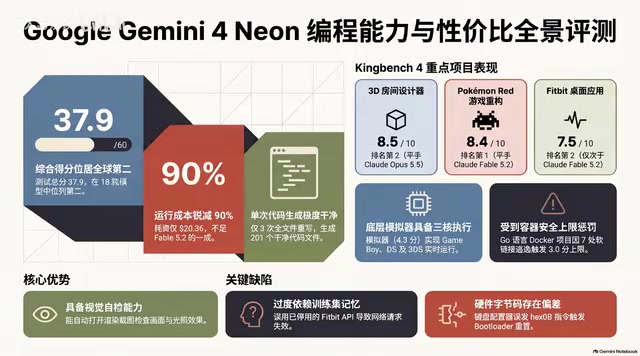
Gemini 4 Neon Hands-On: Value King or Confident Catastrophe?
Gemini 4 Neon review: 1M-token context, four thinking levels, 201 files in one KingBench4 pass at one-tenth Fable 5.2's cost—but it hallucinates fake data, leaves 7 symlink escapes, and bricks keyboards.

Google Gemini 4 Neon Hands-On: 6 3D Works That Impress and Fail
Hands-on with Google Gemini 4 Neon on a 3060 laptop: 6 3D works tested. Sunshower Fishing Harbor and mechanical keyboard impress; soft-body physics and faces fall short.

Gemini 4 Neo Web Novel Writing Test: Faint AI Flavor, Textured Dialogue
Bilibili creator's first-look review of Gemini 4 Neo for Chinese web novel writing: testing a Three Kingdoms transmigration opening with faint AI flavor, emotionally textured dialogue, and strong crisis building, plus comparison of 4A/4H/4C models and full workflow demos.