OpenAI Calls for Global AI Standards: Collaborative Evaluation and Governance Take Center Stage

OpenAI calls for shared global AI standards built on three pillars: evaluation, reporting, and governance.
OpenAI has released a standardization roadmap calling for global AI standards through coordinated evaluation, reporting, and governance mechanisms. As generative AI capabilities surge ahead of regulatory frameworks, the initiative argues that unified testing methods, transparent disclosure formats, and cross-institutional coordination are essential for making models from different vendors meaningfully comparable — and for helping regulators and the public build informed trust. The article also notes that having industry leaders drive standard-setting is a double-edged sword: it can accelerate consensus but may also entrench barriers favoring incumbents, making broad participation from open research communities and regulators essential.
OpenAI Proposes a Global AI Standards Roadmap
OpenAI recently published a vision for building the next generation of AI standards, with the core argument being the establishment of shared global AI standards — a coordinated framework of evaluation, reporting, and governance mechanisms designed to improve the safety of artificial intelligence systems. This position emerges against a backdrop of rapidly advancing generative AI capabilities and comparatively lagging regulatory frameworks, reflecting a growing urgency among leading industry players around the need for standardization.
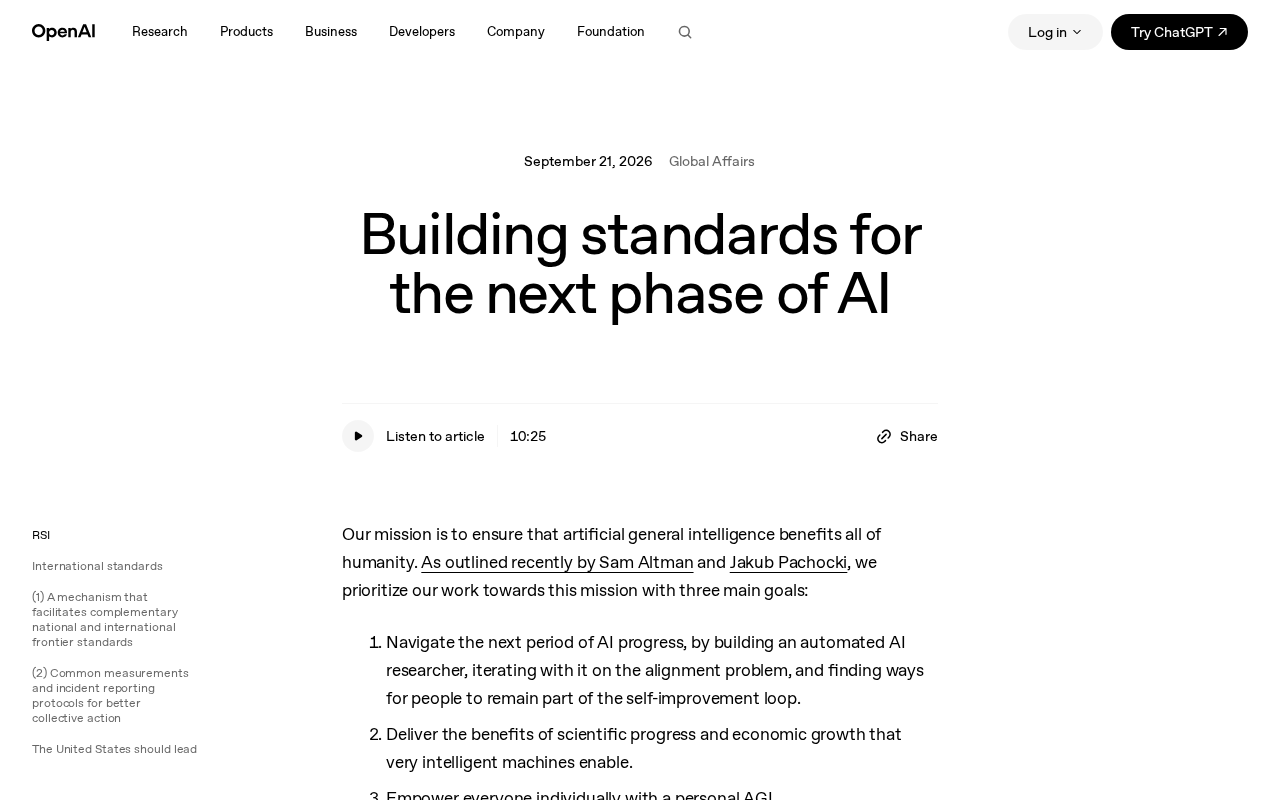
As large models are deployed in high-stakes domains such as healthcare, finance, and education, the absence of unified safety evaluation benchmarks means different vendors operate by their own rules — leaving users and regulators unable to make meaningful cross-vendor comparisons of model reliability and risk. At its core, OpenAI's initiative is a push to establish a reproducible, comparable shared language for the industry.
Why Standardization Matters More Than Ever Right Now
A defining characteristic of AI's new developmental phase is the widening gap between the uncertainty of model capabilities and the speed at which they are deployed. As capability boundaries continue to expand, internal testing by individual companies is no longer sufficient to build external trust.
The value of standardization operates on three levels. At the evaluation level, unified testing methodologies are needed to measure model performance across safety, robustness, and alignment — preventing self-serving, marketing-style safety claims. At the reporting level, transparent disclosure allows regulators, researchers, and the public to access consistently formatted data and make informed judgments. At the governance level, coordinated rules help manage AI risks across national borders and institutional boundaries, reducing opportunities for regulatory arbitrage.
For an industry where technology iterates on a monthly basis, standards that lag too far behind lose their constraining power, while standards that are too rigid risk stifling innovation. Striking that balance is the real challenge in bringing initiatives like this one to life.
The Three Pillars: Collaborative Evaluation, Reporting, and Governance
OpenAI breaks its approach down into three mutually reinforcing pillars — evaluation, reporting, and governance — and the framework itself is worth examining closely.
Evaluation: Establishing Comparable Safety Benchmarks
Evaluation forms the technical foundation of any standards system. Only when the industry reaches consensus on how to measure AI safety can subsequent reporting and governance rest on objective ground. This requires developing reproducible test sets, clearly defined risk metrics, and third-party verification mechanisms — rather than relying entirely on developer self-assessment.
Several evaluation frameworks have already been explored in practice and can serve as references. For example, ML Commons' MLPerf benchmark focuses on performance measurement; NIST's AI Risk Management Framework (AI RMF) provides a structured approach to risk identification and response; and in academia, benchmarks like HELM (Holistic Evaluation of Language Models) attempt to compare large model performance across multiple dimensions. However, these efforts remain fragmented, and there is no universally recognized authoritative standard accepted by both regulators and the broader industry. "Third-party verification" is a critical gap: most model safety claims still come from developer self-evaluation, and the practical questions of credentialing independent auditors, managing the tension between test data confidentiality and public disclosure, and establishing the legal standing of evaluation results all need to be resolved before standards can take hold.
Reporting: Advancing Transparent Disclosure
The reporting pillar emphasizes standardized information flow. Just as financial reporting follows generally accepted accounting principles, the capabilities and risk information of AI systems require a unified disclosure format — one that makes data from different sources comparable and lowers the barriers to external oversight.
The AI field has already seen some pioneering efforts in disclosure. "Model Cards" and "Data Cards" are among the more representative examples: the former, introduced by Google, documents a model's intended uses, limitations, performance metrics, and ethical considerations; the latter describes training data sources, composition, and potential biases. The EU's AI Act also requires technical documentation and transparency reports for high-risk AI systems. These efforts point in the right direction, but their formats vary and their level of detail is inconsistent, making cross-institutional comparisons still quite difficult. Establishing universal disclosure standards analogous to GAAP or IFRS in financial reporting requires reaching consensus on two fronts: what to disclose (metric selection) and how to disclose it (format and verification).
Governance: Cross-Institutional Coordination Mechanisms
Governance is the institutional infrastructure that translates evaluation and reporting into reality. For global AI standards to be genuinely effective, coordination among companies, governments, and international organizations is essential. This is also the most challenging part of the entire initiative — technical standards are relatively easier to agree on among experts, but cross-border governance involves questions of sovereignty, competition, and the distribution of interests.
The challenges of cross-national AI governance are largely visible from the track record of existing international standards bodies. ISO and IEC are already advancing AI-related standards (such as ISO/IEC 42001), and organizations like the ITU are pushing AI governance agendas under the UN framework. But compared to international norms in areas like nuclear safety or aviation, AI standardization faces unique challenges: the pace of technological iteration far outstrips traditional standard-setting cycles (which typically take years), and nations are in significant strategic competition over AI. The divergent regulatory philosophies of the three major powers — the US favoring industry self-regulation, the EU emphasizing rights protection and ex-ante oversight, and China prioritizing state direction — make a truly binding, globally unified framework difficult to achieve in the near term.
The Dual Implications of Industry Leaders Driving Standards
Having a leading vendor like OpenAI spearhead standards development is a double-edged sword. On the positive side, frontier companies possess the most advanced technical practices, and their proposed evaluation methods tend to be more reflective of real-world model behavior; their push can also accelerate industry consensus.
At the same time, it's important to remain vigilant: the power to set standards is itself a form of power. If rules are dominated too heavily by a handful of companies, they may create barriers that favor incumbent players, or allow the definition of "safety" to be shaped by commercial considerations. Truly robust AI standards require broad participation from the open research community, independent research institutions, and regulators — creating a system of mutual checks and balances.
Conclusion: Standards as the Infrastructure of Trust
As AI enters its next phase, the competitive focus is gradually shifting from "how capable" to "how trustworthy." OpenAI's initiative reminds the industry that reproducible evaluation, transparent reporting, and coordinated governance together constitute the trust infrastructure that AI deployment at scale demands. Whether this initiative can move from vision to an actionable global standard depends on its ability to bring in a sufficiently broad range of stakeholders and find a dynamic equilibrium between innovation and constraint.
(Note: This article is based on the content of OpenAI's publicly released standards initiative. Specific implementation details are subject to official follow-up documents.)
Related articles

Workbuddy for Absolute Beginners: How a Desktop AI Agent Fits Into Real Workflows
A beginner's guide to the Workbuddy desktop AI agent: installation, claiming credits, file management, and building automated workflows—compared with CodeX for fit and cost, helping professionals shift from AI question-askers to AI managers.

OpenAI's New Agent Stack: Computer Use, Decisions API, and Ultra-Fast Workflows
OpenAI Dev Day unveiled a new agent stack: Computer Use outperforms humans, Decisions API delivers ultra-low-latency classification via Luna, Agents API opens the same Computer Use capabilities, and GPT-6.1 Sol costs only one-seventh of Astra. Core updates, benchmark data, and developer insights.

Liang Wenfeng Open-Sources DeepInfo Inference Framework, Takes On U.S. Ban
DeepSeek open-sources its DeepInfo inference framework after its models, featuring GPU/CPU cross-pipelining, small-model prediction with large-model verification, and full Huawei Ascend and NVIDIA chip support—facing the U.S. federal ban head-on. This article analyzes its significance for AI deployment and open-source strategy.