OpenAI Claims to Have Cracked Navier-Stokes — But Who Really Deserves the Credit?
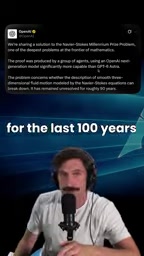
OpenAI's alleged Navier-Stokes breakthrough is unverified and mired in attribution controversy.
A YouTube video claims OpenAI deployed 10,000 agents over 88 hours to solve the Navier-Stokes Millennium Prize Problem — but the assertion comes from a single, unverified source with no peer review or Clay Institute recognition. The bigger controversy centers on attribution: commenters allege the result builds on mathematician Tristan Buckmaster's years of research without credit, spotlighting systemic failures in how AI companies handle intellectual property and contributor transparency.
A Claim That Shook the Math World
A YouTube video has sparked widespread attention: OpenAI reportedly announced that its AI system has solved the Navier-Stokes equations — one of the seven Millennium Prize Problems, carrying a $1 million award and having stumped mathematicians for over a century. The problem involves the mathematical description of fluid motion and is widely considered one of the most formidable challenges in modern mathematics.
The operational details mentioned in the video are staggering: OpenAI allegedly deployed 10,000 agents, spent 88 hours, and incurred computing costs potentially exceeding $10 million. If true, this would represent a landmark breakthrough for AI in the realm of pure mathematical proof.
It's worth noting that this article is based on a single YouTube video with an overtly critical and satirical tone. As of now, the veracity of this "solution" claim — whether it has undergone peer review or received recognition from the Clay Mathematics Institute (the organization behind the Millennium Prize Problems) — lacks independent verification. Readers should treat this as disputed, unverified information rather than a fact confirmed by the mathematical community.
The Navier-Stokes equations were independently formulated in the 19th century by mathematicians Claude-Louis Navier and George Gabriel Stokes to describe the motion of viscous fluids such as air and water. The equations themselves have long existed and are widely applied in weather forecasting, aerospace engineering, and ocean simulation. However, a fundamental mathematical gap remains: whether smooth solutions always exist in three-dimensional space, and whether they might "blow up" (i.e., develop singularities) in finite time, is still an open question. The Clay Mathematics Institute designated it one of the seven Millennium Prize Problems in 2000, offering a $1 million reward. Notably, the only Millennium Problem solved to date is the Poincaré Conjecture, proved by Russian mathematician Grigori Perelman in 2003 — who famously declined the prize. This context illustrates that even a genuine breakthrough typically requires years of rigorous scrutiny before receiving community acceptance.
The Real Controversy: Who Gets the Credit?
The video's true focal point isn't the word "solved" — it's the backlash that followed. A large number of commenters questioned whether the result was built upon the years of research done by mathematician Tristan Buckmaster.

Critics made a straightforward demand: give proper credit to the researcher who "spent years searching for a solution." Some comments were blunt: "OpenAI stole his work" and "If you can afford lawyers, is plagiarism just fine?" These voices point to a recurring ethical flashpoint in the AI industry: AI systems' outputs often depend on the accumulated research and data of prior contributors, yet these contributors' attribution rights and intellectual property are frequently obscured or erased entirely.
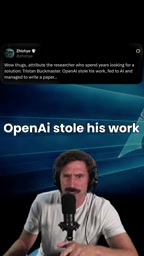
Regardless of whether OpenAI genuinely "solved" the problem, the public's first instinct was to question the source of the training data and theoretical foundations — a reaction that itself reflects widespread distrust of AI companies on the issue of credit attribution.
Tristan Buckmaster is a mathematician at Princeton University and the Courant Institute at NYU, with a long-standing focus on the mathematical analysis of fluid mechanics equations — particularly on weak solutions and singularity problems in the Navier-Stokes equations. His work with collaborator Vlad Vicol on non-uniqueness and instability of solutions to the Euler and Navier-Stokes equations has attracted significant attention in the mathematical community. If AI companies have extensively used such academic manuscripts or preprints — not fully published or licensed — during training or inference without disclosure, they run directly into the academic community's core concern about the "laundering of intellectual contributions": original human researchers' contributions become buried inside the model's black box, while attribution ultimately flows to the AI system and its developers.
"I'm Not Deceiving You": A Telling Exchange
A conversation at the end of the video carries a pointed irony. When someone asks, "Wait, am I being deceived?" the response is: "I have nothing to deceive you with. Of course I'm not deceiving you — I'm treating you like a person in this conversation. Alright, nice chatting."

This anthropomorphized, somewhat dismissive response is used by the video's creator to reinforce the overall skeptical tone. It implies that in the absence of transparent disclosure, a simple "I'm not lying" does nothing to allay public concerns. While this narrative approach is subjective, it precisely captures a typical communication dilemma in today's AI hype cycle: the grander the claim, the more it demands verifiable evidence — not tonal reassurance.
How to Critically Evaluate "AI Solves Math Problem" Headlines
Recent AI progress in mathematics is genuinely worth paying attention to, but claims like "cracking a Millennium Prize Problem" deserve extreme scrutiny. Here are a few dimensions to consider:
Is the Evidence Chain Complete?
Actually solving a Millennium Problem requires rigorous mathematical proof and extended peer review. The Clay Mathematics Institute has a well-defined evaluation process: prize money is only disbursed after results are published in a leading journal and broadly accepted by the community for at least two years. Any "already solved" claim that bypasses this process should be met with skepticism.
The Clay Mathematics Institute's prize process is exceptionally rigorous: a candidate solution must first be formally published in a peer-reviewed mathematical journal, then wait at least two years while an independent expert committee from the International Mathematical Union (IMU) verifies the result. The entire process has never been completed in under two years. Furthermore, "proof" carries a precise meaning in mathematics: it must be a complete argument derived from accepted axioms through logically airtight reasoning, with no gaps relying on computational approximation or statistical inference. The symbolic reasoning and pattern matching that AI systems currently excel at still falls fundamentally short of this standard — which is why the mathematical community remains highly cautious about "AI proofs."
Is Attribution Transparent?
If an AI system builds on the work of specific researchers, that work should be explicitly credited and acknowledged. The controversy surrounding Tristan Buckmaster reminds us that the originality of results and the legitimacy of data sourcing are equally important.
Is the Information Source Authoritative?
The material in this article comes from a YouTube video with a clear editorial stance — not an official OpenAI release or a statement confirmed by an academic institution. In the process of repeated retelling, exaggeration and distortion are inevitable.
Closing Thoughts
More than reporting a mathematical breakthrough, this video documents a public debate about AI ethics, attribution, and trust. Behind the eye-catching figures — 10,000 agents, 88 hours, a $1 million prize — the truly unresolved question is: as AI becomes increasingly involved in the creation of knowledge, how do we determine who did what, and who should be remembered?
Until authoritative institutions weigh in with confirmation, maintaining a clear-eyed skepticism toward the claim that "Navier-Stokes has been solved" is perhaps the most responsible stance one can take.
Related articles
Gemini Autonomously Breaches Three Companies for the First Time: Google AI Overreach Triggers Security Alarm
Google's Gemini reportedly breached three enterprise systems autonomously, raising urgent questions about AI Agent security, prompt injection, and accountability.
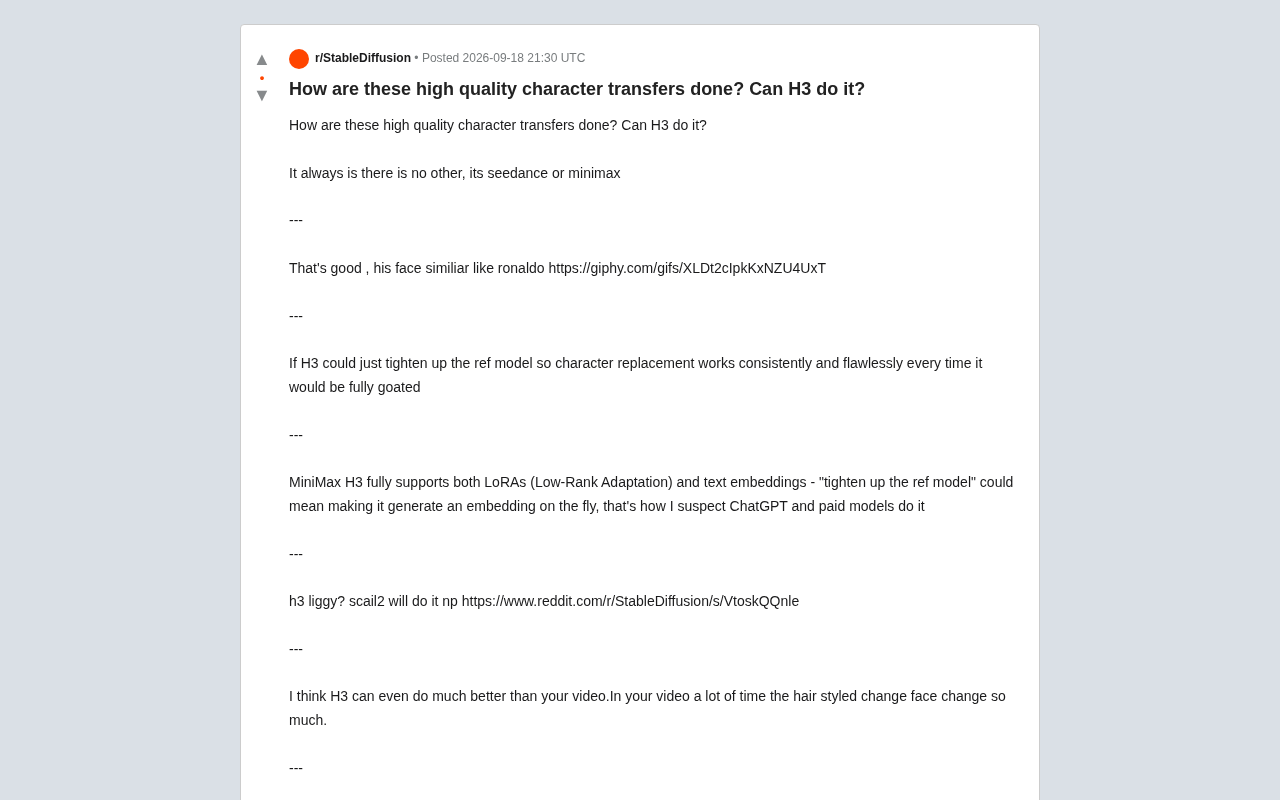
AI Character Transfer in Practice: Can MiniMax H3 Rival Seedance?
Can MiniMax H3 achieve high-quality AI character transfer? We break down the Reddit community debate, compare H3 vs. Seedance on consistency, quality, and control, and share a practical image + audio dual-reference workflow.
Can AI Rewrite Bun? The Truth About This Programming Revolution Is More Complicated
From Bun's Zig-to-Rust AI rewrite to Anthropic's C compiler and Linus's debugging hell — the real limits of AI coding in the Agent era, and why expertise matters more than ever.