OpenAI Codex App In-Depth Review: How This AI Programming Assistant Is Reshaping the Development Workflow

OpenAI Codex App shifts programming from writing code line-by-line to natural language orchestrated development.
OpenAI's Codex App is a complete intelligent development environment with natural language as its core interaction method, supporting natural language app building, multi-task parallel workspaces, voice interaction fine-tuning, scheduled automated tasks, and intelligent Code Review. It transforms the developer's role from code implementer to decision-making orchestrator, covering the full development lifecycle from project initialization to code review, marking a fundamental shift in the programming paradigm from "writing code" to "orchestrating code."
OpenAI Codex App: Programming Is Becoming the Art of Orchestration
OpenAI's latest release, the Codex App, has sparked widespread attention in the developer community. This isn't just another code auto-completion plugin—it's a complete intelligent development environment that integrates project building, multi-task parallelism, automated review, and voice interaction. Based on actual demonstrations, it's pushing programming from "typing code line by line" toward a new paradigm of "orchestrated development."
Technical Background: The History of Codex OpenAI Codex was originally released as a standalone API in 2021, built on a model that fine-tuned GPT-3 specifically on code datasets. It also served as the initial technical foundation for GitHub Copilot. After several generations of iteration, the model powering the current Codex App deeply integrates GPT-4o's multimodal understanding capabilities with Chain-of-Thought reasoning mechanisms optimized specifically for code generation. Compared to earlier versions, the new-generation Codex can not only generate individual functions or code snippets but also understand an entire project's dependency relationships, module boundaries, and architectural intent—a critical technical leap from "code completion" to "project-level development." Behind this capability lies pre-training on hundreds of billions of lines of open-source code, along with continuous alignment of code quality preferences through RLHF (Reinforcement Learning from Human Feedback).
Natural Language App Building: Conversation Is Development
In traditional development, scaffolding a new project often requires initializing project structure, configuring dependencies, writing base components, and a series of other tedious steps. In the Codex App, all of this is simplified to a single natural language instruction.
In the demo, a developer simply types "build a Photo Booth app," and Codex immediately generates the complete project structure, including directories, components, and basic logic. Even more impressive is the incremental development capability—when you add "include image upload functionality," it automatically locates the component that needs modification and adds the corresponding business logic, rather than regenerating the entire project.
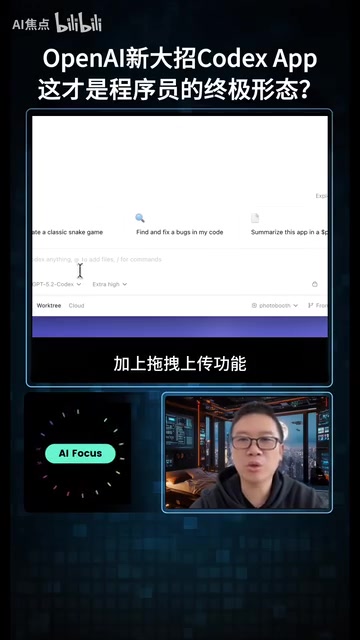
What Is Incremental Code Generation? Incremental Code Generation is a core metric that distinguishes "toy-level" from "engineering-level" AI programming tools. Early code generation models suffered from severe "context amnesia"—each conversation started fresh with no awareness of the existing codebase structure. Codex App solves this problem by maintaining a persistent Project Context Graph: it indexes existing files' dependency relationships, interface definitions, and naming conventions, precisely locating nodes that need modification when receiving new instructions rather than starting from scratch. This is similar to the "find references" feature in traditional IDEs, but Codex understands code intent at a semantic level rather than a syntactic level, enabling vague instructions like "add image upload functionality" to be accurately mapped to specific code changes.
The core value of this interaction model is: the developer's role shifts from "implementer" to "decision-maker". You only need to describe "what to do," and Codex handles "how to do it." It's like having a senior engineer on standby at all times—you just verbally communicate requirements, and the code falls into place automatically.
Multi-Task Parallelism: A Multi-Threaded Workflow for Developers
For developers who routinely handle multiple projects simultaneously, the Codex App's multi-task parallel capability is a major breakthrough.
The demo showcases a typical scenario: the left window has Codex writing a Snake game from scratch, while the right window simultaneously has it checking bugs in another project. The two tasks don't interfere with each other—each progresses independently.
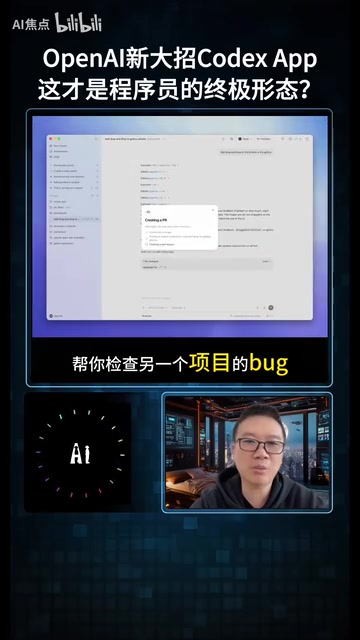
The key is its support for the Workspace concept, which means you can work on multiple code branches simultaneously.
The Technical Significance of Workspace Isolation The Workspace concept isn't new in software engineering—Git's branching mechanism and VS Code's Multi-root Workspace are both manifestations of it. But Codex App's innovation lies in binding AI context isolation to code workspaces: each Workspace has independent conversation history, code indexing, and task queues, and the AI model won't produce context contamination when processing requests from different workspaces. From a technical implementation perspective, this is similar to process isolation in operating systems—each workspace is an independent "AI process" with its own memory space (context window) and execution state. This design makes parallel processing possible and solves the long-standing "multi-project confusion" problem plaguing AI programming tools, where the model incorrectly applies Project A's code style or variable names to Project B.
In real-world development, this solves a long-standing pain point: when you're developing a new feature and suddenly need to fix an urgent bug, you no longer need to frequently switch branches or save context—Codex can handle these tasks in parallel across different workspaces.
This capability is especially valuable for tech leads or full-stack developers—you can simultaneously push forward front-end interfaces, back-end APIs, and test case writing, truly achieving "one person, multiple threads" development efficiency.
Voice Interaction and Scheduled Tasks: New Forms of Human-AI Collaboration
In AI-assisted programming tools, how to efficiently perform "fine-tuning" has always been a challenge. Codex App's answer is: voice interaction.
When the code or interface generated by Codex doesn't fully meet expectations, you don't need to manually modify it or even type—just say "make the font bigger" with your voice, and it immediately understands and executes the modification.
Bridging Technology Between Voice Commands and Code Modifications Transforming voice commands into precise code changes requires crossing three technical layers: first is ASR (Automatic Speech Recognition), converting speech to text; second is intent understanding, parsing vague expressions like "make the font bigger" into specific operational intent (modifying the CSS font-size property); and finally code localization and modification, finding the correct modification location in the existing codebase and generating changes. OpenAI's Whisper model handles the first step, while GPT-4o's multimodal capabilities (simultaneously understanding screenshots and voice content) dramatically improve accuracy for the latter two steps—the model can "see" the current interface state, making more precise judgments combined with voice commands rather than blindly modifying code based solely on text descriptions. This visual-language-code tri-modal collaboration represents the technical frontier of current AI programming tools.
This detail may seem simple, but its implications are profound. It frees developers from the constraints of keyboards and mice, making programming interaction more natural. Imagine discussing architecture design at a whiteboard while simultaneously directing Codex to adjust code implementation with your voice—this seamless experience is something traditional IDEs cannot provide.
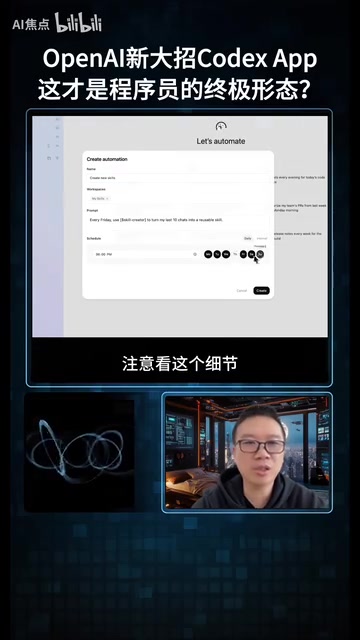
Additionally, Codex supports setting up scheduled automated tasks. For example, you can configure it to automatically review the previous day's code changes every morning, or automatically reply to comments and suggest modifications in GitHub PRs (Pull Requests). This means even when you're away from your desk, Codex continues working—a true "24/7 AI technical co-founder."
What Is a Pull Request (PR)? A Pull Request is a core workflow mechanism in modern collaborative software development, popularized by GitHub in 2008. When a developer finishes development on a feature branch, they submit a merge request to the main branch via PR, where team members can perform code reviews, leave comments, and request changes on the PR page until code quality meets standards before merging. A PR is essentially a collaborative deliberation space for code changes, recording the complete modification history and discussion process. Codex's ability to automatically participate in the PR workflow means it can serve as an ever-present "AI reviewer," continuously processing code review queues while human team members rest, dramatically shortening PR wait cycles—particularly valuable for distributed teams working across time zones.
Intelligent Code Review: A Quality Gate Before Code Submission
Code review is a critical step in ensuring code quality, but in fast-paced development, it's often compressed or skipped entirely. Codex App deeply integrates intelligent Code Review capabilities into the workflow.
Before code submission, you can have GPT-4 perform a comprehensive review of the code, providing suggestions across multiple dimensions including code standards, potential bugs, and performance optimization. More importantly, these suggestions don't just remain at the "comment" level—you can apply modification suggestions directly to the code with one click.

AI Code Review vs. Traditional Static Analysis Tools Automated code review isn't a new concept. Static analysis tools like ESLint, SonarQube, and Checkstyle have been used in the industry for years, detecting code style issues, potential null pointers, security vulnerabilities, and more through predefined rules. However, the limitation of traditional static analysis tools lies in the rigidity of their rules—they can only find problems matching known patterns and cannot understand the business intent of code. The breakthrough of AI Code Review is the introduction of semantic understanding: GPT-4 can comprehend a function's business purpose, judge whether a piece of logic aligns with requirement descriptions, and discover issues like "code is correct but business logic is wrong"—problems that static analysis tools are completely unable to catch. Furthermore, the closed-loop design of "one-click apply modification suggestions" solves the pain point of traditional tools that "only report problems without offering solutions," upgrading the review tool from a passive "issue list" to an active "fix assistant."
This "review as fix" closed-loop experience dramatically shortens the path from discovering problems to solving them. For team collaboration, it can serve as a pre-filter before human Code Review—AI handles routine issues first, letting human reviewers focus on higher-level judgments like architecture design and business logic.
The Programming Paradigm Is Shifting: From Writing Code to Orchestrating Code
Looking at the full landscape of Codex App's capabilities, OpenAI's ambition extends far beyond "assisted programming." It's building a complete development platform with natural language as the core interaction method, covering the entire lifecycle from project initialization, feature development, and bug fixing to code review.
The Historical Context of Programming Paradigm Shifts The evolution of programming languages is essentially a history of "continuously rising abstraction levels": from machine code to assembly language, from assembly to C, from procedural to object-oriented programming, from imperative to declarative programming (like SQL and HTML)—each leap takes developers further from "machine details" and closer to the "essence of the problem." Natural language programming is the latest extension of this abstraction path—it completely delegates "how to implement" decisions to AI, letting humans focus on "what to implement." This aligns with software engineering's "high cohesion, low coupling
Related articles
 Product Reviews
The Programmer's Desk Setup Guide: Building a Workspace That Feels Like Home
Discover how programmers build productive, comfortable workspaces. From multi-monitor setups to ergonomic design, explore the desk philosophy that drives focus and flow.
 Product Reviews
Qoder vs Cursor Real-World Comparison: Which $20/Month AI IDE Is Better?
Hands-on comparison of Qoder vs Cursor AI IDEs: Agent autonomy, human interaction count, and architecture decisions. Qoder needed only 2 interactions vs Cursor's 8.
 Product Reviews
Cursor Cloud Agent Demo: Eliminating Bottlenecks Across the Entire Software Development Lifecycle
Deep analysis of Cursor's Cloud Agent demo showing how cloud VMs, automated test artifacts, and a full-chain control plane systematically eliminate human bottlenecks across the software development lifecycle.