OpenAI Codex Free Tier Real-World Test: Only 20 Uses Per Week, Bug Fix Battle Comparison

OpenAI Codex free tier offers ~20 weekly uses but demonstrates significantly stronger bug-fixing ability than rival AI coding tools.
OpenAI Codex, built on the codex-1 model with o3 architecture, gives free users approximately 20 calls per week (each consuming ~5% of weekly quota). Through a text-to-video project's black screen bug fix case, Codex leveraged its cloud sandbox async agent mode and deep code reasoning to one-shot fix a problem that stumped multiple other AI tools. This reveals that tiny capability gaps between AI programming tools often determine whether critical problems get solved — choose tools based on actual ability, not free quota size.
Introduction
OpenAI's recently launched programming tool Codex has made quite a splash in the developer community. As the latest product bringing the GPT series of models to the programming domain, Codex not only offers excellent code generation and repair capabilities but also provides free-tier users with a certain usage allowance.
From a technical perspective, the latest version of Codex released in 2025 runs on the codex-1 model, which is built on the o3 architecture and fine-tuned for programming tasks through reinforcement learning. Unlike general-purpose conversational models, Codex was trained extensively on open-source code repositories, technical documentation, and programming Q&A data, giving it a deeper understanding of code structure, function call chains, and program execution logic. More importantly, Codex's core design philosophy positions it as an "asynchronous programming agent" — it doesn't just complete code snippets but can independently read entire code repositories in a cloud sandbox environment, understand project context, write and run tests, and ultimately deliver complete code modification proposals in the form of Pull Requests. This end-to-end workflow fundamentally distinguishes it from traditional code completion tools (like GitHub Copilot's inline suggestions).
This article reveals the true limits of Codex's free tier through real-world testing data, and shares a bug fix case from a text-to-video project — the same problem that stumped multiple AI tools was solved by Codex in one shot. What this reflects is the "a miss is as good as a mile" capability gap between AI programming tools.
How Much Free Quota Does OpenAI Codex Actually Give You?
Real-World Data Estimates
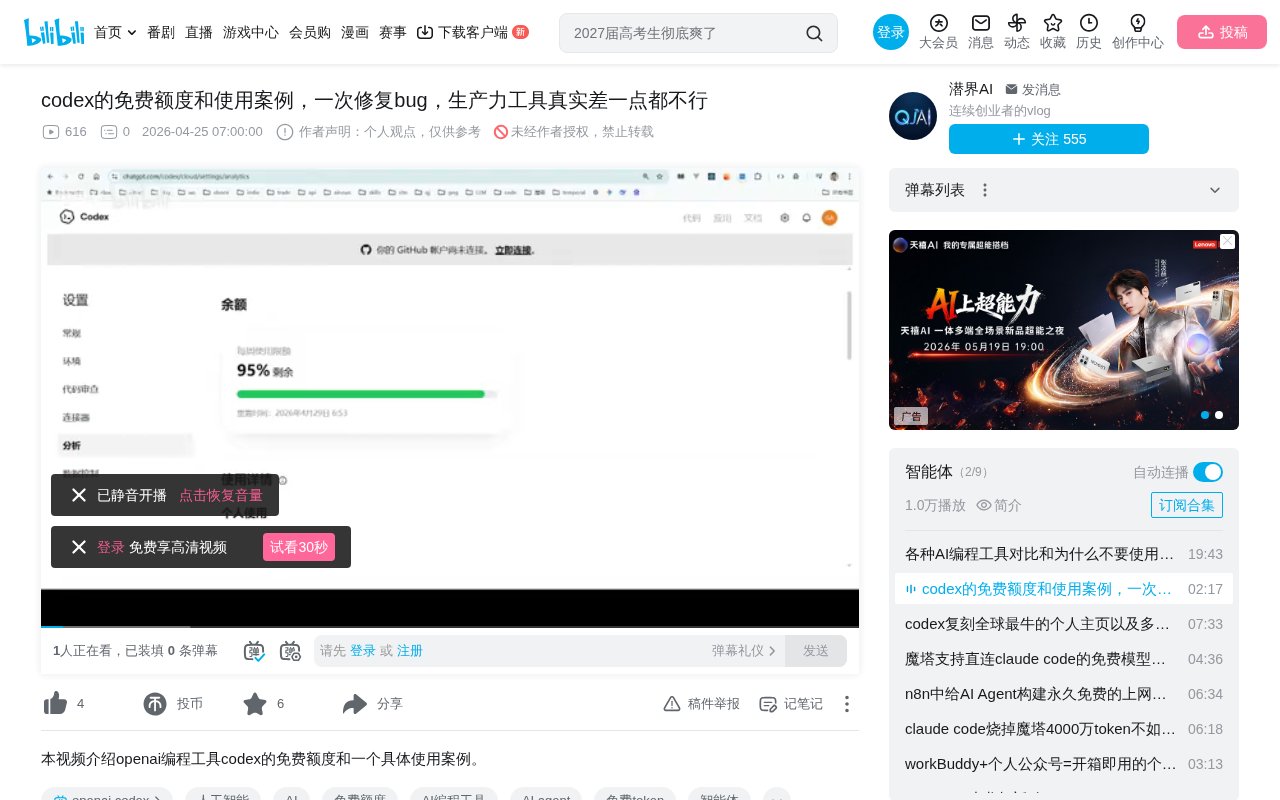
Based on actual testing, the OpenAI backend management panel shows that after sending just one request, the weekly quota displays 95% remaining. Through simple calculation:
- Each request consumes approximately 5% of the weekly quota
- Free accounts can make roughly 20 calls per week
- Quota automatically resets weekly
In other words, free users only get about 20 chances per week to interact with Codex's latest model. For casual users who only need it occasionally, this quota is barely sufficient; but for developers who need to frequently debug code, the 20-call limit can feel quite tight.
The Technical Logic Behind Quota Consumption
Free quotas for AI services are typically implemented through token allocations or request count limits. Tokens are the basic units that large language models use to process text — one English word usually corresponds to 1-2 tokens, while one Chinese character typically corresponds to 1-3 tokens. Codex's quota consumption mechanism is somewhat special: since it executes complete code analysis and modification workflows in a cloud sandbox, each task involves not only input/output token consumption but also computational resource overhead from the model's multi-round reasoning, file reading, test execution, and other intermediate steps within the sandbox. This explains why a single request consumes about 5% of the weekly quota — each call actually triggers a complex multi-step agent workflow rather than a simple question-and-answer exchange. OpenAI's weekly-reset quota strategy both prevents resources from being exhausted in a short period and gives free users ongoing opportunities to experience the product.
Comparison with Other AI Programming Tools' Quotas
Current AI programming tools on the market vary significantly in their free quotas. Codex's 20 calls per week sits at a moderate level. However, as the following case demonstrates, you can't just look at the number of free uses when choosing a tool — model capability and actual problem-solving efficiency are often more important than quota numbers.
Real-World Case: Using Codex to Fix a Text-to-Video Black Screen Bug
Bug Background
This case comes from a text-to-video project. The core functionality is to automatically generate videos based on input text, where the video background images should correlate with the text content. However, during actual execution, a stubborn bug appeared — the generated video backgrounds were always pure black, with no images displayed at all.
To understand why this bug was so tricky, you need to know the typical technical architecture of text-to-video projects. These projects usually involve multiple technical modules working together in a typical pipeline: text parsing and segmentation, keyword extraction, image asset generation or retrieval, audio synthesis (TTS, or text-to-speech), and finally video composition and rendering. The image generation step might call AI image generation models like Stable Diffusion or DALL·E, or it might retrieve relevant images through search engine APIs. Video composition typically uses tools like FFmpeg or MoviePy to overlay image sequences, audio tracks, and subtitles. The black screen bug meant that during the video composition phase, the background layer was either not loaded correctly or the image generation step was skipped entirely. The insidious nature of this type of bug is that the video composition process itself doesn't throw errors (FFmpeg defaults to a black canvas when missing image input), making it very difficult to pinpoint the root cause from error logs alone.
This bug looks straightforward, but in previous attempts, multiple AI programming tools failed to truly fix it. After analyzing the code, these tools all confidently declared "fixed," but when actually running the video generation workflow, there was simply no "generate background image" step — the root cause was completely overlooked.
Codex's Complete One-Shot Fix Process
When the same bug description was submitted to Codex, even more concise prompts were used compared to previous attempts. Yet the results were surprising:
- Precisely identified the root cause — Codex not only understood the surface symptom (black screen) but also found the fundamental reason (missing image generation step)
- Image generation steps appeared in post-fix run logs — a critical change that never appeared after fixes from other tools
- The final generated video successfully displayed background images matching the text content
From pure black backgrounds to meaningful background images, this long-standing bug was resolved by Codex in one shot.
Why Other Tools Failed to Identify the Root Cause
The differences in code understanding across AI programming tools fundamentally stem from differences in model architecture, training data, and reasoning strategies. Surface-level understanding means the model can identify code syntax, variable naming, and function signatures — most modern AI programming tools can do this. Deep understanding involves reasoning about program execution flow — the model needs to mentally simulate code execution, trace data flow between different modules, and identify which critical steps were missed or short-circuited. In this case, other tools likely only focused on the video rendering module's code (since the black screen was a rendering result), while Codex traced back to the upstream image generation step. This difference is closely related to the model's Chain of Thought capability — the long-chain reasoning ability trained through reinforcement learning on the o3 architecture enables Codex to maintain accuracy over longer logical chains, thereby discovering root causes hidden deep within call chains.
The "1% Gap" Rule in AI Programming Tools
Why Tiny Model Capability Differences Matter Enormously
This case reveals a thought-provoking phenomenon: In the AI programming tools space, the capability gap between models might only be 1%, but it's precisely this 1% that determines whether a problem can be solved.
When two models perform comparably in 99% of scenarios, developers can hardly perceive any difference. But when you encounter a problem that happens to fall within that 1% gap, one tool can solve it and the other simply cannot — there's no middle ground, no "close enough."
The Limitations of Prompt Engineering
Prompt Engineering refers to the technique of carefully designing input text to guide AI models toward better outputs. Common strategies include: providing detailed contextual information, using few-shot examples, and asking the model to think step by step (Chain of Thought). However, this case reveals an important limitation of prompt engineering: when a model itself lacks the understanding capability for a specific problem, no amount of clever prompting can compensate for this deficiency. It's like describing a calculus problem in every possible way to someone who doesn't understand calculus — no matter how clear the description, they cannot provide the correct answer. Conversely, when a model possesses sufficient understanding, even concise or imperfect prompts can trigger the correct reasoning path. This reminds developers: prompt optimization is certainly important, but choosing a model with sufficient foundational capability is the prerequisite.
Implications for Developers Choosing AI Tools
From this case, several practical recommendations can be distilled:
- Don't rely on a single tool: When one AI programming tool gets stuck, try another — you might achieve an unexpected breakthrough
- Prompts aren't a silver bullet: In this case, more concise prompts actually produced better results, showing that the model's inherent understanding is the core variable
- "Fixed" doesn't mean actually fixed: Always verify output results and check whether run logs contain the expected processing steps
- Focus on actual effectiveness, not free quota: More free uses doesn't mean better — tools that solve problems at critical moments are worth long-term investment
Conclusion
Although OpenAI Codex has limited free quota (approximately 20 uses per week), it demonstrates clear advantages in actual code repair capability. Through this text-to-video project's black screen bug fix case, we directly observed the seemingly small yet critical capability differences between different AI programming tools.
For developers, rather than chasing more free calls, it's better to focus on a tool's ability to solve tough problems. After all, in real-world development, the one call that solves your problem is worth more than a hundred fruitless attempts.
Related articles
 Product Reviews
The Programmer's Desk Setup Guide: Building a Workspace That Feels Like Home
Discover how programmers build productive, comfortable workspaces. From multi-monitor setups to ergonomic design, explore the desk philosophy that drives focus and flow.
 Product Reviews
Qoder vs Cursor Real-World Comparison: Which $20/Month AI IDE Is Better?
Hands-on comparison of Qoder vs Cursor AI IDEs: Agent autonomy, human interaction count, and architecture decisions. Qoder needed only 2 interactions vs Cursor's 8.
 Product Reviews
Cursor Cloud Agent Demo: Eliminating Bottlenecks Across the Entire Software Development Lifecycle
Deep analysis of Cursor's Cloud Agent demo showing how cloud VMs, automated test artifacts, and a full-chain control plane systematically eliminate human bottlenecks across the software development lifecycle.