OpenAI Codex Outage Today Has Been Resolved, Service Back to Normal

OpenAI Codex suffered an outage today that was quickly confirmed and resolved, highlighting cloud AI availability risks.
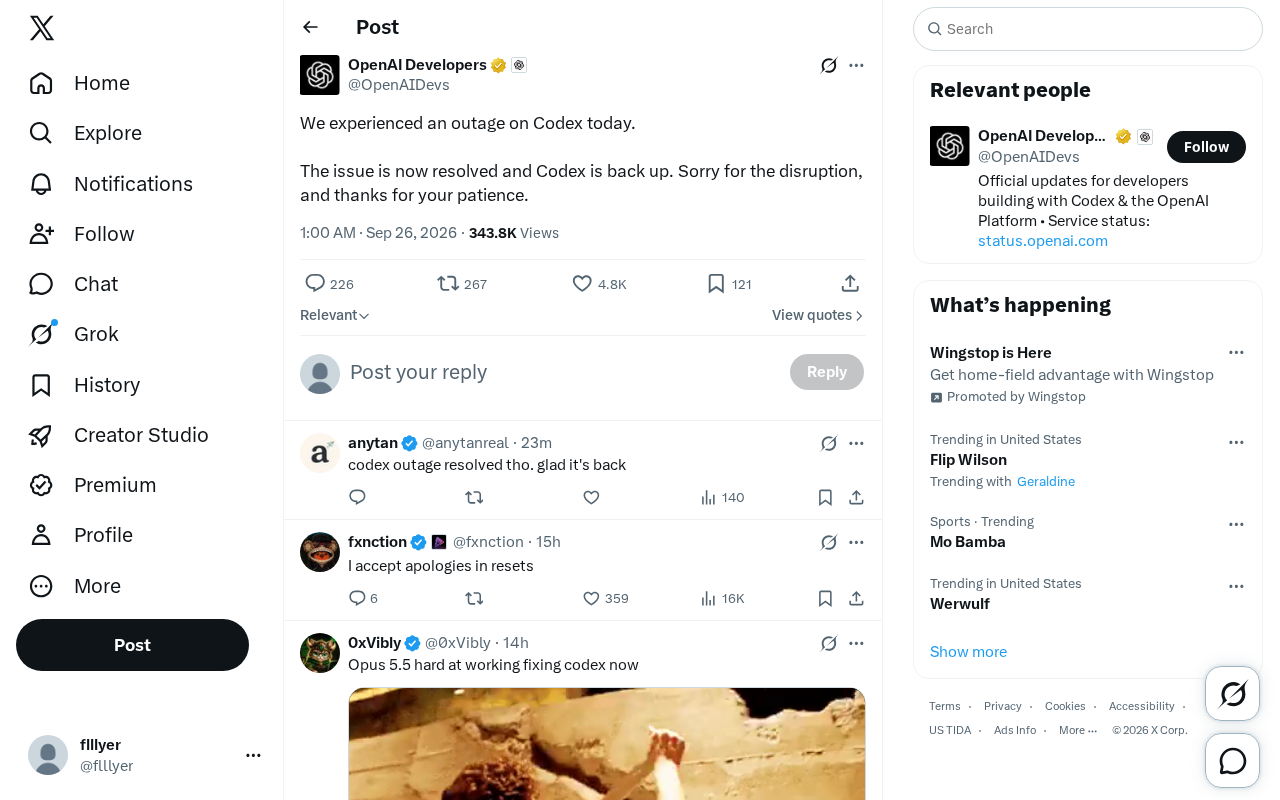
OpenAI officially confirmed that its code generation tool Codex experienced a service outage, stating that the issue was resolved the same day and service has returned to normal. Since Codex underpins many programming assistance tools, the downtime directly impacted developers and teams that rely heavily on AI code completion. The incident is a reminder that cloud-based AI services carry inherent availability risks, and developers should maintain local development capabilities with fallback plans ready. OpenAI issued a public apology and announced the fix on the same day, demonstrating basic service transparency — though the brief communication lacked details on outage duration, impact scope, and root cause, limiting its usefulness for enterprise-level risk assessment.
Incident Overview
OpenAI officially confirmed via social media that its code generation tool, Codex, experienced a service outage today. According to the official statement, the issue has been resolved and Codex is back to normal operation. OpenAI apologized to users for the disruption and thanked them for their patience during the downtime.
Based on the information released, this was a typical service availability incident — from the outage occurring, to diagnosis, resolution, and public communication, forming a complete response loop. While the announcement was brief and did not include specific technical details, for users who rely on Codex in their daily development workflows, the restoration of service is the most critical piece of information.
What This Means for Developers
As OpenAI's core capability for code-related tasks, Codex is widely integrated into various programming assistance tools and development workflows. An outage directly impacts teams and individual developers who have embedded AI code completion and code generation into their actual engineering processes.
For users who treat AI coding assistants as productivity tools, unexpected outages like this serve as a reminder: AI services are fundamentally cloud-dependent products, and their availability is directly constrained by backend infrastructure. At critical project milestones, over-reliance on a single AI service can introduce delivery risks. The prudent approach is to maintain local development capabilities and prepare fallback plans, so that a temporary unavailability of one external service doesn't bring the entire workflow to a halt.
Codex was originally released by OpenAI in 2021 as a specialized model fine-tuned from the GPT series for code tasks, capable of understanding and generating code in dozens of programming languages. It serves as the underlying technology behind GitHub Copilot and is also available to third-party developers via the OpenAI API, with wide adoption in IDE plugins, CI/CD pipelines, and automated script generation tools. Because of its upstream position in many development toolchains, a single-point failure tends to have a "cascading" effect on multiple downstream products — making the actual number of affected users far greater than just those directly calling the Codex API.
Outage Response and Service Transparency
It is worth acknowledging that OpenAI chose to publicly address the issue on the same day it occurred, clearly stating that the problem had been resolved and offering an apology. This kind of timely and candid communication is the standard expected of a mature cloud service provider.
Compared to common industry practices, rapid status updates can effectively reduce user uncertainty and anxiety. When users encounter tool failures, what they typically need most is not a complex technical explanation, but a clear answer: Is this a known issue? When will it be fixed? OpenAI's response this time met that basic expectation.
However, the brief announcement does leave information gaps. The official communication did not disclose the duration of the outage, the scope of impact, or the root cause. For enterprise users, a more detailed postmortem report would be far more helpful in assessing service stability and risk.
The industry has established fairly mature standards for cloud service outage communications. Many major cloud providers (such as AWS, Google Cloud, and Azure) maintain public Status Pages that display real-time health status for each service, and publish formal Postmortem reports after incidents conclude — typically covering the incident timeline, affected service scope, Root Cause Analysis (RCA), and follow-up remediation measures. These reports not only serve the informational needs of current users but also act as important reference material for enterprise clients conducting vendor risk assessments. In SRE (Site Reliability Engineering) practice, publishing blameless public Postmortems is considered one of the core methods for improving system reliability.
Conclusion
This Codex outage was limited in scope, handled swiftly, and service has been fully restored. While the incident itself was relatively minor, it reflects a reality that AI tools must confront as they move into production environments — stability and availability are increasingly becoming key indicators of AI product maturity.
As more and more developers deeply integrate AI coding capabilities into their daily work, the performance of service providers in terms of infrastructure reliability and incident transparency will directly shape user trust and decision-making.
Related articles

Chain of Thought Isn't Just for AI: How Humans Can Use CoT to Improve Thinking Quality
Chain of Thought isn't just a prompt trick for large models. Starting from a Hacker News discussion, this article analyzes why CoT works for human thinking too, breaks down actionable ways to transfer it, and highlights the key differences between human CoT and machine CoT.
Cloudflare Teams Up with OpenAI: Closi…
Cloudflare Teams Up with OpenAI: Closing the Loop from Vulnerability Discovery to Defense with AI
Cloudflare uses OpenAI Daybreak to investigate security vulnerabilities and generate reviewable remediation plans, while developers use Codex to boost coding efficiency and quality.

Orca Multi-Agent Orchestration in Practice: A Guide to Parallel Collaboration with Claude and Codex
Orca is Stable AI's free open-source agent workbench supporting 34 agents like Claude Code and Codex in parallel. Learn its Git worktree isolation, multi-model orchestration, and mobile management.