OpenAI Codex Parallel Tasks in Practice: How to Run Multiple AI Coding Tasks Simultaneously

Run multiple AI coding tasks simultaneously with OpenAI Codex Cloud's isolated container architecture.
OpenAI Codex Cloud enables developers to launch multiple AI coding tasks in parallel using isolated containers, dramatically reducing wait time. This article covers the full workflow — from letting Codex autonomously suggest and trigger parallel tasks, to reviewing PRs and merging results — while offering a grounded assessment of agentic coding's current state and the importance of keeping humans in the loop.
In the final installment of NetNinja's OpenAI Codex tutorial series, the focus shifts to one of Codex Cloud's most compelling capabilities — running multiple tasks in parallel. This isn't just a feature highlight; it represents a fundamental shift toward a new way of working called "agentic coding." This article walks through the hands-on workflow and takes an honest look at the current state of AI-assisted development.
From Single Tasks to Parallelism: The Core Value of Codex Cloud
From earlier tutorials in the series, we've seen Codex in various modes: Codex Cloud executing remote tasks in isolated containers, Codex CLI for local project development, the Codex extension supporting both local and remote triggers, and even direct Pull Request review on GitHub.
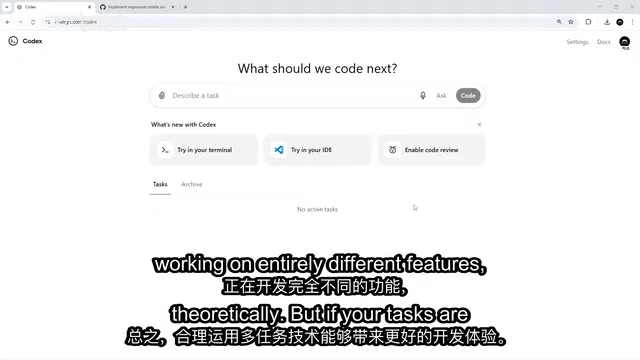
What this final chapter demonstrates is Codex Cloud's most underappreciated capability — launching four, five, or more tasks simultaneously without waiting for the previous one to finish.
The key mechanism is isolation: each task runs in its own independent container, completely separated from the others. These containers (typically based on Docker or similar technology) are essentially lightweight OS-level virtualization — each with its own filesystem, process space, and network environment. They start in seconds, consume minimal resources, and are perfectly suited for high-concurrency, short-lived task scheduling. This means you can hand off multiple unrelated features to the AI simultaneously, dramatically cutting down on wait time and enabling true parallel development.
The One Risk to Watch Out For: Merge Conflicts
Parallel tasks aren't without trade-offs. The author honestly acknowledges the potential downside: merging multiple feature branches sequentially can lead to code conflicts, since different tasks may modify the same sections of code.
This touches on a classic version control challenge — merge conflicts: when two or more branches modify the same region of the same file and Git cannot automatically determine which version to keep, human intervention is required. Modern version control systems use three-way merge algorithms to detect and mark conflict areas, but the final call still rests with the developer.
The solution isn't complicated — simply ensure each task handles completely different functional modules, and the probability of conflicts drops significantly. This is a natural extension of the software engineering principle of Separation of Concerns (SoC) applied to AI collaboration. First articulated by computer scientist Edsger Dijkstra in 1974, the principle calls for decomposing programs into functionally independent modules with single, well-defined responsibilities. When each AI task has its own clear domain, parallel collaboration becomes both safe and efficient.
Hands-On Demo: Letting Codex Plan Its Own Parallel Tasks
The most illuminating moment in the demo is when the author doesn't issue three specific instructions upfront — instead, he poses an open-ended question to Codex:
"Can you look at the codebase and suggest three reusable UI components that could each be run as separate tasks on Codex?"
This is agentic programming in its truest form — the AI doesn't just respond to a single prompt. It autonomously reviews the codebase, analyzes project structure, formulates a plan, and generates actionable proposals. Unlike the traditional "ask-and-answer" model, an agent proactively explores context and breaks down goals, with humans stepping in only at critical review points. This marks a significant shift from AI as a "code completion tool" to AI as an "autonomous executor."
After clicking Ask, Codex analyzed the project and returned three proposals, each with its own dedicated launch button — Codex automatically generated the corresponding execution prompt for each component.
The three suggestions were:
- HeroSection component: the primary visual hero area of the page
- PairCard component: for list-based display
- TagInput component: extracting the "pill-style" tag input logic from a form into a standalone component
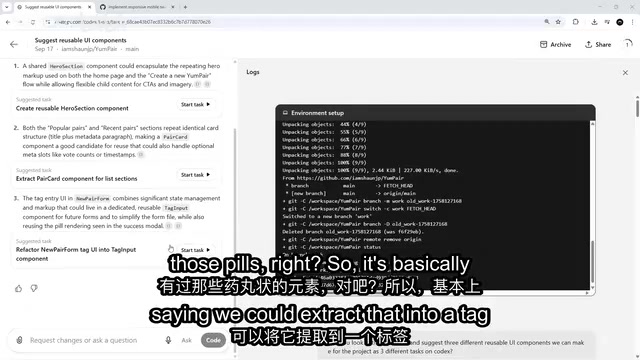
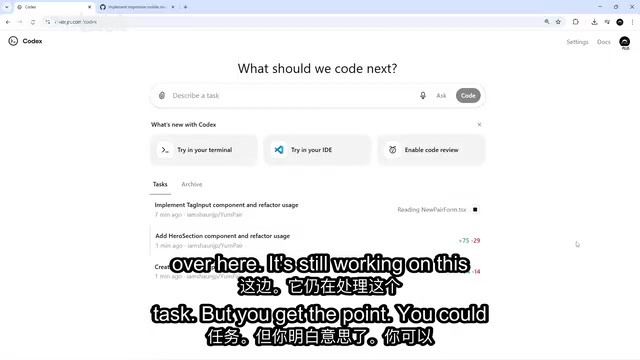
The author clicked each button in sequence, and all three tasks launched instantly. Back on the Dashboard, all three tasks were running simultaneously in their own isolated containers. He noted: "Doing all this manually — even with AI assistance — would be quite tedious. But here, spinning up three parallel tasks at once is effortless."
Review and Merge: Keeping Humans in the Loop
Two of the tasks completed quickly. The author opened the code to review it, confirmed the changes were purely refactoring — extracting logic into independent components with a well-contained scope of change — and proceeded to create a PR.
The entire workflow reflects a key safety principle in AI system design — Human-in-the-Loop (HITL): preserving human decision-making authority at critical points in an automated process. This concept originated in early semi-automated control systems and has become a cornerstone of responsible AI deployment, especially in high-stakes domains like software releases, healthcare, and finance, to guard against systemic risks from AI errors.
The core value of this workflow lies in decoupling time and space:
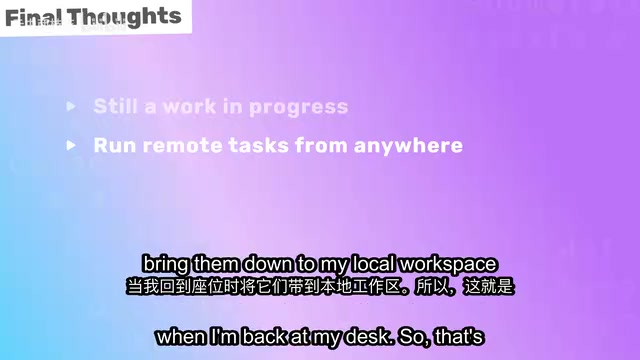
"I can kick off tasks from anywhere — from my phone, from my laptop, whenever inspiration strikes. I don't even need to have the code open to get multiple tasks running in parallel. Then I come back to my desk later and review, test, and merge everything into the repo."
This "launch anytime, process asynchronously, review later" workflow is exactly what sets Codex Cloud apart from local AI tools.
A Clear-Eyed Take on Codex and Agentic Coding
As a series finale, the author offers several grounded assessments that every developer would do well to consider carefully.
Local Tools Are Still a Work in Progress
The author views the local experience with Codex CLI and the extension as still half-baked, expecting significant iteration over the coming months — particularly around the connection experience with cloud services.
The Cloud's Core Advantage Is Flexibility
Codex Cloud's real appeal is "anytime, anywhere, multi-task, multi-variant" — you can kick off tasks without being tied to a local dev environment, let the AI keep working while you're away, and come back to review results all at once.
Always Keep Humans in the Loop
The author repeatedly emphasizes: regardless of which AI tool you use, you must always review its output and ensure humans remain part of the decision-making process. AI makes mistakes. Sometimes it takes three or four rounds of different prompts to get the desired result — not fundamentally different from guiding a junior developer who occasionally goes off track.
Beware of Over-Reliance on AI
Perhaps the most thought-provoking point is the author's response to industry expectations. He mentions that many AI experts have predicted AI will write nearly all code in the near future. In his view, that prediction doesn't hold today and won't come true anytime soon.
More importantly:
"Even if AI does start writing all the code, you'll still need to be able to read what it generates in order to review, debug, and adapt it. You need to understand how your application works."
He therefore encourages developers to continuously maintain their manual coding skills and domain knowledge, and to avoid letting core competencies quietly erode through over-reliance on AI.
Closing Thoughts
Codex's parallel task capability essentially upgrades AI from a "pair programming assistant" to a "delegatable asynchronous team member," enabling developers to take on more of a project-manager role — orchestrating multiple workstreams simultaneously.
But the advancement of technical tooling doesn't change one fundamental truth: understanding code, reviewing code, and controlling architecture remain the irreplaceable core competencies of a developer. AI raises the ceiling on productivity, while human judgment sets the floor on output quality. As you enjoy the efficiency gains that parallel tasks bring, holding onto that clarity of mind may be the most important skill of all in the age of agentic coding.
Key Takeaways
Related articles
Understanding GitHub's Availability Report: Platform Stability and Developer Response Strategies
Deep dive into GitHub's monthly availability report: analyzing service degradation impacts, CI/CD fault tolerance, and platform dependency risk strategies for resilient development.

OpenAI's Claim of Solving a Millennium Prize Problem Sparks Academic Controversy
OpenAI claims its AI solved a Millennium Prize Problem, sparking debates over attribution, verification, and AI's role in reshaping mathematical research.
Ledoit-Wolf Covariance Shrinkage in Practice: 57% Lower Turnover + 10x GPU Acceleration
Learn how Ledoit-Wolf covariance shrinkage reduces portfolio turnover by up to 57% and how cuML GPU acceleration cuts backtest time from 1.5 hours to 9 minutes.