OpenAI Codex Team on How AI Agents Are Reshaping Engineering Organizations
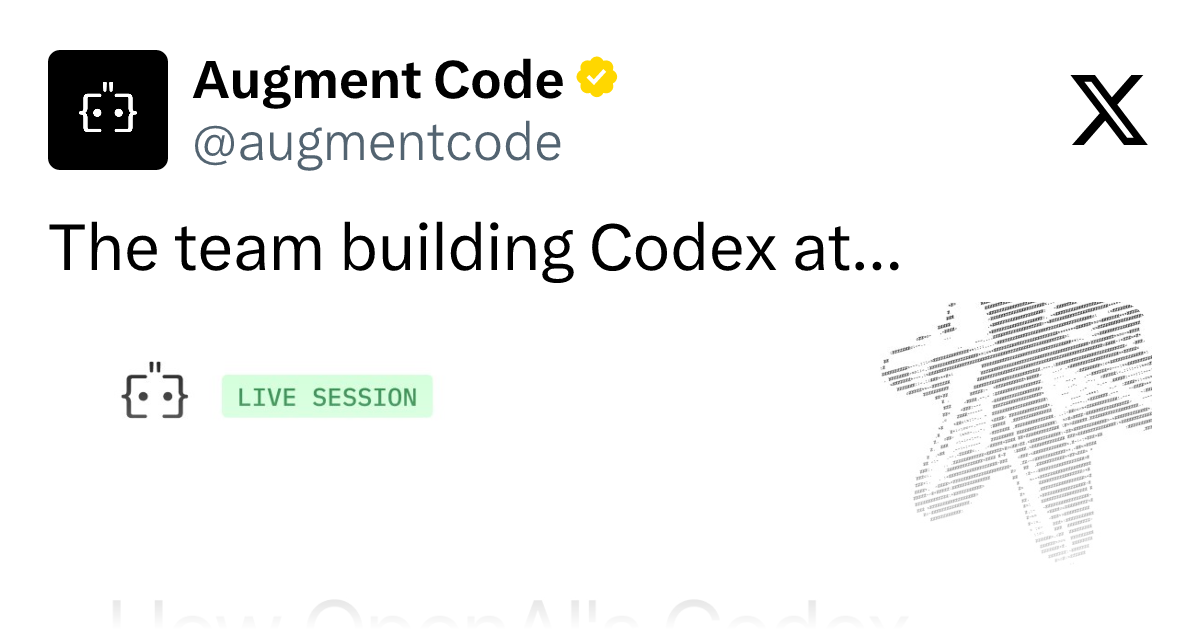
OpenAI's Codex team shares firsthand insights on how coding agents are transforming engineering organizations.
OpenAI has announced an online fireside chat featuring Codex product lead Rohan Varma and Augment Code VP of Engineering Vinay Perneti, focused on how coding agents are changing engineering organizations in practice. The conversation covers three key areas: how the Codex team itself uses agents end-to-end to build software, how team structures and roles evolve after agent adoption, and which change management strategies actually work. Aimed at engineering leaders navigating AI transformation, the event signals an industry shift from debating whether AI can code to figuring out how to organizationally scale its use.
When AI coding assistants evolve from supporting tools into genuine team members, the way engineering organizations operate undergoes profound change. OpenAI's Codex team — having lived through this transformation firsthand — is preparing to share their front-line observations in a public conversation.
A Conversation Focused on Engineering Org Transformation
OpenAI has announced an online fireside chat centered on AI agents and the transformation of engineering organizations. The discussion will feature Codex product lead Rohan Varma alongside Augment Code's VP of Engineering Vinay Perneti, focusing on a rapidly evolving question: how are engineering organizations actually changing as coding agents become part of the team?
According to OpenAI, the team behind Codex has a "front row seat" to witness firsthand how engineering organizations transform after adopting agents. That framing is itself revealing — it suggests the Codex team isn't just building tools, but actively redefining what collaborative software development looks like in practice.
Three Core Topics Worth Watching
The conversation will revolve around three specific questions, each touching on a critical pain point in real-world AI coding adoption.
How the Codex Team Uses Agents End-to-End to Build Software
The first topic covers how the Codex team itself uses agents to manage the complete software development lifecycle — from requirements through delivery. This is a classic dogfooding scenario: how a team building agent-powered tools actually relies on those agents in high-intensity engineering environments often reveals the true capability boundaries and collaborative patterns of such tools.
What's Actually Happening Inside Engineering Orgs That Have Adopted Agents
The second topic examines real organizational change. Tool adoption is only the surface-level story — the deeper transformation happens in team structure, role distribution, and workflow. When agents can handle portions of coding, testing, and even code review, the question of where engineers' responsibilities shift becomes something every technical leader must confront.
Which Change Management Strategies Work — and Which Don't
The third topic cuts straight to the lessons learned in practice. Any new technology introduction comes with change management challenges. The discussion will explore which management strategies have genuinely worked when driving agent adoption across teams, and which have fallen flat. This kind of practice-based retrospective is especially valuable for engineering leaders who are evaluating or actively pursuing an AI transformation.
Why Engineering Managers Should Pay Attention
OpenAI's announcement explicitly calls out the target audience: engineering team leaders trying to make sense of "this moment." That framing reflects a real gap — many engineering managers already recognize that agents will bring structural change, but lack a clear path forward on how to organize for it, manage the transition, and measure outcomes.
Augment Code's decision to send their VP of Engineering adds a customer-side perspective to the conversation. As a company focused on AI-powered coding capabilities, Augment's engineering practices can complement the Codex team's observations, preventing the discussion from becoming a one-sided vendor narrative.
From a broader vantage point, conversations like this signal that the AI coding discourse is shifting from "can it work?" to "how do we organize around it?" As agents gradually become team members rather than pure productivity tools, engineering culture, collaboration workflows, and even talent evaluation frameworks will all need to be reconsidered.
How to Participate
The event is scheduled for Thursday at 10 a.m. Pacific Time as a live online stream. Interested readers can register through the sign-up link published by OpenAI. For technical teams exploring how to put AI agents into practice, this is a direct opportunity to hear from practitioners working on the front lines.
A note on context: this article is based on OpenAI's event announcement, and the actual conversation content has not yet been made public. The real value will depend on the specific details both speakers share live — especially the concrete examples around which change management strategies worked and which didn't.
Related articles

Invalid Source Material Notice
The source material provided lacks substantive information and is unrelated to AI/tech topics, making it impossible to produce a complete professional article.

Invalid Source Material: Unable to Generate a Valid AI/Tech Article
This Twitter source material is an irrelevant marketing tweet with no AI or tech content, making it impossible to generate a valid professional article.
Insufficient Source Material: Unable to Generate a Valid Article
The source material was limited to a single broken tweet with no usable content, making it impossible to produce a complete, high-quality article.