OpenAI Cuts Off Cursor: The Full Story Behind the Feud and China's Push for Open-Source, Affordable AI
OpenAI cuts off Cursor amid Musk rivalry as Chinese AI models race toward open-source affordability.
OpenAI terminated Cursor's access to its models after SpaceX acquired the popular AI code editor, citing model distillation concerns tied to Musk's team. Cursor responded that OpenAI accounts for only 5% of its traffic, having already shifted to Anthropic's Claude. Meanwhile, Chinese AI models — Alibaba's Qwen, Zhipu's GLM, and Tencent's Hunyuan — collectively embraced open-source, affordable strategies, offering near-top-tier capabilities at a fraction of overseas costs, accelerating AI democratization.
The Open Rift Between OpenAI and Musk's Camp
The most headline-grabbing event in AI circles this week was the direct confrontation between OpenAI and Elon Musk's camp. OpenAI announced that starting November 12, it would officially terminate the coding tool Cursor's access to its models — and even its next-generation ASTA model would be completely off-limits.
Cursor is an AI-native code editor deeply rebuilt on top of the VS Code architecture, developed by Anysphere. It deeply integrates large language model capabilities into the programming workflow, supporting code completion, cross-file editing, natural language code generation, and more. Since its launch in 2023, Cursor quickly gained traction in the developer community and has been regarded as a benchmark product for the evolution of traditional IDEs into the AI era. Its business model heavily relies on backend LLM API calls, making the choice of model provider directly tied to product experience and operational costs.
The flashpoint was a shift at the capital level: SpaceX acquired Cursor, bringing it under Musk's AI technology umbrella — and this directly triggered OpenAI's decision to cut off access. OpenAI determined that Musk's team had a track record of "model distillation" — using another party's model outputs to train their own models — which constitutes a violation of the terms of service.
"Model distillation" is a knowledge transfer technique in machine learning, first proposed by Geoffrey Hinton and colleagues in 2015. The core principle involves using the outputs of a pre-trained large "teacher model" (including soft label information such as probability distributions) to guide the training of a smaller "student model." In legitimate scenarios, distillation is an efficient model compression method. However, in commercial competition, if one party makes unauthorized, large-scale API calls to a competitor and uses the returned results as training data for their own model, it essentially amounts to stealing the intellectual property embedded in the other party's model — and this is precisely the crux of OpenAI's accusation against Musk's team. Behind this accusation lies the concentrated eruption of a long-standing competitive rivalry between two major AI camps.
Interestingly, Cursor showed no sign of backing down. Its CEO fired back directly, stating that OpenAI's models account for only about 5% of Cursor's user traffic, that the platform had already shifted its primary workload to Anthropic's Claude series and in-house models, and that the cutoff would have no material impact.
Anthropic was founded in 2021 by former OpenAI Research VP Dario Amodei and his sister Daniela Amodei, making it OpenAI's most direct competitor. The company centers its mission on "AI safety" and has developed the Claude series of large language models. Claude particularly excels in code generation, long-context understanding, and instruction following, which has earned it strong recognition from developers in the programming tools space. Cursor's CEO's statement reveals an industry reality: in the vertical of AI-powered programming tools, Claude has already established a fairly solid lead. To date, Anthropic has received over $10 billion in investments from giants like Google and Amazon, continuously deepening its technological and commercial moat.
Competitors Seize the Moment Amid a War of Words
Anthropic promptly announced it would further increase compute support for Claude within Cursor — a clear move to capitalize on the situation. Musk himself also weighed in publicly, accusing OpenAI CEO Sam Altman of being "untrustworthy" and counter-claiming that Altman was the one who actually stole OpenAI's assets and technology.
This war of words fundamentally reflects the white-hot competition among top AI companies as they enter the commercialization phase. As model capabilities converge — the gaps between GPT-4, Claude, Gemini, and other top models in benchmark tests are narrowing — the decisive factor for commercial success is no longer raw model capability alone, but rather who controls more application entry points and user touchpoints. Cursor, as a high-frequency tool with millions of daily active developers, is essentially an extremely valuable distribution channel. Controlling the tool's entry point means controlling model call volume, user feedback data, and monetization revenue. Whoever can lock in more application entry points — tools like Cursor that developers use daily — gains the upper hand in the ecosystem war. This is the fundamental reason the battle is so fierce.
Chinese AI Models Collectively Pivot to Open Source and Affordability
In stark contrast to the fierce infighting in the overseas camp, the domestic AI model ecosystem presented a "hundred flowers blooming" landscape this week, all heading in a remarkably unified direction — open source and affordability.
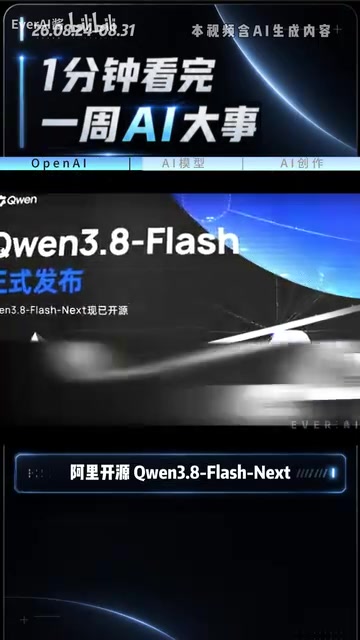
Alibaba open-sourced the Qwen 3.8 Flash Next model and gave an early preview of Qwen 4's entirely new architecture, demonstrating sustained technological iteration. The Qwen series is a family of large language models developed by Alibaba's Tongyi Lab. Since its initial release in 2023, it has gone through multiple versions, covering a complete product lineup from lightweight Flash models to full-scale large models. Alibaba chose to open-source the Qwen series under permissive licenses such as Apache 2.0, making it one of the most active Chinese contributors to the global open-source model community. The early disclosure of Qwen 4's "entirely new architecture" is particularly noteworthy — given that the Transformer architecture has dominated the industry for years, any architectural innovation could bring leaps in efficiency and capability. This represents an important window for observing whether Chinese models can achieve genuine technical breakthroughs.
The mysterious model "Niulai" that previously went viral in the community also finally revealed its true identity — it's Zhipu AI's GLM-5.3 Flash. Zhipu AI was incubated from the Knowledge Engineering Lab in Tsinghua University's Department of Computer Science and is one of the earliest Chinese startups to focus on large models. Its GLM (General Language Model) series employs a unique autoregressive blank-filling training paradigm and performs exceptionally well in Chinese and English understanding and generation tasks. The fact that GLM-5.3 Flash circulated anonymously as "Niulai" and generated significant buzz shows it had already won strong user approval in blind testing. The model's capabilities benchmark against Anthropic's Opus 4.8, but at a fraction of the cost — just a few dozen times cheaper — reflecting the technical prowess of Chinese models in dramatically reducing inference costs through engineering optimizations such as quantized inference and Mixture of Experts (MoE) architectures.
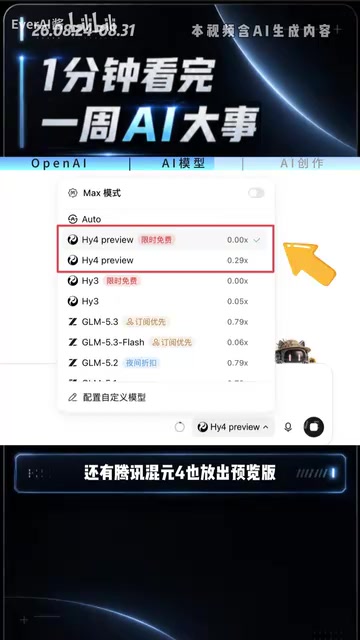
Additionally, Tencent released a preview version of Hunyuan 4. Overall, the domestic AI track is collectively moving toward an "open source + affordability" strategy, which is undoubtedly a major boon for developers.
The Strategic Calculus Behind the Affordability Play
The open-source, affordable approach chosen by Chinese models isn't simply a price war. On one hand, lowering barriers to entry through open source enables rapid accumulation of developer ecosystems and use cases, creating a virtuous feedback loop — the feedback data and application innovations generated by developers in real-world usage feed back into continuous model optimization and iteration. On the other hand, achieving costs at a fraction of those of top overseas models means that a large number of cost-sensitive SMEs and startup teams will gain access to affordable AI capabilities.
When models like GLM-5.3 Flash can deliver near-Opus-level capabilities at extremely low cost, the commercialization threshold for AI applications drops dramatically. The premium model API fees that only well-funded large enterprises could previously afford are now easily accessible to small and medium teams, which will unleash tremendous innovation energy at the application layer. This "match the capability, crush on cost" strategy could become the key path for Chinese models to overtake competitors on the global stage.
Multi-Front Breakthroughs in AI Creative Tools
Beyond the flurry of large language model updates, AI creative tools also saw notable progress this week.
Google's Gemini Omni 1.1 Flash video model officially went live. Simply show it 10 seconds of opening footage, and the model can naturally continue the narrative. This video continuation capability marks an important evolution in generative AI for video creation — from "fragment generation" to "coherent storytelling." Traditional AI video generation tools (such as Runway Gen series, Pika, etc.) mainly rely on text descriptions or single-frame images to generate short video clips, often lacking narrative coherence between segments. Video continuation requires the model to not only understand visual content but also grasp motion trajectories, physical laws, character behavior logic, and story arcs — essentially testing its "world model" capabilities. Once this technology matures, it will profoundly transform creative workflows in film pre-production, short-form video content creation, and game cutscene production.
On a different front, AI meeting tool Meet Jamie launched an image editing model that lets users complete photo editing through conversation. This kind of "conversational photo editing" further lowers the technical barrier for image editing, enabling ordinary users to easily accomplish operations that previously required professional software like Photoshop. From a technical perspective, conversational image editing integrates multiple AI capabilities including natural language understanding, image segmentation, and local inpainting, abstracting complex pixel-level operations into simple natural language commands. It represents a paradigm shift in human-computer interaction — from "learning the tool" to "describing intent."
An AI Industry Landscape of Simultaneous Division and Convergence
Looking at this week's developments as a whole, the global AI industry is exhibiting a fascinating dual dynamic: overseas top companies are becoming increasingly fragmented amid commercial interests and factional allegiances — the OpenAI-Musk split is just the tip of the iceberg — while China's model ecosystem is accelerating convergence under a shared consensus of open-source affordability, creating a more developer-friendly environment.
For developers and enterprise users, this landscape means more choices. Whether you commit to a Claude-powered programming workflow, adopt affordable Chinese models like GLM or Qwen, or experiment with Google's multimodal creative tools, the trend toward AI democratization is now irreversible. What's worth watching next is whether, as new architectures like Qwen 4 land, Chinese models can truly close the gap with — or even surpass — the overseas first tier. As the technology gap continues to narrow while the cost advantage widens significantly, the competitive balance in the global AI industry may be quietly shifting.
Related articles

Workbuddy for Absolute Beginners: How a Desktop AI Agent Fits Into Real Workflows
A beginner's guide to the Workbuddy desktop AI agent: installation, claiming credits, file management, and building automated workflows—compared with CodeX for fit and cost, helping professionals shift from AI question-askers to AI managers.

OpenAI's New Agent Stack: Computer Use, Decisions API, and Ultra-Fast Workflows
OpenAI Dev Day unveiled a new agent stack: Computer Use outperforms humans, Decisions API delivers ultra-low-latency classification via Luna, Agents API opens the same Computer Use capabilities, and GPT-6.1 Sol costs only one-seventh of Astra. Core updates, benchmark data, and developer insights.

Liang Wenfeng Open-Sources DeepInfo Inference Framework, Takes On U.S. Ban
DeepSeek open-sources its DeepInfo inference framework after its models, featuring GPU/CPU cross-pipelining, small-model prediction with large-model verification, and full Huawei Ascend and NVIDIA chip support—facing the U.S. federal ban head-on. This article analyzes its significance for AI deployment and open-source strategy.