OpenAI Cuts Off Cursor: The Programming Tool Ecosystem War Behind the AI Model Supply Ban

OpenAI stops supplying AI models to Cursor after SpaceX acquires its parent company, igniting an AI ecosystem war.
Following SpaceX's acquisition of Cursor's parent company Anysphere, OpenAI announced it will cut off AI model services to the popular coding tool. This move exposes deep tensions between Musk and OpenAI, the fragility of AI tool supply chains dependent on single model providers, and forces millions of developers to face an uncertain model migration. The incident highlights the growing trend of vertical integration in the AI industry.
Background: A Tech Blockade Triggered by an Acquisition
Cursor, the AI coding tool regarded as a productivity powerhouse by millions of developers worldwide, has recently been swept into the vortex of a tech giant power struggle. Cursor is a deeply customized AI coding IDE built on Microsoft's open-source VS Code editor, developed by the startup Anysphere. By deeply integrating large language models into the code editing workflow, it enables intelligent code completion, cross-file context understanding, natural language instruction programming, and more. Founded in 2022 by a team with MIT roots, Anysphere saw its valuation skyrocket to the multi-billion-dollar range in just two years, becoming a breakout product in the AI coding tools space. Its core technical architecture relies on calling external LLM APIs — the company doesn't train foundation models itself, but instead focuses on optimizing the editor-level interaction experience and context engineering.
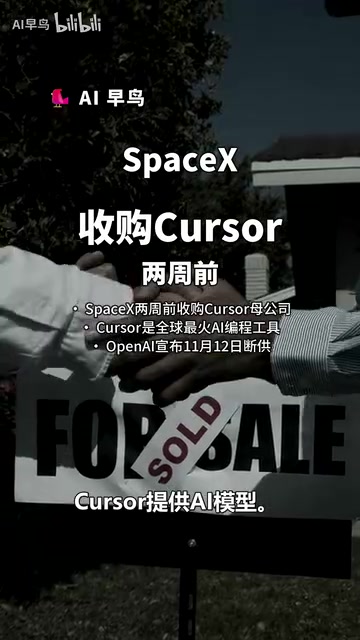
The trigger for this crisis was SpaceX's acquisition of Cursor's parent company Anysphere. Shortly after the acquisition was completed, OpenAI announced it would stop providing AI model services to Cursor starting November 12, and that new models would no longer be made available to them either.
The business logic behind this decision isn't hard to understand: Cursor previously relied on OpenAI's GPT model series as its core inference engine, and once it became part of Musk's business empire, OpenAI naturally had no desire to continue supplying ammunition to a competitor's ecosystem. This "supply cut" is essentially a direct clash over control of technical resources between two major Silicon Valley camps.
The Deeper Logic Behind OpenAI's Supply Cut
Business Competition or Principled Stance?
On the surface, OpenAI's move looks like business protectionism, but the underlying tensions are far more complex. Musk is one of OpenAI's co-founders, but he parted ways with the company long ago and founded the competitor xAI.
The feud between Musk and OpenAI traces back to 2015, when he co-founded OpenAI with Sam Altman and others, originally positioning it as a nonprofit AI research organization aimed at ensuring the safe development of artificial general intelligence (AGI). Musk contributed roughly $100 million in early funding. However, after Musk left the board in 2018, OpenAI gradually transformed into a "capped-profit" company and pushed further toward becoming a fully for-profit entity in 2023. Deeply dissatisfied, Musk filed a formal lawsuit in early 2024, alleging that OpenAI had betrayed its founding commitments to open source and nonprofit status, turning technology that was supposed to benefit all of humanity into proprietary assets for a few corporations like Microsoft. This legal dispute remains unresolved and forms the deep emotional and legal backdrop for the current supply cut.
Now, with SpaceX bringing Cursor under its wing, OpenAI is effectively using an "API supply cut" to draw boundaries around Musk's entire AI ecosystem.
From a market perspective, Cursor has accumulated a substantial base of paying users in the AI coding tools space. Behind those users lies massive API call consumption of OpenAI's models — continuing to provide service would essentially mean helping a competitor strengthen its product moat. It's worth noting that OpenAI's API service is one of its core monetization paths: developers and enterprises pay per API call to use GPT models, and OpenAI has built a massive application ecosystem through this model. This approach resembles "Infrastructure as a Service" (IaaS) in cloud computing, where foundation model providers sit at the very top of the industry chain and hold enormous leverage over downstream application layers. API terms of service typically include usage restrictions and termination clauses, meaning providers can adjust their service recipients at any time within the legal framework — this is the institutional foundation that allowed this supply cut to be executed so swiftly. Therefore, this cutoff looks more like a carefully considered strategic contraction than a simple technical restriction.
The Battle for Ecosystem Control
Interestingly, OpenAI isn't just stopping existing services — it has explicitly stated that new models will no longer be made available to Cursor. This means Cursor will be unable to access OpenAI's future technological iterations, and the technology gap will gradually widen over time. This is a blockade strategy with far greater long-term lethality — not a clean break, but a slow bleed.
Musk's Fierce Response: Going on the Attack
After the news broke, Musk took to social media with harsh language, directly calling Altman and Brockman (OpenAI co-founder Greg Brockman) "thieves." This characterization wasn't baseless — the protracted legal battle between Musk and OpenAI centers on the accusation that OpenAI has strayed from its founding nonprofit mission and allegedly misused early resources.
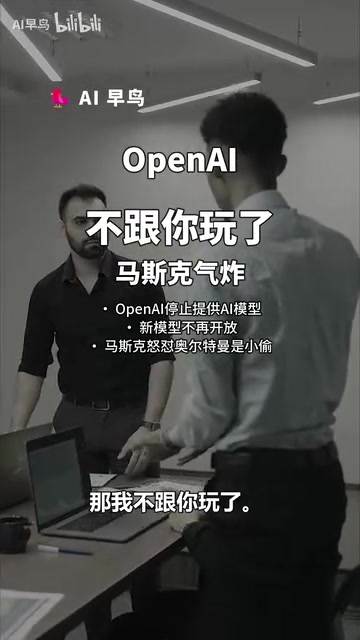
Musk's aggressive stance reflects how the emotional intensity of this dispute has far exceeded that of an ordinary business conflict. When the personal grudges and commercial interests of two tech leaders become deeply intertwined, every business decision by either side gets amplified and over-interpreted, while ordinary developer users often end up bearing the brunt of the confrontation.
The Real Predicament Facing Cursor Users
For the millions of developers who rely on Cursor for their daily programming work, this clash between titans has created real uncertainty. In the short term, Cursor can continue using existing OpenAI models, but after November 12, its AI coding capabilities will face significant adjustments.

The most likely scenario is that Cursor will pivot to xAI's Grok model as its primary engine. xAI is an AI company founded by Musk in July 2023, with the Grok series of large language models as its core product. Grok was initially integrated into the X platform (formerly Twitter), positioned as an AI assistant with "humor" and a "rebellious spirit." On the technical front, xAI has invested heavily in building a supercomputing cluster called "Colossus," deploying 100,000 NVIDIA H100 GPUs for model training, with plans to scale even further. Grok-2 and subsequent versions have continuously improved in general reasoning and code generation, but on programming-specific benchmarks (such as HumanEval and MBPP), they still lag behind OpenAI's GPT-4o and Anthropic's Claude 3.5 Sonnet. If Cursor does switch to Grok as its primary engine, the quality of model-generated code will become the critical variable for user retention. This means Cursor users will be forced to accept a "model migration" they never chose.
Additionally, some analysts believe Cursor may accelerate the introduction of Anthropic's Claude models or open-source alternatives (such as DeepSeek and the Llama series) to achieve multi-model compatibility and reduce dependency risk on any single provider. A multi-model compatibility architecture refers to a technical approach where application-layer AI products connect to multiple foundation model providers simultaneously, allowing users to flexibly switch models based on task type, cost, and performance requirements. Anthropic's Claude series is known for its long-context processing and code generation capabilities, with Claude 3.5 Sonnet in particular earning high praise in the developer community. On the open-source model front, Meta's Llama series (latest being Llama 3.1) offers a powerful locally deployable alternative; China-based AI company DeepSeek has also demonstrated near-closed-source-level performance on programming tasks with models like DeepSeek-Coder. A multi-model compatibility strategy not only reduces supply chain risk but also enables users to achieve optimal cost-performance combinations across different scenarios — this is becoming a new competitive dimension in the AI coding tools space.
The Fragility of AI Coding Tool Supply Chains Exposed
This incident has exposed a structural problem in the current AI application ecosystem: the core competitiveness of most AI coding tools (including Cursor, GitHub Copilot, Windsurf, and others) is highly dependent on a handful of foundation model providers. Once upstream supply relationships shift, a product's technical foundation can be shaken in short order.
From a more macro perspective, OpenAI's supply cut is a microcosm of the "vertical integration" trend in the AI industry. Vertical integration refers to a strategy where companies control upstream and downstream segments of the industry chain to strengthen competitive moats. In the AI industry, this trend manifests as foundation model providers beginning to enter the application-layer market directly. OpenAI launched Codex and deeply integrated it into ChatGPT; Google embedded Gemini models into development tools like Android Studio; Microsoft tied OpenAI models to the world's largest code hosting platform through GitHub Copilot. This dynamic of "being both referee and player" puts independent AI application developers under dual pressure: they must pay API fees to foundation model providers on one hand, while directly competing with those providers' own products on the other. Historically, similar vertical integration has triggered antitrust controversies in areas like PC operating systems and smartphone app stores.
Foundation model providers are increasingly asserting themselves in the application layer — building their own coding assistants (like the evolved products of OpenAI Codex) while imposing API restrictions on potential competitors. This trend poses long-term pressure on independent AI application developers.
For the developer community, the core takeaway from this dispute is this: when choosing AI coding tools, a provider's stability and multi-model compatibility have become considerations equally important as features themselves. The reliability ceiling of any tool dependent on a single API is firmly capped by the stability of that supplier relationship.
Conclusion
The feud between OpenAI and Musk has been brewing for years, but this time, the flames have spread directly to the programming tools developers use every day. Cursor's fate reflects the true intensity of the battle for ecosystem control in the AI industry. For users, the most pressing concerns right now are how Cursor's actual coding experience will change after the model switch, and whether this clash of titans will accelerate the entire AI coding tools space toward a multi-model, decentralized future.
Key Takeaways
Related articles
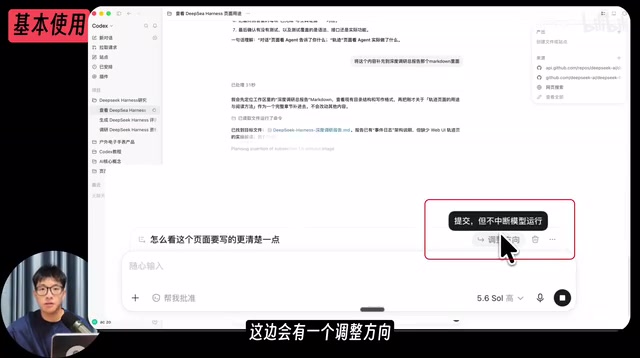
The Complete Codex Guide: A Hands-On Manual from Basics to Advanced
A complete guide to the new Codex: project folders, office file processing, multi-agent collaboration, image annotation, agents.md, Skills, automation workflows, and advanced AI programming features.
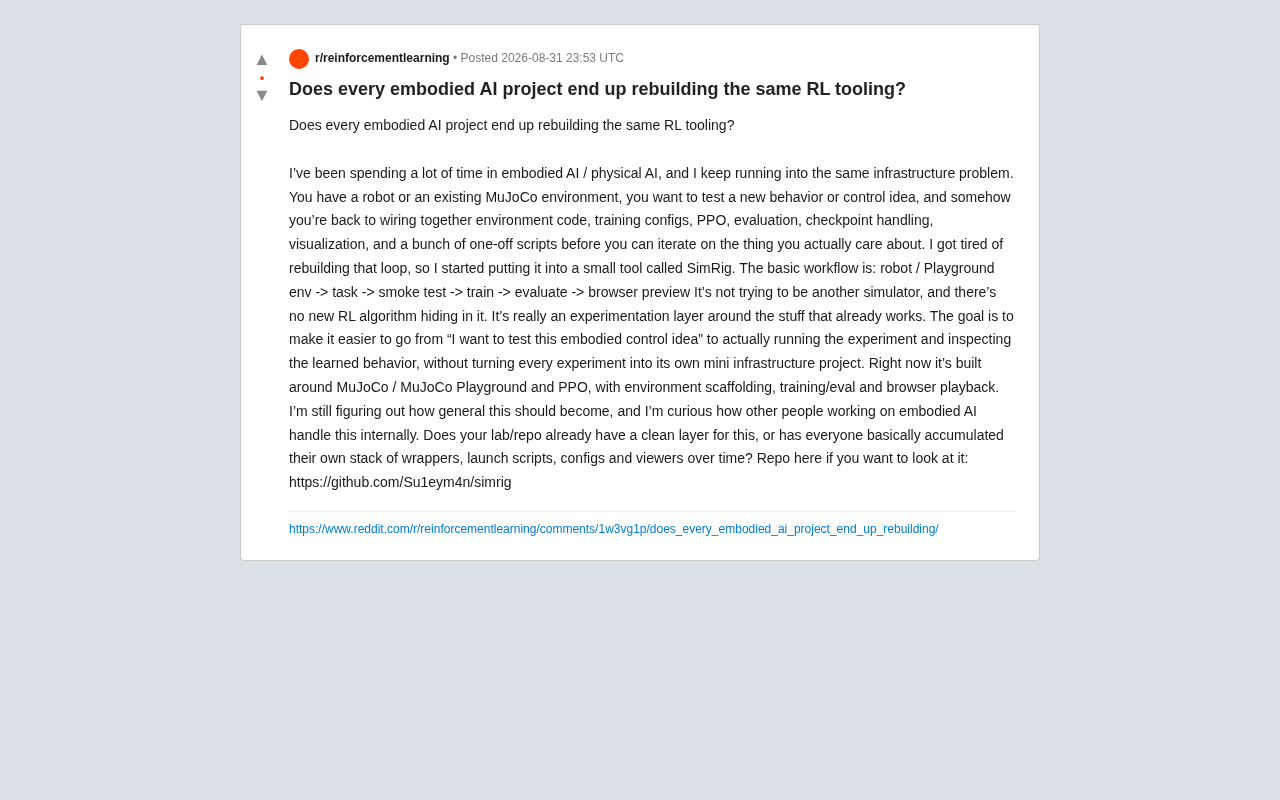
SimRig: Building a Unified Experimentation Layer for Embodied AI — Stop Reinventing the Wheel
SimRig builds a lightweight experimentation layer on MuJoCo and PPO, offering standardized workflows from environment setup to browser preview, cutting engineering friction for Embodied AI research.

AI Security 101: A Complete Guide from Prompt Injection to Agent-Based Attack and Defense
A systematic guide to AI security fundamentals covering LLM principles, prompt injection attacks, AI code auditing, CTF applications, and Agent attack-defense evolution.