OpenAI DevDay 2026: A Quiet Affair — Breaking Down Three New Announcements

OpenAI DevDay 2026 unveiled GPT 6.1-Sol, Dots, and Decisions API to a largely underwhelmed audience.
OpenAI DevDay 2026 was widely seen as lacking standout moments. GPT 6.1-Sol targets cost-efficiency with near-6A intelligence at one-fifth the price plus 8x speed, but the "close to" framing signals it likely can't top Opus 5.5 — and the speed boost may require a $500 membership. Dots is a cloud-hosted agent service similar to Meta's Muse with little apparent differentiation. The Decisions API promises sub-hundred-millisecond end-to-end decisions but needs real-world validation. Against a backdrop of strong competition, the event failed to deliver the big move many anticipated.
A Highly Anticipated Event That Fell Flat
OpenAI DevDay 2026 has wrapped up, and the consensus among many observers was blunt — underwhelming. Expectations for this event were actually quite high, largely because OpenAI's recent moves haven't exactly won over its user base.
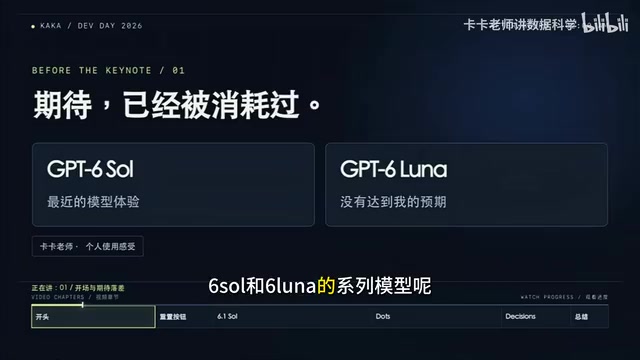
According to a live recap by a Bilibili content creator, the 6Sol and 6Luna model series failed to meet user expectations, and a rerun was eventually scheduled — awkwardly timed right before the rerun date. Subscribers were further frustrated by reports that their usage quota would be cut in half, from 20x down to 10x. With competitor Opus 5.5 generating serious buzz, many assumed OpenAI would drop something big at DevDay to hit back.
As it turned out, the most "exciting" moment of the entire event came at the very end — Tibo grabbed a blue button from the audience and pressed it, handing everyone in the room a rerun card. Beyond that, the information density throughout the event was notably thin.
Breaking Down the Three Announcements
This DevDay centered on three things. Let's go through each one.

GPT 6.1-Sol: A New Bet on Cost-Efficiency
The first highlight was the launch of GPT 6.1-Sol. Tibo claimed it delivers intelligence close to 6A but at one-fifth the price — on par with the 6S tier. It also supports an ultra-fast mode previously exclusive to the A series, offering up to 8x speed.
The creator was skeptical about the model's real-world performance, for a fairly simple reason: if OpenAI itself only says it's "close to 6A," it almost certainly can't match the widely praised Opus 5.5. On top of that, the 8x speed boost may require a $500 membership tier to unlock, which significantly undercuts the cost-efficiency pitch. It's worth noting this detail comes from a single source and is speculative — actual performance remains to be verified through independent testing.

Dots: A Platform-Hosted Agent Service
The second announcement was OpenAI's Dots. The creator compared it to Meta's Muse — a product that's been generating its own hype recently — and noted stylistic similarities to OpenCloud from earlier this year.
The key difference between Dots and local container-based solutions (like "Lobster") is where the agent runs: Lobster uses the user's local machine as the container, while Dots and Muse both rely on platform-side servers, allocating a dedicated instance per user so the agent runs entirely in the cloud. Conceptually, it's a managed model that offloads the computational burden from local devices to the platform.

The creator admitted this direction doesn't feel particularly fresh to them, so they haven't felt compelled to dig much deeper.
Cloud-hosted agent services represent an architectural philosophy of fully outsourcing the AI agent runtime to the platform. Compared to local deployment, cloud instance models spare users the cost and maintenance of local compute — agents can run continuously without depending on the user's device being on. The tradeoffs, however, include greater data privacy risks and exposure to platform-side changes in terms, quotas, or pricing. Meta's Muse takes a similar approach, giving users isolated cloud sandboxes so agents can invoke browsers, file systems, and other tools to handle complex tasks. This space is already highly competitive, with platforms differentiating mainly on instance performance, persistent storage, depth of third-party integrations, and mechanisms for monitoring and rolling back agent behavior.
Decisions API: Low-Latency Decision-Making
The third announcement was the Decisions API. The creator drew a comparison to a decision-making model (Gel) that attracted attention a couple of weeks ago. Tibo claimed the API enables end-to-end model decisions in under a few hundred milliseconds.
Low-latency decision-making sounds abstract, but the use cases are quite tangible — the creator joked that within days, someone will probably use it to blast through a hard game boss (like the Ender Dragon in Minecraft) in minutes. Expect real-world demos soon.
End-to-end low-latency decision APIs tackle a core limitation of traditional large language models in real-time environments: inference latency. A standard LLM typically takes several seconds to complete a single inference pass, making it essentially unusable for scenarios requiring millisecond-level responses — such as game AI, real-time transaction risk control, or autonomous driving assistance. The "under a few hundred milliseconds" claim implies targeted optimization in model architecture or the inference pipeline, potentially through smaller specialized models, distillation techniques, or significant trimming of the reasoning chain. Similar approaches have appeared in finance through low-latency inference hardware (like Groq's acceleration solutions). It's worth noting that low latency typically comes at the cost of reasoning depth and accuracy, making this API better suited for scenarios with well-defined decision rules and higher fault tolerance, rather than tasks requiring complex multi-step reasoning.
A Wait-and-See Mood — Real Testing Is What Matters
Taken together, the three launches from this DevDay — GPT 6.1-Sol, Dots, and the Decisions API — don't represent any kind of breakthrough. GPT 6.1-Sol pursues a price-cutting, speed-boosting strategy, but the performance ceiling is already telegraphed by the official "close to 6A" framing. Dots is a cloud-hosted agent service that closely resembles what competitors are already offering. The Decisions API leads with low latency, but its practical value depends heavily on the specific use case.
With Opus 5.5 in full stride, this kind of release cadence was bound to disappoint anyone hoping for a knockout punch. For everyday users, rather than rushing to conclusions, the smarter move is to wait for third-party benchmarks — especially side-by-side comparisons of GPT 6.1-Sol against 6S and 5.6S, and clarity on whether the 8x speed mode is actually accessible without a premium membership tier. Those are the real indicators of whether these launches have substance.
Related articles

Chain of Thought Isn't Just for AI: How Humans Can Use CoT to Improve Thinking Quality
Chain of Thought isn't just a prompt trick for large models. Starting from a Hacker News discussion, this article analyzes why CoT works for human thinking too, breaks down actionable ways to transfer it, and highlights the key differences between human CoT and machine CoT.
Cloudflare Teams Up with OpenAI: Closi…
Cloudflare Teams Up with OpenAI: Closing the Loop from Vulnerability Discovery to Defense with AI
Cloudflare uses OpenAI Daybreak to investigate security vulnerabilities and generate reviewable remediation plans, while developers use Codex to boost coding efficiency and quality.

Orca Multi-Agent Orchestration in Practice: A Guide to Parallel Collaboration with Claude and Codex
Orca is Stable AI's free open-source agent workbench supporting 34 agents like Claude Code and Codex in parallel. Learn its Git worktree isolation, multi-model orchestration, and mobile management.