OpenAI DevDay 25 Updates: Persistent Agent Dots and GPT-6.1 Sol Make Their Debut

OpenAI DevDay drops 25 updates headlined by persistent agent Dots and the cost-efficient GPT-6.1 Sol model.
OpenAI's latest DevDay packed in 25 updates across two major themes: Dots, a 24/7 persistent agent connected to 4,000+ apps and powered by the flagship Astra model (with casual chat free but task execution counting against quotas); and GPT-6.1 Sol, a model approaching Astra's intelligence at one-fifth the cost, with cached input priced at just $0.10 per million tokens. A new $500 Pro tier offers 25× the Plus quota with exclusive Ultra Fast mode, while developer and collaboration tools including Codex Cloud, Agents API, Codex CLI, and Space/Pages round out OpenAI's push to embed AI deeply into development and team workflows.
OpenAI DevDay 25 Updates: Persistent Agent Dots and GPT-6.1 Sol Make Their Debut
OpenAI unveiled 25 updates at its latest DevDay, spanning persistent agents, model upgrades, developer tools, and collaboration products. Based on coverage from AI-focused content creators, the two centerpieces of this event are Dots — an always-on agent that works around the clock — and GPT-6.1 Sol, a new model that dramatically cuts costs without sacrificing performance. Here's a breakdown of the highlights.
Dots: A 24/7 Persistent Agent
Dots is positioned as an agent that runs continuously, working on behalf of users around the clock. It learns from user feedback, has its own dedicated computer and browser, and can connect to over 4,000 apps within the OpenAI ecosystem. It's powered by Astra, currently OpenAI's most capable model.
According to OpenAI, the first "primary Dots" is already being rolled out to eligible users, with the ability to create full Dots teams for collaboration coming later. The feature is available on Pro, Business, Premium, and Enterprise plans — including the $100/month Pro plan — with broader rollout planned.
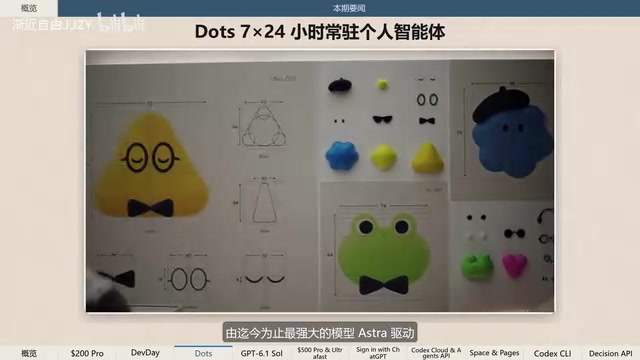
The "doesn't count against usage limits" framing deserves some clarification. Per OpenAI's own documentation, the first Dots included in a plan is free; additional ones cost extra. Ordinary conversations with Dots don't count against usage limits, but when you instruct Dots to launch or manage tasks in Codex or ChatGPT Work, those actions do consume your quota. In other words, "free" largely applies to casual chat — actual productivity tasks still draw from your usage allowance.
"Persistent Agent" represents a new paradigm distinct from traditional conversational AI. Conventional chat models reset their state at the end of each session, whereas persistent agents retain memory across sessions and can execute tasks asynchronously in the background without requiring real-time user supervision. This design enables AI to handle long-horizon tasks spanning hours or even days — such as continuously monitoring a data source, automatically processing an email queue, or advancing a multi-step project on a schedule. When Dots is described as having "its own dedicated computer and browser," this essentially means the agent is allocated a sandboxed compute environment where it can independently operate web browsers and run code without relying on the user's local device. This builds directly on OpenAI's previously released "Computer Use" capability and reflects the dominant architectural direction in the AI Agent space today.
GPT-6.1 Sol: Near-Astra Intelligence at 1/5 the Cost
The biggest model news is GPT-6.1 Sol. It approaches Astra in intelligence while costing just one-fifth as much, with cached input pricing as low as $0.10 per million tokens — 95% below the standard input price and 50% lower than the previous GPT-6.0 Sol's cached input rate.
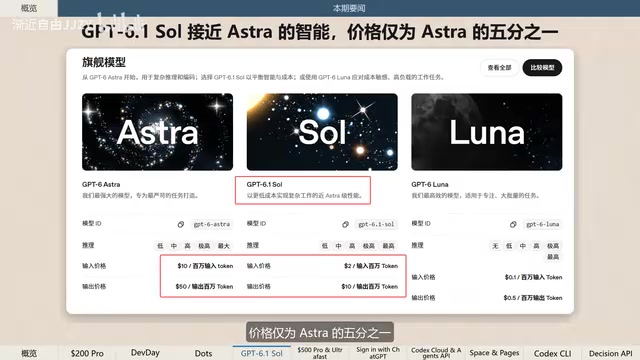
In terms of capabilities, GPT-6.1 Sol offers major improvements over GPT-6.0 Sol in coding, computer use, and complex professional tasks, closing the gap with GPT-6.0 Astra on several benchmarks: it outperforms Astra and Opus 5.5 on Terminal Bench 4.0 at a fraction of the cost, and scores just 1 point below GPT-6.0 Astra on the Artificial Analysis Intelligence Index. It's also more reliable at following user intent and safety constraints. The model is available starting today for Plus, Pro, Business, Enterprise, and EDU users in ChatGPT Work and Codex.
The signal behind these numbers is clear: OpenAI is pursuing a strategy of "near-flagship intelligence at deeply discounted prices" to democratize high-performance models and make top-tier AI accessible to more developers at lower cost.
"Cached Input" pricing is an important billing mechanism in large model APIs. When the same prefix text — such as a system prompt or long document context — is called repeatedly, the provider can cache it in fast storage so subsequent requests don't need to reprocess it, enabling lower-cost billing. For use cases that require extensive inference within the same context (such as code assistance, RAG retrieval-augmented generation, or long document analysis), the higher the cache hit rate, the greater the cost savings. GPT-6.1 Sol's cached input price of $0.10 per million tokens means developers who frequently invoke the same context can compress inference costs to near-marginal levels — a substantial cost benefit for teams building large-scale AI applications. Terminal Bench and the Artificial Analysis Intelligence Index are widely used third-party model evaluation benchmarks; the former focuses on terminal operation and code execution capabilities, while the latter provides a composite assessment of reasoning, knowledge, and instruction-following performance.
Pricing Changes: Pro Quotas and a New $500 Tier
The DevDay announcements also included notable clarifications on subscription quotas. The $200 Pro plan's quota is officially defined as 10× that of Plus, while existing $200 Pro users will temporarily retain a 20× multiplier along with a substantial amount of bonus usage.
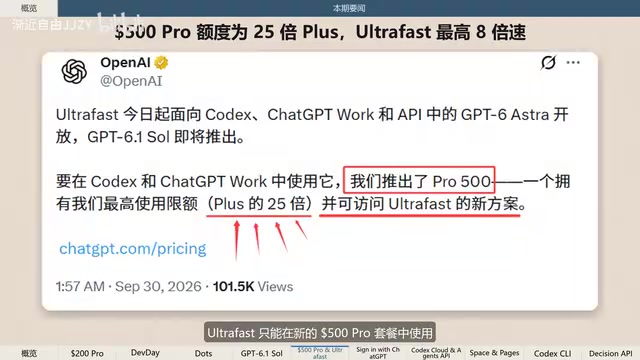
The genuine newcomer is the $500 Pro plan, which offers 25× the quota of Plus. The Ultra Fast mode — exclusive to this tier — enables up to 300 tokens per second and 8× token throughput in Codex, and up to 6× in the API.
Additionally, users can now sign in and use their ChatGPT subscription directly across more than 16 partner products — including Devin, OpenCode, and Notion — without restrictions, with all included usage available seamlessly. This signals a shift in ChatGPT subscriptions from a single entry point to a "universal compute account" spanning multiple products.
Developer Tools and Collaboration Products
Beyond models and pricing, this update also rolled out a comprehensive suite of developer and collaboration tools.
Codex Cloud can run on your computer, be operated remotely from your phone, or run in the cloud from any device. It offers reusable development environments for fast task startup and supports shared team configurations, available on Plus, Pro, Business, Healthcare, Education, and Enterprise plans.
Agents API — the same technology powering all cloud-based agents including Dots — is entering preview, with support for computer use. The fully upgraded Codex CLI now supports voice conversations, letting users speak directly to Codex to launch and guide tasks, and introduces an Agents view for distributing work across multiple agents and tracking progress.
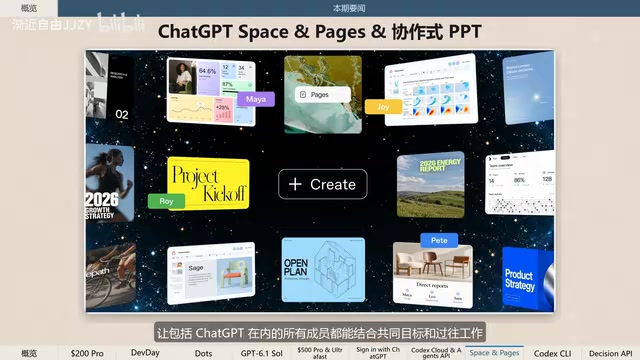
On the collaboration side, OpenAI introduced Space (a shared workspace for humans and AI to work together), Pages (a new document type built for human-AI collaboration), and Collaborative Presentation (enabling teams and ChatGPT to co-create professional slide decks). These features are available on Pro, Business, and Enterprise plans. For developers, the new Decisions API focuses model intelligence on a set of user-defined questions with a limited range of predefined answers, enabling real-time decisions — useful for content classification, request routing, or selecting an agent's next action. It's available in limited preview starting today.
The arrival of the Agents API in preview marks OpenAI's formal opening of agent orchestration capabilities to third-party developers. Previously, multi-agent collaboration required developers to implement task distribution, state management, and tool-calling logic themselves. The Agents API standardizes this infrastructure, allowing developers to build custom agent teams through a unified interface without building a scheduling layer from scratch. The Decisions API represents a complementary philosophy: rather than pursuing general-purpose reasoning, it constrains model capabilities to a set of predefined structured options, trading flexibility for lower latency and more predictable outputs. This "constrained reasoning" approach is more practically valuable in high-throughput scenarios like content moderation, request classification, and traffic routing — contexts where response speed and consistency typically matter more than open-ended creativity.
Summary
Across these 25 updates, OpenAI's strategic direction is evident: use Dots to drive the adoption of persistent agents, use GPT-6.1 Sol to dramatically lower the cost of high-performance models, and embed AI deeply into development and team collaboration workflows through tools like Codex, Agents API, and Space/Pages. For everyday users, the key questions are around subscription value and quota changes. For developers, the real wins are lower token costs and a more complete agent toolchain.
Related articles

Chain of Thought Isn't Just for AI: How Humans Can Use CoT to Improve Thinking Quality
Chain of Thought isn't just a prompt trick for large models. Starting from a Hacker News discussion, this article analyzes why CoT works for human thinking too, breaks down actionable ways to transfer it, and highlights the key differences between human CoT and machine CoT.
Cloudflare Teams Up with OpenAI: Closi…
Cloudflare Teams Up with OpenAI: Closing the Loop from Vulnerability Discovery to Defense with AI
Cloudflare uses OpenAI Daybreak to investigate security vulnerabilities and generate reviewable remediation plans, while developers use Codex to boost coding efficiency and quality.

Orca Multi-Agent Orchestration in Practice: A Guide to Parallel Collaboration with Claude and Codex
Orca is Stable AI's free open-source agent workbench supporting 34 agents like Claude Code and Codex in parallel. Learn its Git worktree isolation, multi-model orchestration, and mobile management.