OpenAI DevDay Deep Dive: GPT-6.1 Sol, the Always-On Agent Dots, and More

OpenAI DevDay launches lighter models, an always-on agent, and a Decisions API to make AI truly work for you.
OpenAI's DevDay announcements share a single strategic logic: evolving AI from conversational assistant to autonomous executor of complete work units. GPT-6.1 Sol delivers near-flagship agentic capability at one-fifth the cost; always-on agent Dots runs continuously in a cloud environment connected to 4,000+ apps; the Space platform unifies human and multi-AI collaboration; and the Decisions API converts open-ended generation into fast, cheap structured routing. OpenAI also disclosed that models can now independently complete over one-third of day-long research tasks — providing capability backing for the entire product lineup.
OpenAI packed a dense slate of announcements into this year's DevDay, spanning a lightweight model, an always-on personal agent, a productivity platform, and a Decisions API — rounded off with a global quota reset for users. The through-line across all of it is a clear strategic signal: AI is accelerating its shift from "conversational assistant" to "does the work for you."
GPT-6.1 Sol: Five Times Cheaper, Still Nearly Flagship-Grade
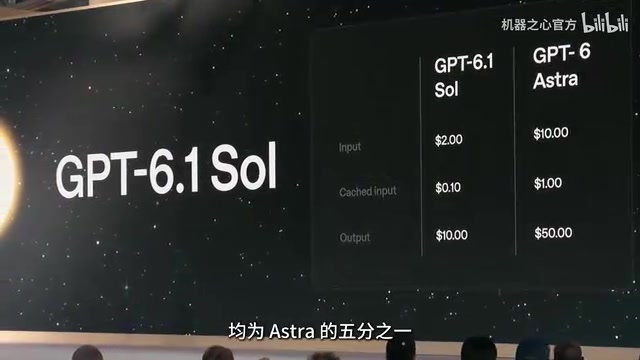
GPT-6.1 Sol is positioned as a lightweight model, but OpenAI is quick to emphasize that it approaches the performance of the flagship GPT-6 Astra on agentic coding, computer use, and professional workflows. The real headline is the price — both input and output costs via the standard API are one-fifth of Astra's.
For developers, that pricing structure has an immediately practical implication. Workflows requiring many sequential calls or long runtimes have historically been bottlenecked by cost; Sol lets teams run significantly more tasks within the same budget. In other words, Sol isn't chasing the outer edge of single-call capability — it's redefining the price-performance sweet spot in the "good enough and affordable" zone.
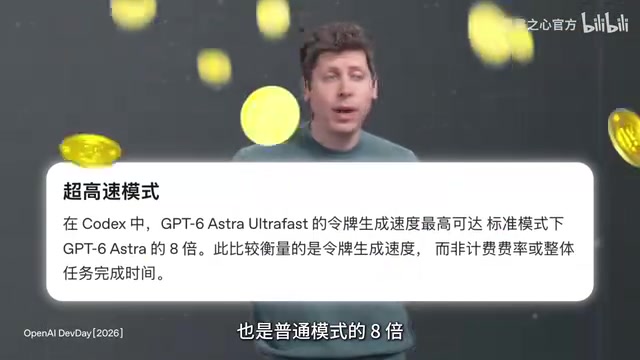
The model launch also comes with plan changes. The former $200-tier quota has been trimmed to 1.5x its previous level, while a new $500/month Pro plan has been introduced. Pro subscribers get exclusive access to "Super Acceleration" — delivering Astra Ultra Fast inside Codex, with token generation speeds up to 8x faster than standard.
The Speed-vs-Consumption Trade-off
There's no free lunch, of course. Using this mode in Codex and Work burns through your plan quota at 8x the normal rate as well. Whether the Pro plan is worth it comes down to a single variable: how much is the time you spend waiting on AI actually worth to you? For teams iterating rapidly on time-sensitive work, 8x speed may well justify the cost. For occasional individual users, the math deserves more scrutiny.
Dots: OpenAI's Always-On Personal Agent
Dots — already being compared externally to "OpenAI's Muse" — is arguably the most imaginative announcement of DevDay. It's an always-on personal agent powered by GPT-6 Astra, equipped with its own cloud-based computer and browser, and capable of connecting to over 4,000 applications.
Dots's core capability is continuous forward progress. You can hand it a long-running task and let it operate autonomously — tracking customer feedback on an ongoing basis, preparing code fixes, and so on. This is fundamentally different from traditional back-and-forth dialogue. Dots doesn't wait for your next instruction at every step; it plans and executes around your goal on its own.

OpenAI has also built in some thoughtful UX choices: conversations with Dots don't consume your GPT usage quota, and users can reach it at any time via SMS, Teams, or other channels. That means the agent genuinely integrates into everyday communication workflows rather than being siloed inside a dedicated interface.
The concept of an "always-on personal agent" represents a fundamental departure from mainstream conversational AI. Traditional chat models operate in a stateless request-response loop — no execution context persists after the conversation ends. Agent mode introduces three key elements: persistent state, autonomous planning, and tool invocation. Dots's dedicated cloud compute environment means it can continue executing tasks while the user is offline, store intermediate results, and proactively send notifications when conditions are met. This architecture falls into what's typically called a long-running agent — and the core challenge is making reasonable intermediate decisions unsupervised, while gracefully handling unexpected errors and task boundaries. Compared to similar efforts like Anthropic's Claude Computer Use or Google's Project Mariner, Dots distinguishes itself by bridging continuous execution with existing communication channels (SMS, Teams), aiming to embed the agent into users' current workflows rather than asking them to migrate to an entirely new platform.
Space and the Decisions API: Infrastructure for Collaboration and Judgment
Beyond the individual-focused Dots, OpenAI also announced Space — a team collaboration layer. Space is a productivity platform that brings pages, files, tasks, and context into a single shared environment. Within that space, humans can edit, comment, and query; GPT and Codex can write code; and Dots can be added in to work alongside everyone. It's essentially a unified workspace built for human-plus-multiple-AI collaboration.
Also worth noting is the Decisions API. It lets a model evaluate context and choose among a set of predefined options — for example, deciding whether a customer service inquiry should route to pre-sales, post-sales, or a human agent, or whether an agent's next step should be to keep searching or ask the user for clarification.

The design philosophy behind the Decisions API is pragmatic: take open-ended generation tasks and compress them into cheap, fast, continuously running structured decisions. For high-volume, low-latency judgment scenarios — customer service routing, workflow branching — this approach is both more controllable and more economical than full conversational reasoning.
The "structured decision" pattern that the Decisions API embodies is essentially a narrowing of LLM use cases from free-form generation to classification-based routing. The conventional approach — sending a full prompt and parsing natural language output — is slow, expensive, and produces formatting that's hard to guarantee. Structured decisions instead predefine a finite set of output options (enumerated values), requiring the model only to select the best option given the context: shorter reasoning paths, fewer tokens consumed. This is consistent with OpenAI's earlier moves like Function Calling and JSON Mode, but goes a step further by abstracting decision semantics into a first-class API primitive. For production systems processing thousands of judgments per second — real-time customer routing, ad serving decisions — this pattern lets you retain the model's semantic understanding while keeping latency and cost at the level of deterministic systems.
How We Work with AI Is Being Rewritten
Underpinning all of these announcements is one particularly weighty data point: OpenAI stated that as of July this year, large models can now independently complete more than one-third of "day-long" research tasks with no human intervention.
That number is worth sitting with. It means AI is no longer just helping humans with isolated fragments of work — it's capable of independently carrying a meaningful share of complete, end-to-end work units. From GPT-6.1 Sol driving down the per-call cost, to Dots enabling round-the-clock autonomous operation, to the Decisions API making judgment cheap and fast, the product lineup from this DevDay points in a single direction: systematically lowering the barrier to letting AI genuinely work for you.
The way we use AI may be about to change in ways that actually matter.
Related articles

ChatGPT Space Launches: Team Collaboration and New Pages Features Explained
ChatGPT Space is OpenAI's new team collaboration feature with Pages, real-time collaboration, and Slack/Google Drive sync. We break down its privacy design, multi-platform integration, and the full workflow from conversation to document.

Migrating Apache Spark UDFs to GPU Acceleration with AI Agents
NVIDIA developer blog explains how AI Agents rewrite Apache Spark UDFs for GPU acceleration, covering migration criteria, agent rewriting and verification workflows, plus pitfalls like result consistency and CPU-GPU transfer overhead.

Zed Editor v0.40.4-rc2 Released: Usage Credits Now Available Without Upgrading
Zed editor releases v0.40.4-rc2, allowing users to use usage credits for AI features without upgrading to a paid plan, lowering the trial barrier.