OpenAI DevDay Developer Updates: Faster Coding and Parallel Collaboration

OpenAI DevDay focuses on faster coding, AI code review, and parallel task collaboration for developers.
OpenAI's DevDay developer updates center on three directions: accelerating coding iteration, introducing AI-assisted code review, and supporting parallel multitasking. Together, these point to a larger strategic goal — evolving AI coding tools from single-point code completion into a full-workflow productivity platform covering writing, reviewing, and collaborating. Parallel workflow support is especially notable, reflecting the industry's shift toward agentic AI: tools that proactively manage multiple tasks in the background rather than passively responding to requests. The article also cautions that official previews lean toward vision over reality, and developers should evaluate based on full documentation and hands-on testing.
Core Signals from OpenAI DevDay for Developers
OpenAI unveiled a series of developer-focused updates at DevDay, centered around three key themes: faster coding experiences, smoother code review, and support for parallel workflows. These directions signal a strategic shift — from showcasing raw model capabilities toward productivity tools built for real-world software engineering.
Based on official announcements, this round of updates targets some of the most frequent and time-consuming parts of a developer's daily work: writing code, reviewing changes, and managing multiple tasks in parallel. Whether AI tools can close the loop on all three often determines whether they're a "toy" or a genuine productivity boost.
Note: This article is based on OpenAI's official social media previews from DevDay. Source material is limited, and some details are pending the full official documentation.
Faster Coding: Lowering the Cost of Getting Started and Iterating
Leading with "Code faster" signals that OpenAI considers coding speed the top priority for developer experience. For most teams, the value of AI-assisted programming isn't just code generation — it's shortening the cycle from idea to working code.
The underlying reality is that developers don't spend most of their time typing. The real time sinks are context switching, reading documentation, debugging, and writing repetitive boilerplate. If AI tools can take on more of that burden, the productivity gains far exceed what you get from "generate a snippet."
Reviewing Changes: Bringing AI Into Code Quality Assurance
"Review changes" puts the spotlight on code review — a step that's long been underestimated. Code review is a critical quality gate, but it's also one of the most common bottlenecks for teams. Reviewers need to understand the intent behind a change, assess its scope, and catch potential defects.
When AI enters the code review process, it can quickly summarize what a commit does, flag potential risks, and even suggest improvements. This reduces the burden on senior engineers while giving junior developers immediate feedback. Making code review smarter is an important milestone on the path to AI programming tools achieving production-grade usability.
In engineering practice, code review typically spans several dimensions: correctness (does the logic match the intent?), maintainability (is the code easy to understand and modify?), security (does it introduce vulnerabilities?), and performance impact. Traditional automation tools — static analyzers, linters — mainly cover formatting standards and known defect patterns. They struggle to understand the business intent behind a change. AI's differentiating value in code review lies in semantic understanding: it can combine context to judge what a change does, why it was made, and what side effects it might cause, offering feedback that more closely resembles the perspective of a senior engineer. Products like GitHub Copilot Code Review and Cursor are already exploring this space, though accuracy and false-positive rates in complex systems remain key challenges.
Parallel Work: Keeping Multiple Tasks Moving at Once
"Keep parallel work moving" is arguably the most exciting of the three. Modern software development is rarely linear — a developer often juggles multiple feature branches and issues simultaneously. Keeping multiple parallel workstreams all moving forward requires AI tools to have stronger task management and context-retention capabilities.
This reflects a broader agentic trend: AI is no longer just a passive assistant that responds to individual requests, but a collaborator that can continuously handle multiple tasks in the background. Whoever cracks the parallel workflow problem is well-positioned to define what the next generation of developer tools looks like.
Agentic AI refers to systems that evolve from a single-turn question-and-answer model into one capable of autonomously planning, executing step-by-step, and continuously tracking task state. Traditional AI coding assistants operate on a "request–response" basis where each interaction is independent. Agentic tools, by contrast, can accept a high-level goal (e.g., "implement this feature and make sure the tests pass"), break it down into subtasks in the background, call tools, manage intermediate states, and return final results. The key technical challenge for supporting parallel workflows is context management — the AI must simultaneously maintain the state, intent, and progress of multiple task threads without interference. This is why parallel workflows are far harder to implement than single-point code completion: they demand significantly more from the model in terms of long-context understanding, tool-call reliability, and task scheduling.
What This Means for Developers
Putting these three threads together, OpenAI's intent is clear: build a developer experience that covers the full "write → review → collaborate" workflow, rather than stopping at point-in-time code completion. For teams evaluating AI coding tools, this is a signal worth paying attention to.
A word of caution: official previews tend to favor visionary language, and there's usually a gap between what's announced and what's actually delivered. Developers should evaluate whether these updates genuinely fit their workflows by reviewing the full DevDay documentation and trying things out firsthand.
Summary
OpenAI's DevDay developer updates revolve around three major directions — faster coding, AI-assisted code review, and parallel collaboration — continuing the industry trend of AI programming tools evolving from "autocomplete" toward full-workflow engineering collaboration. Specific feature details still await confirmation from official documentation, but the direction itself is already worth developers' attention.
Related articles

Is n8n Still Worth Learning? Trade-offs of Automation Tools in the AI Agent Era
Is n8n still worth learning? A YouTube creator explains that AI Agent platforms now include transparent logs, execution history, and debugging workflows, leaving n8n with only visual data flow advantages—which new features like Clod code mods are catching up on. This article covers the trade-offs and learning advice.

No Code Needed: Build a Daily AI News Digest Email Workflow
Learn how to build a daily AI news digest email workflow without code. Master the four building blocks—trigger, data, AI, and action—set it up once and it runs forever.
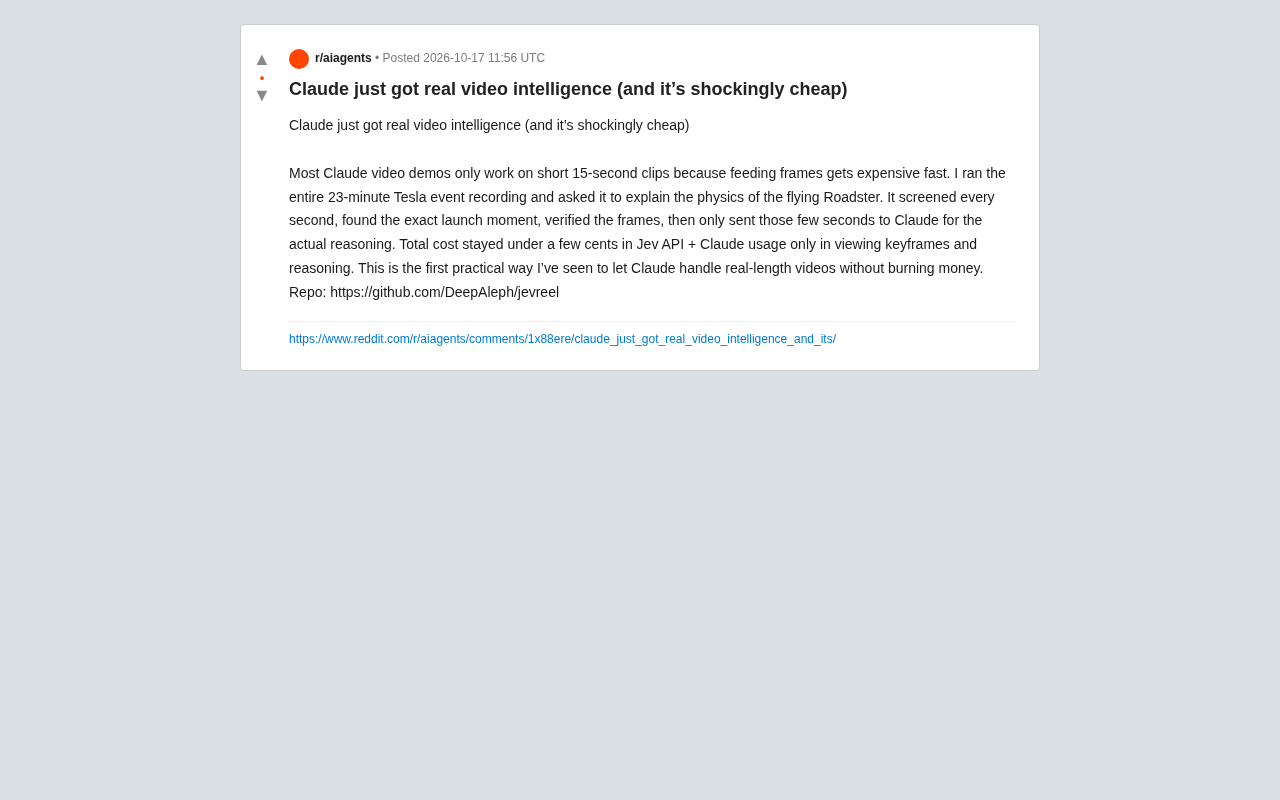
New Breakthrough in Claude Video Understanding: 23-Minute Long Video Processing Costs Only a Few Cents
A developer used the Jev API to filter key frames and then sent them to Claude for reasoning, successfully analyzing a 23-minute Tesla event video for only a few cents. This article explains the technical principles, limitations, and significance of this long-video AI understanding solution.