OpenAI DevDay Preview: A Single Tweet Sparks Anticipation

A "found a new thing" tweet before OpenAI DevDay sparks attention, hinting at a capability discovery rather than a product launch.
On the eve of OpenAI DevDay, a tweet phrased "We have found a new thing" sparked discussion in the developer community. The article argues that "found" rather than "built" hints this may not be another API or model update, but a new observation about model capability boundaries. Meanwhile, DevDay is shifting from a product launch to a capability showcase. Since OpenAI's capability changes directly affect downstream applications, vague signals easily trigger over-interpretation. The author advises recording signals and waiting for verification.
OpenAI's DevDay is coming around again.
A short tweet from Twitter — "Pretty excited for DevDay tomorrow. We have found a new thing." — has generated no small amount of discussion in the developer community. The tweet itself reveals no technical details, but the phrasing of "We have found a new thing" is worth pondering.
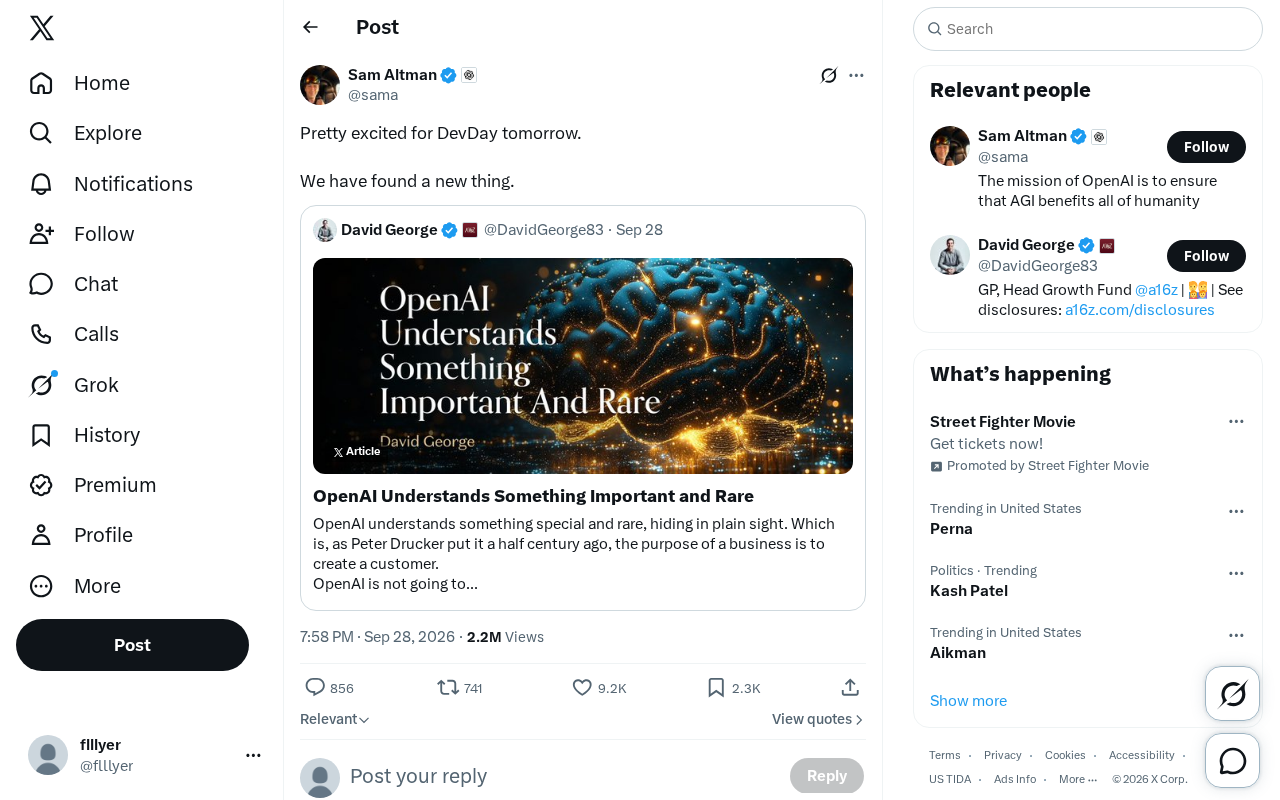
"Found" Rather Than "Built": A Signal in the Wording
If this were simply the release of a new model or feature, words like "built," "launched," or "shipping" would typically be chosen. "Found" instead hints at a discovery — as if some unexpected capability was observed during training, or some new phenomenon was identified in model behavior.
That distinction is not trivial in the context of AI research. Building is an engineering act; discovering is closer to a research act. If what's being shown at DevDay is indeed a "discovery," it may not be another API update, but rather a new understanding of the boundaries of model capability.
Of course, the wording of a single tweet isn't enough to support a definitive judgment. It could also just be part of marketing copy, using vague phrasing to build suspense.
DevDay is OpenAI's annual developer conference, held since 2023, typically focused on releasing new models, API updates, pricing adjustments, and toolchain changes. It's seen as an important window into OpenAI's product cadence and capability boundaries. Typical releases at previous editions included multimodal capability rollouts, the Assistant API, and the GPT Store, which is why the developer community is highly sensitive to its content.
In the context of AI research, the distinction between "discovery" and "building" has real significance. The training of deep learning models is not a fully interpretable process, and researchers frequently discover capabilities in post-training evaluation that were not explicitly designed — for example, in-context learning, chain-of-thought reasoning, and tool-calling tendencies. Such capabilities are often observed first, then systematized for use. So "found" may hint at an observation about model behavior rather than a purely engineering deliverable.
DevDay's Positioning Is Shifting
Looking back at DevDay's trajectory, it was initially more of a product launch event for developers — new models, new APIs, new pricing. But in recent editions, the center of gravity has moved: from releasing tools to demonstrating capabilities, from feature lists to capability demos.
Behind this shift is a change in the industry's rhythm. As foundational model capabilities stabilize, the highlight of a launch event is no longer "what features were added" but "what can the model do now that it couldn't before." If the "new thing" in the tweet corresponds to the latter, it's more likely a breakthrough at the capability level rather than an iteration at the product level.
Why a Single Tweet Is Worth Noticing
The fact that a tweet with almost zero information value can draw attention says something in itself: DevDay's announcements have a real impact on the entire AI application ecosystem. Developers need to plan their own product roadmaps based on OpenAI's capability boundaries, and any change in model capabilities propagates downstream.
The suspense created by "We have found a new thing" is essentially attention converging due to information asymmetry. Before the official announcement, all interpretations are just speculation.
A foundational model's capability boundaries are not static. Variables such as model scale, training data, alignment methods, and inference-time compute all change how a model performs on specific tasks. Developers pay attention to OpenAI's announcements because many downstream products design their features around the stability and capability ceiling of its API — for example, agent workflows, code generation, and multimodal interaction. Once a model gains a new callable capability, product forms that were previously infeasible may become feasible; conversely, adjustments to capabilities or interfaces may force existing products to be rebuilt.
This dependency amplifies the impact of pre-launch signals. Even if a tweet provides no concrete information, it still shifts developers' expectations for their roadmaps, which in turn affects resource allocation and release schedules.
Viewing Pre-Launch Signals with Caution
For this kind of pre-launch teaser, there are two common overreactions: one is to treat vague signals as definitive information and spread them, and the other is to ignore them entirely because there's insufficient information. Neither is advisable.
A more reasonable stance is: record the signal, wait for verification. What the "new thing" in the tweet actually points to can only be answered by DevDay's official content. Until then, staying curious without over-interpreting is the more prudent posture.
One-line Summary
A "found a new thing" tweet before OpenAI DevDay draws attention, with wording hinting at a capability discovery rather than a product launch.
Paragraph Summary
On the eve of OpenAI DevDay, a tweet phrased "We have found a new thing" sparked discussion in the developer community. The article argues that the use of "found" rather than "built" hints this may not be another API or model update, but a new observation or discovery about the boundaries of model capability. Meanwhile, DevDay's positioning is shifting from a product launch event to a capability showcase, with the highlight gradually moving from feature lists to what the model can do that it couldn't before. Because changes in OpenAI's capabilities directly affect the downstream application ecosystem, vague signals easily trigger over-interpretation. The author suggests recording signals and waiting for verification — staying curious but not over-speculating before the official content is released.
Related articles

Chain of Thought Isn't Just for AI: How Humans Can Use CoT to Improve Thinking Quality
Chain of Thought isn't just a prompt trick for large models. Starting from a Hacker News discussion, this article analyzes why CoT works for human thinking too, breaks down actionable ways to transfer it, and highlights the key differences between human CoT and machine CoT.
Cloudflare Teams Up with OpenAI: Closi…
Cloudflare Teams Up with OpenAI: Closing the Loop from Vulnerability Discovery to Defense with AI
Cloudflare uses OpenAI Daybreak to investigate security vulnerabilities and generate reviewable remediation plans, while developers use Codex to boost coding efficiency and quality.

Orca Multi-Agent Orchestration in Practice: A Guide to Parallel Collaboration with Claude and Codex
Orca is Stable AI's free open-source agent workbench supporting 34 agents like Claude Code and Codex in parallel. Learn its Git worktree isolation, multi-model orchestration, and mobile management.