OpenAI Dots vs Anthropic Claude Duet: The AI Assistant Rivalry Escalates
Claude Duet, Dots, and Muse diverge along three paths, signaling AI competition's shift toward task execution.
The article compares Anthropic's Claude Duet, OpenAI's Dots, and Meta's Muse, noting distinct positioning: Claude Duet targets work scenarios with daily proactive briefings, scheduling, dashboards, and even web apps; Dots emphasizes continuous collaboration; Muse leans toward personal life. Claude Duet runs in the cloud and keeps working with your phone off, but sensitive actions like emailing and payments need approval—a "limited autonomy" boundary. This reflects AI competition shifting from answer quality to task completion, which demands task planning, tool use, state management, and exception handling.
AI assistants are shifting from "who answers better" to "who actually gets things done." Anthropic's personal Agent assistant Claude Duet (transliterated as "Dewitt" in the video) now stands alongside OpenAI's Dots and Meta's Muse, forming a three-way rivalry—but each takes a different angle. Based on a Bilibili video, this article breaks down the product logic and industry signals behind this escalation.
Three Assistants, Three Approaches
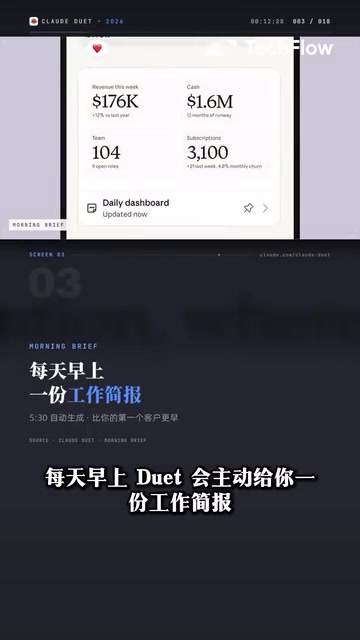
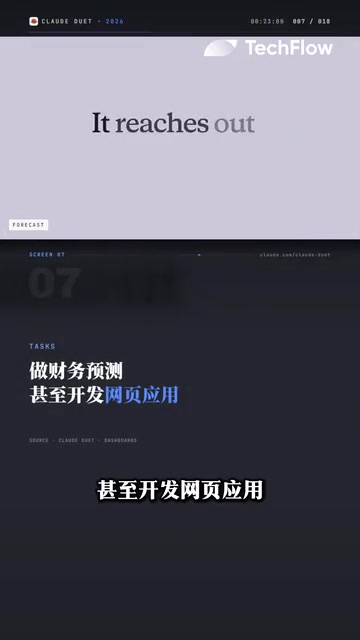
Claude Duet's core selling point is that "you don't have to watch it all day—it pushes work forward on its own." Every morning it proactively generates a work briefing, summarizing to-dos from the email, calendar, and business tools you've authorized it to access, and reminds you about them. You can have it schedule meetings, build data dashboards, produce financial forecasts, or even develop web apps.
By contrast, OpenAI's Dots emphasizes "continuous collaboration," while Meta's Muse leans more toward personal life and everyday matters. Claude Duet is explicitly focused on work scenarios, targeting professionals and small business owners to help them handle complex tasks.
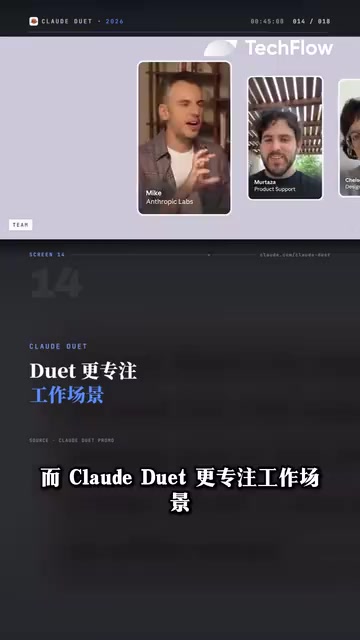
This positioning difference is no accident. Work scenarios involve longer task chains and more complex context, placing higher demands on an assistant's proactivity and reliability; life scenarios are more fragmented and tolerate more errors. By entering through work, Anthropic is trading difficulty for a moat.
Cloud Execution and Sensitive-Action Approval
Claude Duet's tasks run in the cloud—even if you turn off your phone, it keeps working. This means the assistant no longer depends on a local device being online, but exists as a continuously running service.
But for sensitive actions like sending emails or making payments, it still needs your approval. This design draws the boundary between automation and controllability: routine tasks proceed autonomously, while high-risk actions retain human confirmation. For enterprise users, this "limited autonomy" is easier to accept than full delegation, and less hassle than confirming every step.
Cloud vs. local execution
Traditional local AI assistants (such as phone voice assistants) depend on the device being online with a resident process—once the screen locks or the network drops, tasks are interrupted. Cloud execution places the Agent's runtime environment on remote servers, with task state, tool credentials, and intermediate results hosted in the cloud, while the device only issues commands and views results. This brings two direct benefits: tasks can persist for hours or even days across device power cycles; and multiple devices and clients can share the same task context. The cost is that users must trust the provider with their data and define account permissions more granularly.
What "sensitive-action approval" means
In Agent systems, the human-in-the-loop approval gate refers to pausing automatic execution at specific points in a tool-call chain and waiting for explicit human confirmation before continuing. It is typically graded by reversibility and scope of impact: read operations pass by default, while writes to external systems (sending emails, submitting forms) and actions involving funds or permission changes trigger approval. The hard part of approval design is granularity—too coarse and users are constantly interrupted; too fine and it loses its risk-control purpose. Products therefore often define rules by combinations of "tool + parameters."
The Shift in Competitive Logic
The differences among these three products reflect a turning point in AI competition. In the past, the contest was over "who answers better"; now it's over "who can actually get things done for you."

Answer quality is a contest of model capability, whereas "getting things done" tests systems-engineering skills like task planning, tool use, state management, and exception handling. The latter is harder to crack with a single breakthrough and depends more on product and ecosystem integration. By proactively reading authorized tools, generating briefings, and executing continuously in the cloud, Claude Duet is essentially building a workflow agent that can run over the long term.
Task planning and tool use
"Getting things done" relies on a set of technical modules often collectively called Agent capabilities. Task planning means the model breaks vague goals into executable substeps and dynamically adjusts based on intermediate results during execution; tool use / function calling means the model calls external APIs, databases, or browsers in a structured format; state management preserves progress and context across multi-turn, long-running tasks to avoid duplicated work or lost intermediate outputs; and exception handling determines whether a task retries, degrades, or falls back to a human when it hits API errors, missing permissions, or unexpected results. These capabilities cannot be obtained through model parameters alone—they require both an orchestration layer on the engineering side and tool integrations on the ecosystem side.
What It Means for Users
For professionals and small business owners, the value of such assistants isn't in making decisions for people, but in reducing the friction of gathering information and pushing tasks forward. A proactive daily briefing saves the time spent manually checking email and calendars; continuous cloud execution saves the effort of babysitting a device.
But which product to choose depends on your primary scenario: for workflow-intensive needs, pick Claude Duet; for continuous collaboration, Dots; for managing life matters, look at Muse. The direct benefit of this escalation is that assistants will get better and better at being "proactive," while the line users must hold is the approval authority over sensitive actions.
The next stop for AI assistants isn't smarter conversation—it's more reliable execution.
One-line Summary
Claude Duet, Dots, and Muse diverge along three paths, signaling that AI competition is shifting toward task execution.
Paragraph Summary
The article compares Anthropic's Claude Duet, OpenAI's Dots, and Meta's Muse personal Agent assistants, noting their divergent positioning: Claude Duet focuses on work scenarios, proactively generating a daily work briefing and able to schedule meetings, build data dashboards, produce financial forecasts, and even develop web apps; Dots emphasizes continuous collaboration; Muse leans toward personal life matters. Claude Duet's tasks run in the cloud and continue even with your phone off, but sensitive actions like sending emails and making payments require user approval, defining a boundary of "limited autonomy." The author argues this reflects AI competition shifting from answer quality to task-completion capability, which tests systems engineering and ecosystem integration—task planning, tool use, state management, and exception handling—and is harder to crack with a single breakthrough. For users, product choice should match their primary scenario while holding on to approval authority over sensitive actions.
Related articles

Zero-Code AI God Sandbox: Is This Reddit User's Wild Idea Feasible?
A Reddit user wants 3-4 AI agents to play gods in a sandbox world for friends to interact with. Is this zero-code idea technically feasible? We break down the barriers.
Is Claude the AI That Refuses to Be a "Yes-Man"? A Reddit Discussion
Reddit discusses whether Claude is the least "yes-man" LLM. This article analyzes Claude's honesty design, comparisons with other models, and users' real attitudes toward AI people-pleasing.
What Security Teams Need to Know: Risks of Abliterated Models in Agents
Abliterated models strip alignment constraints at the weight level. When used in AI Agents with tool-calling capabilities, risk escalates from content to operations. This article offers security teams four directions: model provenance auditing, behavioral baseline detection, runtime protection, and supply chain admission.