What Security Teams Need to Know: Risks of Abliterated Models in Agents
Abliterated models dismantle alignment constraints at the weight level; combined with Agents, risk escalates from content to operations, requiring security teams to build model governance frameworks.
The article points out that Abliterated models selectively eliminate refusal behavior by modifying weights—a permanent capability modification fundamentally different from traditional jailbreak prompts, against which prompt-layer defenses are completely ineffective. When such models drive Agents with tool-calling capabilities, the risk escalates from "saying the wrong thing" to "doing the wrong thing," potentially being induced to perform sensitive operations such as deleting files, sending emails, or calling payment APIs. The article emphasizes that the model's own alignment is the Agent's last internal line of defense, yet security teams generally lack auditing of model weight provenance, with third-party model marketplaces and community variants especially hard to detect. It proposes four response directions: model provenance auditing, refusal behavior baseline detection, runtime protection redundancy, and bringing model weights into SBOM admission lists. The article concludes that community discussion of this issue is low, contrasting with rapid Agent deployment, and security teams should proactively incorporate it into their threat models.
What Security Teams Need to Know: Risks of Abliterated Models in Agents
When AI Agents begin autonomously calling tools, accessing the network, and executing code, the language model behind them becomes the "brain" of the entire system. If that brain is deliberately "unlocked"—that is, if an Abliterated model is used—what happens to the security boundary? This is a question security teams must take seriously today.
What Is an Abliterated Model?
An Abliterated model is a model variant in which the behavioral constraints of the model's alignment layer have been removed or weakened through specific technical means. The term "abliteration" derives from descriptions of the abliteration technique; such methods typically modify model weights to selectively eliminate refusal behavior, so that the model no longer outputs refusals to sensitive requests.
Unlike traditional jailbreak prompts, Abliterated models operate at the weight level. This means the restrictions are not "bypassed" but "dismantled." Prompt-layer defenses and system prompt constraints that security teams are familiar with may be completely ineffective against such models.
Model alignment is the umbrella term for techniques that make model behavior conform to human intent and safety norms; common approaches include reinforcement learning from human feedback (RLHF), supervised fine-tuning (SFT), and Constitutional AI. Alignment training instills a "refusal tendency" inside the model: when faced with sensitive requests involving violence, illegal activity, privacy violations, and the like, the model tends to output a refusal or safety guidance rather than directly satisfying the request. This tendency is not implemented through external prompts but is encoded into the model weights, which is why it is called an "internal constraint." Abliterated models target precisely this layer—they do not make the model "forget" knowledge but selectively weaken or eliminate the weight directions that trigger refusal behavior, so the model retains its original capabilities while no longer expressing refusals. This is the fundamental reason it is more dangerous than traditional jailbreaking: jailbreaking is temporary input manipulation, whereas abliteration is permanent capability modification.
Why the Agent Scenario Amplifies the Risk
From "Saying the Wrong Thing" to "Doing the Wrong Thing"
When a bare model outputs harmful text, the impact stays at the information level. But Agents have tool-calling capabilities, and an Agent driven by an Abliterated model may be induced to perform actions such as deleting files, sending emails, or calling payment APIs. The risk escalates from "content risk" to "operational risk."
The Alignment Layer Is the Agent's Last Logical Line of Defense
In an Agent architecture, system prompts, tool allowlists, and permission controls are external constraints, while the model's own alignment capability is an internal constraint. Abliterated models remove the internal constraint; once an external constraint has a configuration gap—which is almost the norm in complex Agent systems—attackers can walk right in.
Concealment from a Supply Chain Perspective
Security teams typically audit an Agent's code, dependencies, and API permissions, but rarely audit the weight provenance of the underlying model. A fine-tuned model from an unofficial channel, a community-shared "unrestricted" variant—any of these may carry abliteration processing. Such risks are especially difficult to detect in model registries and third-party model marketplaces.
A software bill of materials (SBOM) is a list recording all components of a software product along with their sources, versions, and dependencies, originally used to address open-source component vulnerabilities and license compliance. In AI scenarios, the SBOM needs to be extended into an "AI-BOM" or "model bill of materials," covering not only traditional dependencies but also model weight files, training data sources, fine-tuning scripts, inference framework versions, and other artifacts. Most current SBOM toolchains do not parse model weight formats (such as safetensors or GGUF), nor do they have a standard process for comparing weight hashes against official releases, which allows abliteration-processed model variants to easily bypass routine dependency audits. If security teams want to bring model weights into admission management, they must first build artifact traceability capabilities; otherwise the "list" is just a piece of paper.
Directions Security Teams Should Focus On
Model provenance auditing: Establish a provenance tracking mechanism for model artifacts, recording the hashes of weight files, download channels, and fine-tuning records. Stay vigilant about model variants of unknown origin.
Behavioral baseline detection: Establish a refusal behavior baseline for the models used by Agents. If a model's refusal rate for known sensitive categories is abnormally low, a review should be triggered.
Runtime protection is indispensable: Even if the model itself is well aligned, assume it may be replaced or compromised. Least-privilege tool invocation, secondary confirmation for sensitive operations, and content filtering of outbound traffic are all necessary redundancy.
Supply chain admission list: Bring model weights into the scope of software bill of materials (SBOM) management, specifying which model versions have passed security assessment and which are prohibited from use in production Agents.
The Current State of Discussion in Practice
This topic has so far received limited attention on Hacker News (3 points, zero comments), indicating that the industry has not yet formed sufficient discussion of the systemic risks of Abliterated models in Agent scenarios. This contrasts with the pace of Agent deployment: more and more teams are putting Agents into production, yet review processes for the integrity of the underlying model are far from mature.
One signal worth noting is that open-source community discussions of Abliterated models tend to focus on "capability unlocking" rather than "risk control." Security teams need to step in proactively and bring such model variants into their threat models rather than waiting for incidents to drive action.
Conclusion
Abliterated models are themselves a technical phenomenon at the model weight level, but when combined with Agents that have execution capabilities, they become a security issue that must be taken seriously. For security teams, the key is not to ban a certain type of technology but to establish a governance framework capable of identifying, tracking, and constraining model variants—and as Agents are deployed at scale, the priority of this task is rising.
Background Supplement
Refusal rate refers to the proportion of outputs in which the model explicitly refuses or provides safety guidance on a fixed set of sensitive prompts. It is a quantifiable metric for measuring the strength of model alignment and the core lever for behavioral baseline detection. In practice, security teams can build standardized prompt sets covering different risk categories (such as violence, illegal operations, privacy theft, self-replication, etc.), periodically sample-test the models used in the production environment, record the refusal rate for each category, and form a time-series baseline. When the refusal rate for a certain category shows a statistically significant decline, or the overall refusal rate falls below a preset threshold, a manual review is triggered. Note that refusal-rate detection itself may also be deliberately evaded—attackers can retain refusal behavior in some categories to maintain a semblance of normalcy, so the baseline should cover sufficiently fine-grained categories and be combined with output content quality assessment rather than merely checking whether a refusal occurred.
Related articles
Learn AI Agent Development for Free: Build a Minimal Conversational Agent from Scratch
Based on Xiao Fu Ge's free Bilibili course, this lesson covers the five-stage AI Agent learning path, OpenAI protocol integration, a lightweight Java project, and building a minimal conversational agent.

Zero-Code AI God Sandbox: Is This Reddit User's Wild Idea Feasible?
A Reddit user wants 3-4 AI agents to play gods in a sandbox world for friends to interact with. Is this zero-code idea technically feasible? We break down the barriers.
Is Claude the AI That Refuses to Be a "Yes-Man"? A Reddit Discussion
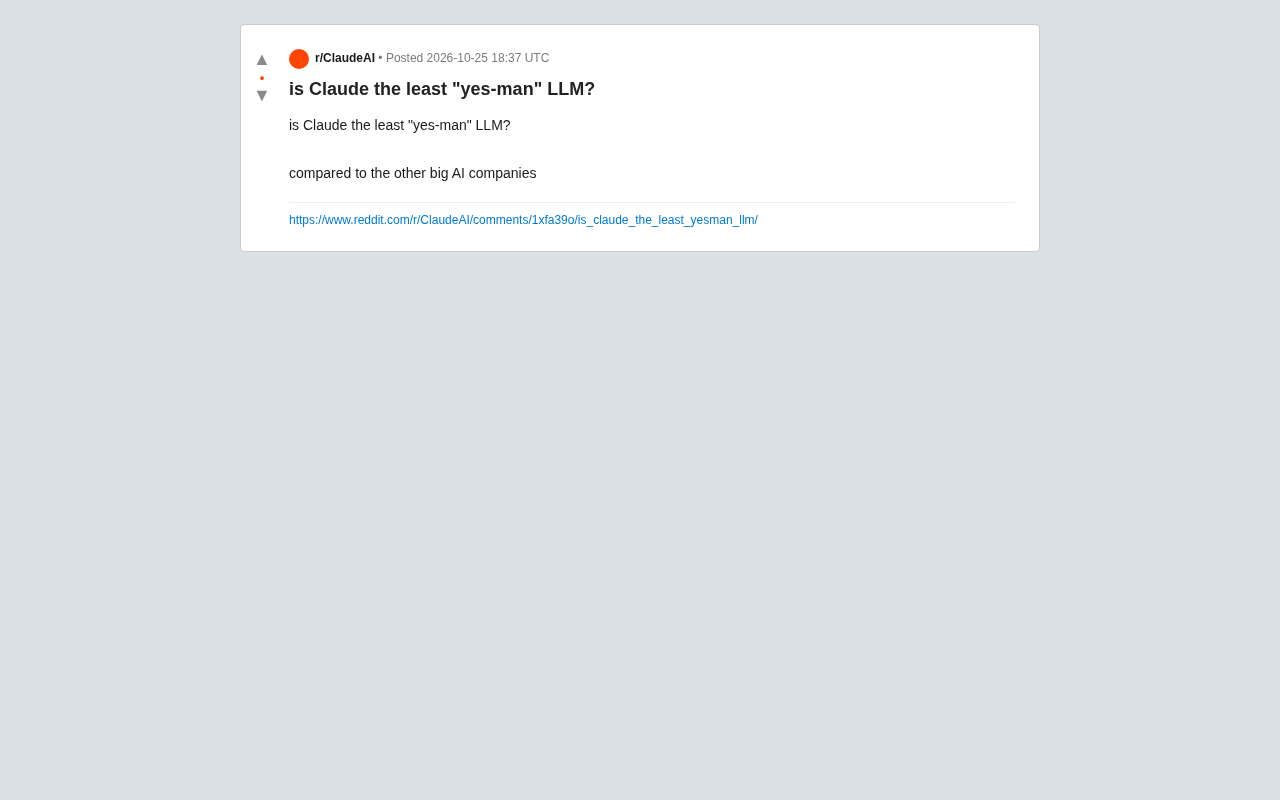
Reddit discusses whether Claude is the least "yes-man" LLM. This article analyzes Claude's honesty design, comparisons with other models, and users' real attitudes toward AI people-pleasing.