OpenAI Enters Singapore: A Comprehensive Guide to the Multi-Year AI Partnership
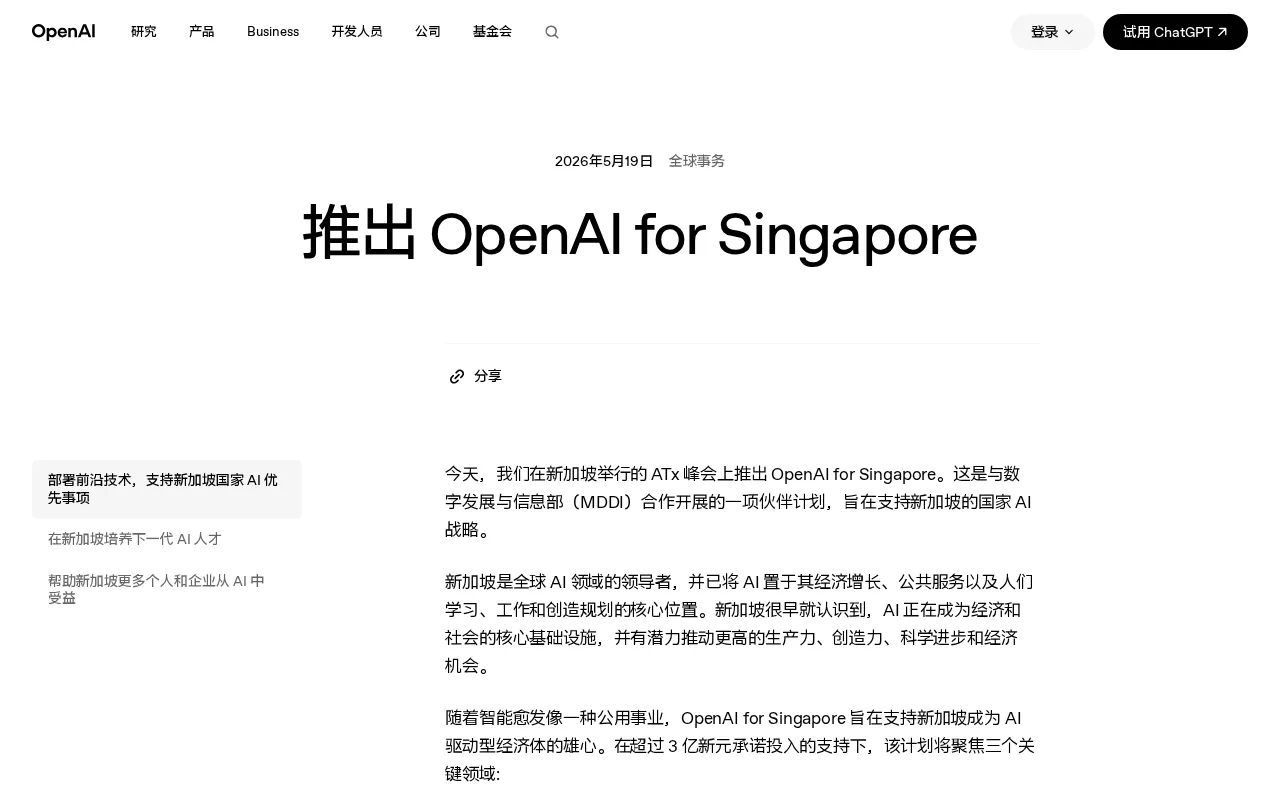
OpenAI establishes a multi-year strategic partnership with Singapore for AI deployment, talent, and public services.
OpenAI has launched "OpenAI for Singapore," establishing a multi-year strategic partnership covering three core areas: expanding AI deployment at scale, cultivating local AI talent, and empowering enterprises and public services. Singapore's favorable policy environment, robust infrastructure, Southeast Asian regional reach, and strong IP protections make it a critical node in OpenAI's Asia-Pacific strategy.
Overview
OpenAI recently announced the launch of "OpenAI for Singapore," marking the AI giant's formal multi-year strategic partnership with Singapore. The initiative spans multiple dimensions including expanded AI deployment, local talent development, and AI support for enterprises and public services — a pivotal step in OpenAI's Asia-Pacific strategy.
Core Elements of the Partnership
Expanding AI Deployment at Scale
OpenAI will expand the reach of its AI technology deployment in Singapore. Local enterprises and government agencies will gain more convenient access to OpenAI's advanced AI capabilities, including GPT-series large language models and related API services.
Technical Background: The GPT (Generative Pre-trained Transformer) series is a family of large language models developed by OpenAI based on the Transformer architecture, having undergone multiple iterations since GPT-1. The core principle involves unsupervised pre-training on massive text datasets, enabling the model to understand and generate natural language, followed by alignment optimization through techniques like RLHF (Reinforcement Learning from Human Feedback). API services are OpenAI's primary commercialization channel — enterprises don't need to build their own models; they simply call standardized interfaces to embed GPT's language understanding, code generation, and content creation capabilities into their own products. This "AI-as-a-Service" (AIaaS) model dramatically lowers the barrier to enterprise AI adoption and serves as the core vehicle for OpenAI's global commercial expansion.
For a city-state that has made digital transformation a national strategy, this represents a significant upgrade in technological infrastructure.
From a practical deployment perspective, scaling up means local users can enjoy lower-latency service responses while data processing better meets regional compliance requirements. Singapore is one of the Asia-Pacific region's densest data center markets, hosting regional nodes from major global cloud providers including AWS, Google Cloud, Microsoft Azure, and Alibaba Cloud. Notably, constrained by scarce land resources and power supply pressures, the Singapore government imposed a moratorium on new data center approvals from 2019 to 2022, only reopening after introducing green energy standards. This means OpenAI's deployment expansion in Singapore will more likely leverage existing cloud providers' infrastructure rather than independently building physical data centers. For AI inference services, local nodes can compress API response latency from 150-200ms (cross-ocean) to under 20ms — critical for latency-sensitive applications like financial transaction analysis and real-time customer service.
Local AI Talent Development
Talent development is another key pillar of the initiative. OpenAI has committed to helping Singapore build a local AI talent pipeline, with specific measures likely including:
- Technical training programs for developers
- Collaborative research with local universities such as the National University of Singapore and Nanyang Technological University
- Tools and resource support for the developer community
As global competition for AI talent intensifies, this initiative carries long-term strategic significance for Singapore's technological competitiveness.
Empowering Enterprises and Public Services
The plan places particular emphasis on AI empowerment for both the commercial sector and public services. As Asia's financial center and trading hub, Singapore's finance, logistics, and healthcare industries all present enormous potential for AI applications.
That said, the Singapore government has been actively driving its Smart Nation initiative, and AI applications in public services span a wide range — from improving administrative efficiency to optimizing citizen services — all of which will be priority areas for the partnership.
Strategic Context: Why Singapore
Policy and Infrastructure Advantages
Multiple factors drive Singapore's position as a critical node in OpenAI's Asia-Pacific strategy:
- Favorable policy environment: The Singapore government maintains an open stance toward AI technology and has issued multiple AI governance frameworks, providing a clear regulatory environment for technology deployment. Notably, the National AI Strategy 2.0 (NAIS 2.0), officially released in 2023, established Singapore's dual objectives in AI: becoming a global exemplar of "AI for the Public Good" while building an internationally competitive AI industrial ecosystem. NAIS 2.0 particularly emphasizes a "Trusted AI" framework, requiring AI systems to demonstrate explainability, fairness, and safety, supplemented by the published AI Governance Framework for enterprise reference. This regulatory approach sits between America's relaxed self-regulation and the EU's strict legislation, forming a distinctive "Singapore path" — precisely the kind of pragmatic yet open policy environment that attracts leading AI companies like OpenAI to use it as an Asia-Pacific strategic anchor.
- Robust infrastructure: As one of the world's most data-center-dense regions, Singapore possesses the hardware capabilities to support large-scale AI deployment
- Regional radiation effect: Singapore serves as a commercial gateway to Southeast Asia, capable of reaching the entire ASEAN market of 680 million people. ASEAN is one of the world's fastest-growing digital economies — according to the e-Conomy SEA report jointly published by Google, Temasek, and Bain, Southeast Asia's digital economy is projected to exceed $1 trillion by 2030. With its English-language business environment, robust financial system, and deep economic ties with ASEAN nations, Singapore naturally serves as a "beachhead" for multinational AI enterprises entering the Southeast Asian market. The partnership ecosystem, talent networks, and regulatory experience that OpenAI builds in Singapore can be replicated at relatively low cost to populous countries like Indonesia, Vietnam, and the Philippines.
- Intellectual property protection: A well-established legal system provides reliable institutional safeguards for technology collaboration
Positioning in the Global AI Competitive Landscape
OpenAI's move also reflects the accelerating internationalization trend among top global AI companies. As countries develop their own national AI strategies, establishing deep partnerships with forward-thinking governments has become a critical path for AI enterprises to expand their global influence.
This "national-level partnership" model, compared to purely commercial expansion, enables deeper technology deployment and ecosystem development. For OpenAI, Singapore serves both as a commercial market and as an Asia-Pacific window for demonstrating responsible AI development principles.
Technical Underpinnings of Responsible AI: OpenAI promotes its "responsible AI" philosophy globally, with one core technical pillar being RLHF (Reinforcement Learning from Human Feedback). This technique involves human annotators rating model outputs to train a "reward model"
Related articles
Meta Muse Hits 900K Downloads in Six D…
Meta Muse Hits 900K Downloads in Six Days: The AI Agent Era Has Officially Arrived
Meta's AI agent Muse hit 902K downloads in 6 days, topping US App Store and Google Play charts above ChatGPT and Claude. A deep dive into Muse's capabilities and the AI Agent race.
 Industry Insights
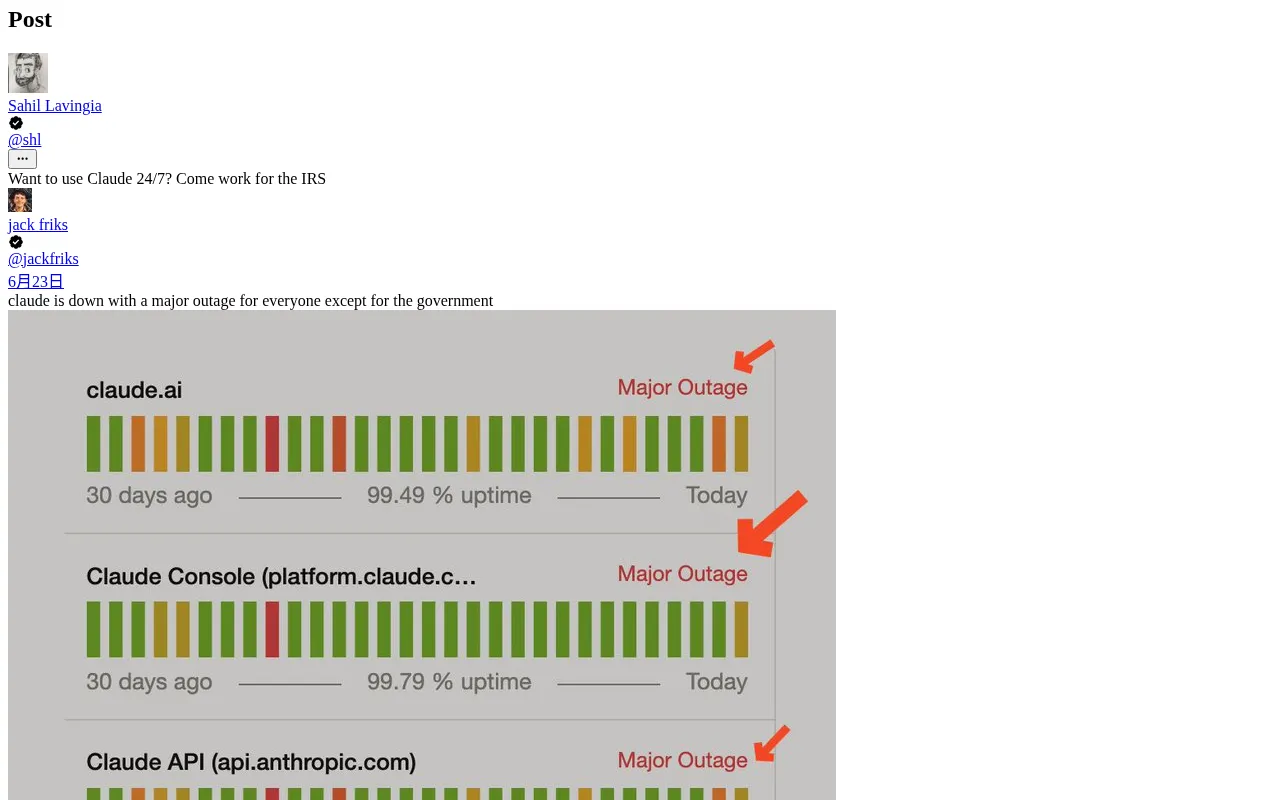
IRS Fully Embraces Claude AI, Accelerating Federal Government's AI Adoption
The IRS is recruiting staff with 24/7 Claude AI access, marking Anthropic's breakthrough into the federal government. Explore the strategic implications and tax use cases.
 Industry Insights
The IRS Mobile App Debate: A Trust Crisis in Government Digital Transformation
The IRS's proposed mobile app has sparked heated debate. This article analyzes the core arguments, exploring data security, privacy, and the trust crisis in government digital transformation.