OpenAI Exposes Model Distillation Attack: How to Protect AI Reasoning Capabilities from Theft
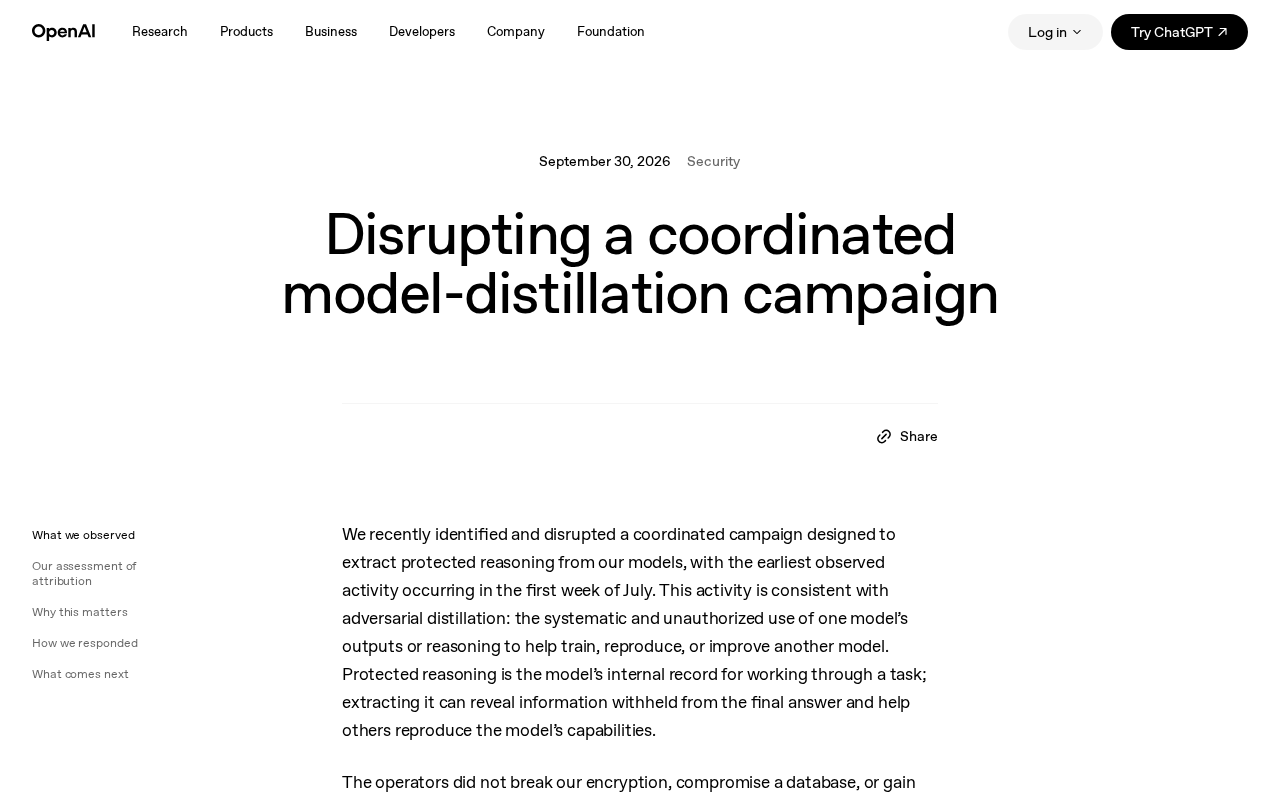
OpenAI disrupts a coordinated model distillation attack, revealing AI reasoning as a new IP battleground.
OpenAI has publicly disclosed a coordinated attack targeting its model reasoning capabilities through adversarial distillation, and detailed its defensive countermeasures. While model distillation is a legitimate compression technique, attackers can exploit it by systematically collecting reasoning outputs at scale to replicate frontier model capabilities at low cost — posing a serious IP threat. With the rise of reasoning models, the "thinking process" has become the most valuable distillation target due to its prohibitively high training cost. This incident marks a shift in AI security from content abuse and jailbreaks to deeper intellectual property protection challenges.
Recently, OpenAI publicly disclosed a coordinated model distillation attack campaign and described the defensive mechanisms it has built against such adversarial distillation activity. This incident reveals a subtle yet serious security threat facing today's frontier AI models — protected model reasoning capabilities have become a prime target for attackers.
What Is a Model Distillation Attack
Model distillation itself is a well-established and legitimate technique: a smaller "student model" learns from the outputs of a more powerful "teacher model," achieving performance close to the larger model while keeping computational costs low. This is widely used in AI engineering for model compression and deployment optimization.
However, when this technique is applied in unauthorized contexts, its nature changes entirely. Attackers send large volumes of systematic requests to a target model, collect its outputs — especially those that reflect the model's core reasoning process — and then train their own model to "replicate" the target model's capabilities. This is essentially theft of the intellectual property and competitive advantage that model developers have invested enormous resources to build.
What OpenAI disclosed this time was not scattered abuse, but a "coordinated, organized" distillation campaign. This implies clear intent and large-scale operation, with the goal of extracting the model's protected reasoning logic. Compared to ordinary API abuse, this type of attack poses a far more direct threat to model developers.
From a technical standpoint, adversarial distillation attacks typically unfold in several stages: attackers first design a prompt library covering a wide range of task types, then use automated scripts to send massive volumes of requests to the target model's API, systematically collecting input-output pairs — with particular emphasis on responses that include complete chain-of-thought reasoning. This data is then used as training data to train a "student model" via supervised fine-tuning (SFT) or reinforcement learning. Since the student model learns directly from the teacher model's output distribution rather than training from scratch, its convergence speed and final performance often far exceed what a model of the same scale could achieve through conventional training. This is why even without access to the target model's weights, attackers can achieve high-quality capability transfer through a black-box API. The essence of adversarial distillation is transferring model capabilities from "parameter space" to "data space," then re-solidifying them into new parameters.
Why Reasoning Capabilities Have Become the Attack Target
With the rise of reasoning models, a model's value is increasingly reflected in its "thinking process" rather than simply its answer output. High-quality reasoning chains are often the most expensive and hardest-to-replicate part of model training, embodying the accumulation of massive data, compute, and training methodology.
For attackers, directly replicating the training pipeline of a frontier model is nearly impossible — but collecting the model's reasoning outputs at scale to perform "reverse distillation" offers a shortcut. This explains why OpenAI treats protecting model reasoning as a defensive priority: once reasoning capabilities are successfully distilled, attackers can obtain near-frontier model performance at very low cost.
The stealthy nature of these attacks lies in the fact that a single request looks indistinguishable from normal usage. Only by analyzing the overall request patterns, behavioral characteristics, and scale can coordinated distillation attempts be identified.
Reasoning models are a major direction in recent AI development, with representative products including OpenAI's o1/o3 series and DeepSeekAd-R1. Unlike traditional language models that generate answers directly, reasoning models produce an internal "thinking trace" before the final output — progressively decomposing problems, verifying intermediate steps, correcting erroneous paths, and ultimately delivering more reliable answers. This capability shows significant advantages on challenging tasks like mathematics, coding, and logical inference, but its training cost is extremely high — typically requiring large-scale reinforcement learning (RL) combined with carefully designed reward models. This is precisely why reasoning trace outputs become the most valuable collection target for adversarial distillation: attackers don't need to replicate the expensive RL training pipeline; they simply use the collected reasoning traces as supervision signals to distill a model with strong reasoning capabilities at relatively low cost.
OpenAI's Response and Defensive Reinforcement
According to OpenAI's disclosure, the company not only successfully disrupted this distillation campaign but is also continuously strengthening its defenses against adversarial distillation. While the original disclosure did not elaborate on specific technical measures, industry-standard defenses of this type typically involve anomalous request pattern detection, account behavior analysis, rate limiting, and identification and interception of suspicious bulk API calls.
For the broader AI industry, this incident is significant. It demonstrates that as the commercial value of frontier models increases, the "arms race" around model capabilities has expanded beyond traditional content abuse and jailbreak attacks into the deeper domain of intellectual property protection. Model providers need to strike a balance between offering open API capabilities and protecting their core assets.
Defending against adversarial distillation poses unique technical challenges: a single legitimate API call and a single malicious distillation call are formally identical — the key to distinguishing them lies in the overall behavioral pattern rather than any individual request. Common detection dimensions in the industry include: abnormal request diversity (covering an extremely wide range of task types in a short period, exhibiting "exploratory" rather than "utilization" characteristics), downstream account behavior (whether bulk data export is occurring), systematic prompt structure (highly templated, with obvious variable substitution patterns), and a disproportionate ratio of response volume to account tier. Some providers also embed semantic-preserving watermarks (model watermarking) in their outputs to trace the origin in suspected distilled models' outputs, providing technical evidence for legal accountability. These defensive measures must accurately identify malicious behavior without disrupting normal high-frequency usage — making this a continuously evolving adversarial process.
Implications for the AI Ecosystem
This incident also raises broader questions about AI governance. On one hand, legitimate distillation technology promotes the democratization of AI, enabling more developers to deploy efficient models. On the other hand, adversarial distillation could undermine model developers' motivation to continue investing in R&D.
Defining the boundary between fair use and malicious extraction — and how to effectively distinguish the two at a technical level — will be a long-term challenge for AI service providers. For developers using large model APIs, this also serves as a reminder that large-scale calling behavior may trigger risk controls from providers, and compliant usage is the sustainable path forward.
OpenAI's proactive disclosure and explanation of its defensive measures also signals to the outside world: the security boundaries of frontier models are being redefined, and protecting model reasoning capabilities has become an indispensable part of the AI security agenda.
Related articles

Chain of Thought Isn't Just for AI: How Humans Can Use CoT to Improve Thinking Quality
Chain of Thought isn't just a prompt trick for large models. Starting from a Hacker News discussion, this article analyzes why CoT works for human thinking too, breaks down actionable ways to transfer it, and highlights the key differences between human CoT and machine CoT.
Cloudflare Teams Up with OpenAI: Closi…
Cloudflare Teams Up with OpenAI: Closing the Loop from Vulnerability Discovery to Defense with AI
Cloudflare uses OpenAI Daybreak to investigate security vulnerabilities and generate reviewable remediation plans, while developers use Codex to boost coding efficiency and quality.

Orca Multi-Agent Orchestration in Practice: A Guide to Parallel Collaboration with Claude and Codex
Orca is Stable AI's free open-source agent workbench supporting 34 agents like Claude Code and Codex in parallel. Learn its Git worktree isolation, multi-model orchestration, and mobile management.