OpenAI Extends Daybreak Program to Ukraine to Support Civilian Infrastructure Cyber Defense

OpenAI opens its Daybreak cyber defense program to Ukraine, marking AI's entry into national critical infrastructure protection.
OpenAI has announced it is opening the Daybreak program to the Ukrainian government, specifically for civilian infrastructure cyber defense. Ukraine's critical systems — power, communications, and finance — face sustained cyberattacks, and AI tools could provide scalable support for threat detection, vulnerability analysis, and incident response. OpenAI has explicitly scoped the collaboration to civilian defense to establish ethical boundaries and avoid offensive use. This reflects a broader industry trend of leading AI vendors moving into national security, with key questions remaining around capability enforcement, data sovereignty, and the potential international demonstration effect.
OpenAI Extends Daybreak Program to Ukraine
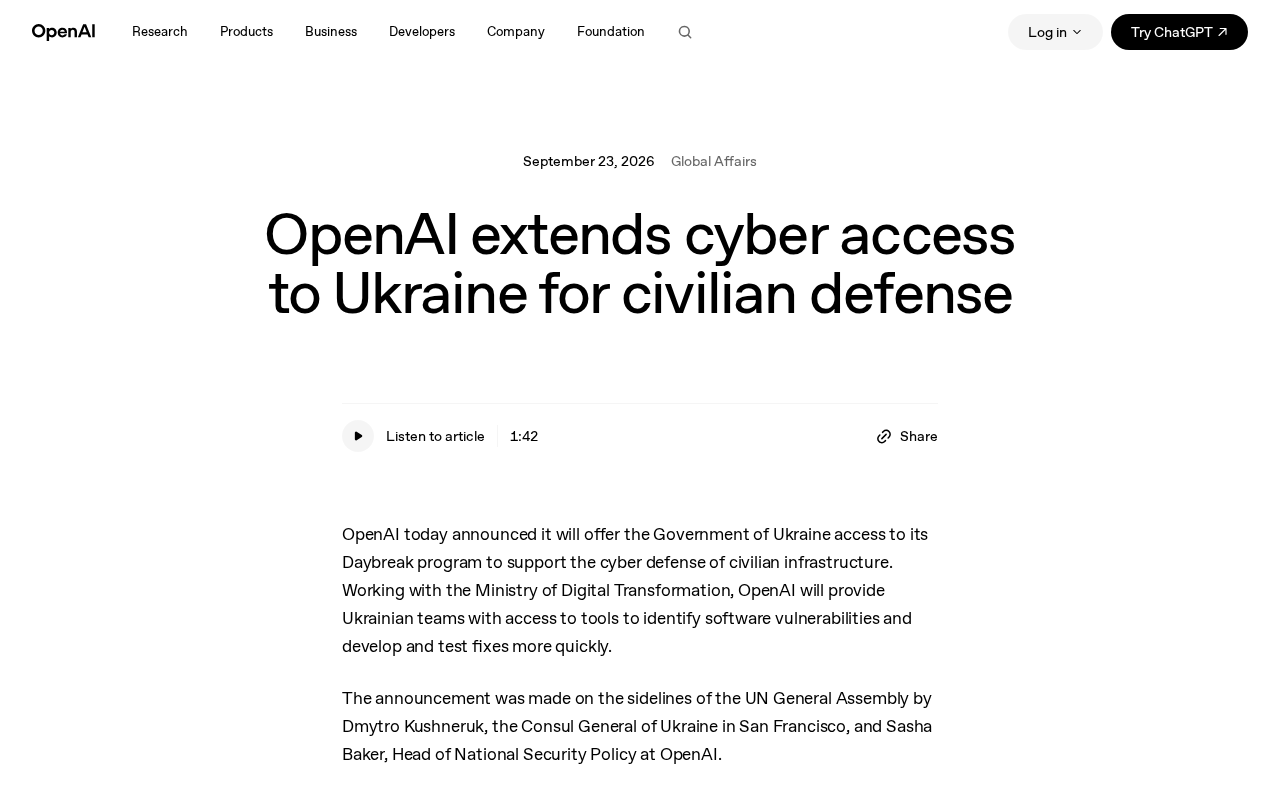
OpenAI has announced it is extending access to its Daybreak program to the Ukrainian government in support of the country's civilian infrastructure cyber defense. This move marks a further deployment of AI capabilities in national-level cybersecurity, and reflects a shifting role for major AI institutions amid geopolitical conflict.
For Ukraine, critical civilian infrastructure — including power, communications, finance, and government systems — has long been under sustained, high-intensity cyberattack. Bringing advanced AI tools into the defensive framework means Ukraine could gain stronger automation and scale in areas such as threat detection, incident response, and vulnerability analysis.
What the Daybreak Program Represents
According to OpenAI, the core purpose of the Daybreak program is to provide AI access tailored to cyber defense scenarios. Unlike standard general-purpose model access, partnerships with governments and critical infrastructure operators typically involve stricter usage boundaries, data handling requirements, and security review processes.
A Focus on "Defense," Not "Offense"
Notably, OpenAI has explicitly scoped this collaboration to "civilian defense." This phrasing is deliberate — it draws an ethical and compliance line defining how AI capabilities may be used: to protect civilian infrastructure from attack, not to conduct offensive cyber operations. This framing helps reduce the controversy risk of AI being misused in military offensive scenarios.
Typical Value of AI in Cybersecurity
In cyber defense practice, AI can typically contribute in the following areas:
- Threat intelligence analysis: Rapidly processing large volumes of logs and alerts to identify anomalous patterns;
- Vulnerability identification and remediation guidance: Helping security teams locate potential weaknesses in code or systems;
- Accelerated response: Providing faster analysis and decision support during an attack to shorten response times;
- Capability amplification: Enabling smaller teams to achieve greater defensive coverage when security staffing is limited.
These capabilities carry significant practical value for parties that have long faced sustained cyber pressure with relatively constrained security resources.
Daybreak is OpenAI's cybersecurity collaboration program specifically designed for governments and critical infrastructure operators — distinct from its standard enterprise API access or ChatGPT Enterprise product lines. The program's core logic is to provide model access with customized restrictions for institutions with defensive needs, paired with stricter usage policy reviews, compliance frameworks, and dedicated technical support channels. Based on available public information, Daybreak is not an open-application general program; rather, OpenAI proactively identifies and invites specific partners to participate. This gives it a degree of policy-instrument character — OpenAI uses it to signal its position and boundaries in geopolitical conflicts, beyond pure commercial logic.
From Commercial AI to National Security Infrastructure
This collaboration reflects a broader trend: leading AI vendors are gradually extending beyond purely consumer and enterprise products into national security and critical infrastructure protection. When AI models become sufficiently capable, they become a variable for both attackers and defenders alike — making it essential for AI institutions to define use cases and set clear boundaries.
OpenAI's choice to use "civilian infrastructure defense" as its entry point is, in some sense, an attempt to establish a relatively acceptable paradigm for AI use in sensitive domains: oriented toward protection rather than destruction, and toward civilian rather than military ends.
This shift is driven by both technical and industry factors. On the technical side, large language models' combined capabilities in natural language understanding, code analysis, and pattern recognition make them a natural fit for cybersecurity tasks such as log parsing, attack chain reconstruction, and vulnerability code review — areas where traditional security tools often rely on rule bases or specialized models with weaker generalization. On the industry side, Microsoft (through its early investment in OpenAI and deep integration with Azure security products), Palantir, Google, and others have already established significant footprints in the government and defense market, creating competitive pressure that is pushing AI-native companies to find compliant pathways into this high-value market. OpenAI's current collaboration can be viewed as a publicly documented case study in its commercial exploration of the government market.
Potential Implications and Open Questions
This collaboration also raises several issues worth watching. The first is practical enforcement of capability boundaries — how to ensure at a technical level that AI is used only for defensive purposes and does not spill over into offensive scenarios. The second is data and security governance — government-level critical infrastructure data is extremely sensitive, and maintaining data sovereignty and security while leveraging advanced AI remains a challenge.
The third is the demonstration effect. When a leading AI company provides support under the banner of national cyber defense, other AI vendors and nations may follow suit, potentially triggering a new round of competition in how AI shapes the offense-defense dynamic in cyberspace.
Given the limited public information currently available, technical details about the Daybreak program, its specific delivery form, and the depth of the collaboration all await further disclosure from OpenAI.
Summary
OpenAI's extension of the Daybreak program to Ukraine is a landmark case of AI technology moving from general-purpose applications into critical infrastructure security. It demonstrates both the real-world value of AI in cyber defense and once again brings to the fore the question of how AI capabilities can be used responsibly. As more details emerge, the practical impact and industry implications of this collaboration will become clearer.
Related articles

STCNet: Dual-Domain Spatiotemporal Consistency Learning for Sparse-View 4D CBCT Reconstruction
STCNet proposes a sparse-view 4D CBCT reconstruction framework requiring only 16 projections per respiratory phase, achieving superior PSNR and SSIM over traditional and deep learning baselines on TCIA-LUNG and CIRS datasets through dual-domain spatiotemporal consistency learning.

Lifting: A New Framework for Quantum State Discrimination in Mid-Circuit Measurements
Lifting is a quantum state discrimination framework for mid-circuit measurements, using repetition encoding, neural decoding, and in-situ calibration to improve MCM reliability on superconducting quantum processors.

ProTok: A Unified Protein Tokenizer via Multi-Codebook Quantization
ProTok introduces a unified protein tokenizer using modular multi-codebook quantization and modality dropout to map sequence, structure, and function into one discrete vocabulary. It ranks 1.4 on average in StructTokenBench, reaches 0.939 lDDT on CATH, and generates 52% designable backbones.