OpenAI Forms Math & AI Advisory Group to Vet AI Research Claims

OpenAI forms an independent math advisory group to vet AI research results before publication.
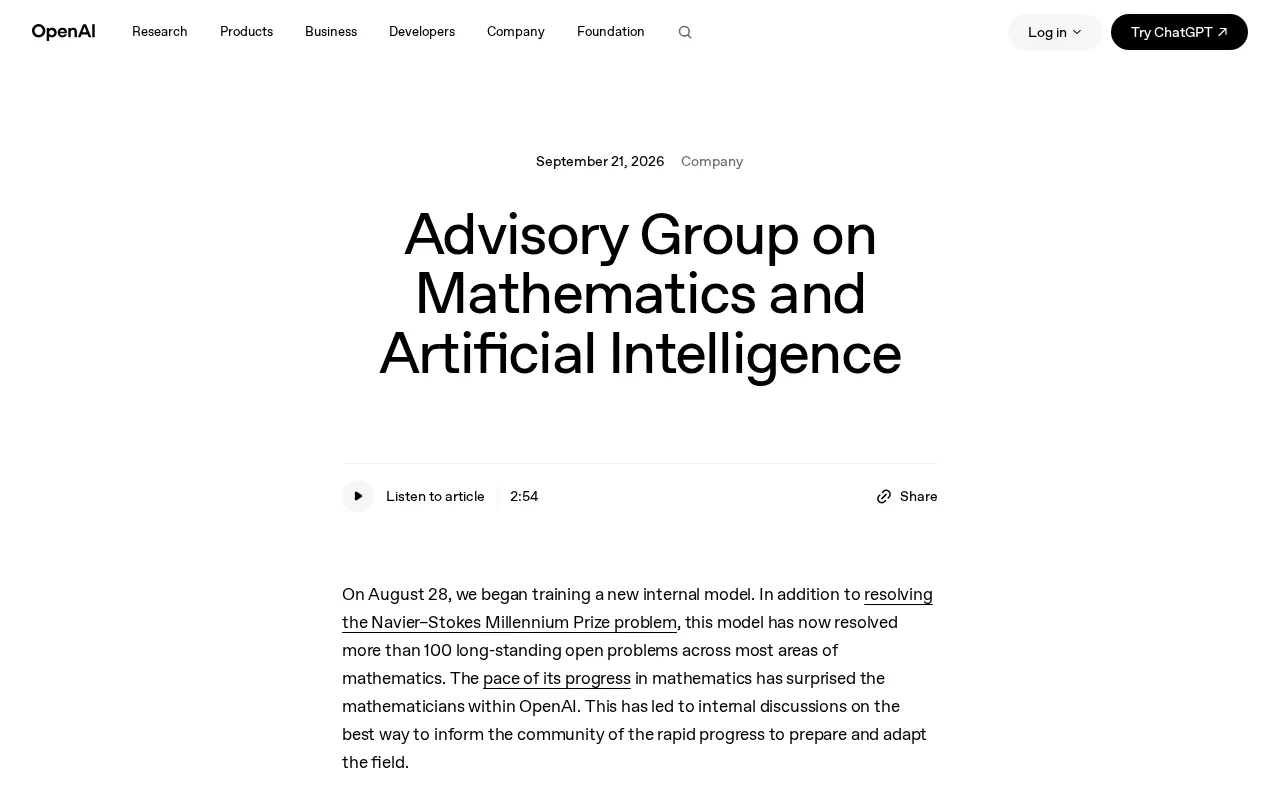
OpenAI has announced a collaboration with an independent "Advisory Group on Mathematics and Artificial Intelligence," covering both technical review and public communication of AI math findings. Because mathematics has clear right-or-wrong standards, it's both an ideal AI benchmark and a field prone to hype — several recent claims of AI "solving" math competitions were later found to have methodological flaws. The group aims to verify rigor and shape messaging before results go public, bridging industry speed with academic-style scrutiny. Key details on membership and processes remain undisclosed.
OpenAI Establishes an Independent Math & AI Advisory Group
OpenAI has announced it is working with an independent "Advisory Group on Mathematics and Artificial Intelligence" to guide the review and public communication of emerging AI research findings. While details remain limited, the move reflects a broader effort by AI research organizations to establish more rigorous third-party oversight as model capabilities grow increasingly complex.
As large language models continue to push the boundaries of mathematical reasoning and theorem proving, the question of how to objectively evaluate and accurately communicate these results to the public has become impossible to ignore. By bringing in an independent advisory group, OpenAI is adding a layer of expert scrutiny to its results before they go public.
Why Mathematics Needs Independent Review
Mathematics serves as a critical "litmus test" for AI reasoning capabilities. Unlike open-ended natural language generation, math problems generally have clear right-or-wrong answers — which makes the field both an ideal benchmark for measuring model performance and an area where the risks of exaggeration or misinterpretation are especially high.
In recent years, there has been no shortage of headlines claiming that AI has "solved" certain categories of mathematical problems — but some of those conclusions later turned out to have methodological flaws, or presented results in overly optimistic terms. An independent advisory group composed of mathematics experts can help verify the rigor of methods and define the true boundaries of any findings before they are made public, guarding against hype.
Covering Both Review and Communication
Notably, OpenAI explicitly states that the advisory group's mandate covers both "review" and "communication." This means the group is involved not only in verifying results on a technical level, but also in shaping how those results are described and disclosed publicly. At a time when AI capabilities are routinely sensationalized, this kind of oversight over messaging can help ensure the public receives a more accurate picture.
Recent benchmark controversies offer useful context here. Some models were announced as having "solved" International Mathematical Olympiad (IMO) problems, only for closer inspection to reveal logical leaps in the model's answers, or reliance on problem variants that had leaked into training data. Another common issue is data contamination — when test problems have already appeared in pretraining corpora, a model's high score looks more like memorization than genuine reasoning. These cases illustrate why benchmark scores alone are insufficient to judge whether a model has truly mastered mathematical reasoning. Domain experts need to walk through the solution process step by step, not just check whether the final answer is correct.
What "Independent" Actually Means
"Independent" is the key word in this announcement. Compared to internal self-assessment, an external team of experts has fewer conflicts of interest, and their conclusions carry greater credibility. This concept is well established in academia — peer review is one of the cornerstones of scientific credibility.
Bringing a similar mechanism into corporate AI research is, in some ways, an attempt to bridge the gap between the rapid iteration of industry and the rigorous validation expected in academia. For an organization like OpenAI, which operates under constant public scrutiny, proactively welcoming external oversight is also a strategic move for building and maintaining trust.
Academic peer review typically involves journal editors inviting anonymous experts to independently assess a paper's methods, data, and conclusions — it is the core process by which scientific knowledge earns credibility. Corporate AI research moves far faster than academic journals, and commercial interests can influence how results are presented. An external independent advisory group can therefore be seen as a lightweight alternative to peer review. Its effectiveness depends heavily on the advisors' genuine independence (i.e., no conflicts of interest), whether review conclusions are made publicly transparent, and whether the group has meaningful power to block or modify publications — rather than simply serving as a rubber stamp.
Potential Industry-Wide Implications
If this model proves effective, it could serve as a reference point for other AI labs. As model capabilities inch closer to — and in some domains surpass — expert human performance, unverified "capability claims" will become increasingly difficult to take at face value. Establishing expert advisory mechanisms for specific academic disciplines may emerge as a new standard for how frontier AI results are published.
It's worth noting that the information OpenAI has made public remains quite limited. The specific members of the advisory group, how it operates, and what its review criteria look like have not been disclosed in detail. Those details will ultimately determine whether this mechanism represents a genuine quality safeguard — or a symbolic PR gesture. The story is worth watching closely as it develops.
Related articles

JobRunner MCP Server: AI Agents Can Now Fix Failed Java Jobs
JobRunner launches an open-source MCP server enabling AI agents to view cluster status, diagnose failures, and recover Java jobs—incident response from any cloud coding environment or existing agent.

MLAI Digital Launches 9 Security Agents: MCP Server Safeguards the Full Lifecycle of Agentic AI
MLAI Digital launches Security MCP Server with nine built-in specialized security agents covering vulnerability discovery, attack simulation, prompt injection detection, API and infrastructure assessment, and accelerated remediation—embedding security validation across the full Agentic AI lifecycle from development to production.

Running Isaac Lab on H100 GPUs: Exploring Better Approaches
Exploring optimization methods for running Isaac Lab on NVIDIA H100 GPUs, including MIG configuration, mixed precision, TensorRT acceleration, and community experience to improve robotics simulation and reinforcement learning efficiency.