OpenAI GPT Live: Full-Duplex Voice AI That Listens, Speaks, and Executes Tasks Simultaneously

OpenAI's GPT Live brings full-duplex voice AI that listens, speaks, and executes tasks simultaneously.
OpenAI unveiled GPT Live, a voice AI model family built for full-duplex real-time conversation. It supports deep task delegation (offloading heavy work to GPT-5.5), multimodal interaction, near-instant translation, and time awareness. With reasoning approaching GPT-5 level, it reshapes human-machine voice interaction.
A Revolution in Voice AI Architecture: Full-Duplex Conversation Arrives
OpenAI recently unveiled GPT Live — a family of models purpose-built for conversational voice. It currently comes in two versions: the flagship GPT Live 1, and the lighter GPT Live 1 mini (free users default to the mini version).
The core breakthrough of this release lies in its full-duplex interaction capability. Full-duplex communication technology originally came from the telecommunications field, referring to the ability of both parties to send and receive signals simultaneously. Its counterpart is half-duplex — the "walkie-talkie mode" used by traditional voice assistants — where you speak, it responds, and both sides must take turns. Human face-to-face conversation is inherently full-duplex: we can nod, interject while the other person is speaking, and understand context and prepare responses at the same time. The core challenge of bringing full-duplex to voice AI is that the model must run both "listening" and "speaking" pipelines simultaneously, while sharing a single context window — placing extremely high demands on real-time inference compute scheduling and latency control.
GPT Live 1 can continuously understand what you're saying while simultaneously generating a spoken response. This means it doesn't always need to interrupt you and can handle pauses more naturally. While you're still speaking, it can signal that it's following the context with brief responses like "mm-hmm" or "got it." This mode of interaction brings machine conversation closer to the rhythm of genuine human communication for the first time.
Deep Task Delegation: Chat Up Front, Execute in the Background
The most noteworthy feature is GPT Live's "deep work delegation" mechanism.
In simple terms, GPT Live handles fast, natural real-time conversation while the more powerful GPT-5.5 runs searches and complex tasks in the background, ultimately merging the results back into the conversation flow. This architecture of a lightweight front-end model plus a heavyweight back-end model is known in software engineering as the "Orchestrator-Executor" pattern, which has been widely discussed in recent years alongside the rise of Multi-Agent research on large models. Its core idea is: use a low-latency, low-cost small model to maintain the real-time user experience, while asynchronously calling a high-reasoning large model to complete time-consuming tasks, then merging the results into the main conversation flow. This is a significant architectural shift: the voice model is no longer just there to chat with you — it can hand off the heavy lifting to a more powerful model, keeping the conversation going up front while running multiple tasks in the background.
This design shatters the capability ceiling of voice interaction. In the past, users facing complex tasks were often forced to switch to typing because voice models "weren't smart enough." OpenAI's earlier GPT-4o had already begun to combine voice with tool calling, but GPT Live pushes this mechanism into voice-first interaction scenarios — meaning "voice" is no longer a downgraded entry point with limited capabilities, but rather a first-class interaction channel on par with text interfaces. When the voice front-end is fluent enough and can call on a high-reasoning back-end model, many operations that once had to be done through text can now be accomplished simply by speaking.
Benchmarks: Voice Reasoning Approaching GPT-5 Level
Beyond fluent interaction, the real leap is reflected in hardcore capability metrics. Based on the published benchmarks, the improvements are quite significant.
A Major Leap in Knowledge Reasoning
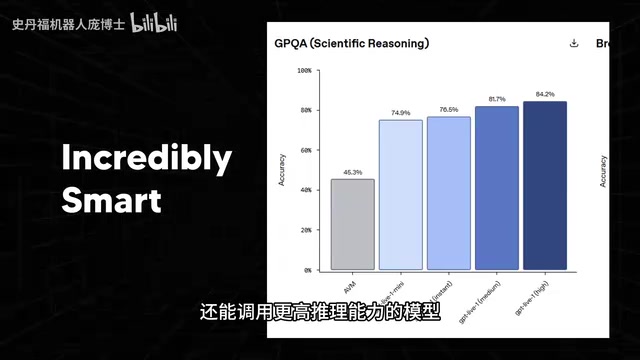
GPQA (Graduate-Level Google-Proof Q&A) is a high-difficulty scientific Q&A benchmark introduced in 2023 by institutions including New York University. Its questions span graduate-level knowledge in biology, chemistry, physics, and more, and are designed to be "difficult to answer with search engines alone," aiming to measure a model's genuine reasoning ability rather than memorization. On this test, the old advanced voice mode achieved around 45% accuracy, while GPT Live mini and the medium version reach 70% to 80% — essentially embedding near-GPT-5-level reasoning ability into voice interaction.
BrowseComp is an agentic search benchmark introduced internally by OpenAI, testing a model's ability to complete multi-step information retrieval and integration in real web environments. An extremely low score means the model can barely complete complex search tasks independently. On this test, the gap is even more dramatic: the old advanced voice mode scored less than 1%, while the free GPT Live Mini version reaches around 30%, and the high-reasoning versions reach 60% or even 75%. This is not a minor patch, but a leap in capability that users can clearly perceive. Together, these results show that GPT Live isn't merely optimized at the voice presentation layer — it has achieved a qualitative leap in knowledge density and tool-use capability.
Stress-Testing Real Phone Scenarios
The voice telecom test is especially representative, examining whether the model can cope with the complex chaos of real phone calls — accents, background noise, line drops, and even both parties talking at once. On this test, the GPT Live 1 instant version and Mini version reach about 40%, nearly double the old version; the mid-to-high versions perform close to four times the old version.
Together, these figures point to one conclusion: GPT Live isn't just more lifelike in voice — it's backed by sufficiently strong knowledge and reasoning capabilities. The combination of "natural conversation + strong reasoning" is something few competitors can currently achieve simultaneously.
Multimodal Interaction: Discussing Images by Voice, Executing Tasks in Real Time
GPT Live can also combine images with voice, letting you look at a picture while discussing what's in front of you.

In one OpenAI demo, a user said they were meeting their girlfriend's parents for the first time and wanted the model to honestly evaluate their outfit. The model first offered advice: "This style is great, but for meeting the parents, it might be a bit too flashy — you could keep the cut but switch to a more understated color." After the user changed outfits, the model continued: "This one is more relaxed and approachable, and pairing the shirt with a white T-shirt looks laid-back… if you want something sharper, you could switch to a cleaner pair of shoes." The whole exchange felt as natural as chatting with a friend.
Real-Time Task Execution On Screen
GPT Live doesn't just answer questions — it can open a mini browser and apps on screen to actually get tasks done for you.

In a weather-and-soccer demo, a user asked about the weather in Mexico City this week, and the model immediately looked it up and answered, "Mild but rainy, with daytime highs in the 70s Fahrenheit." When the user then asked about the next group-stage match time, the model promptly provided the schedule and recommended several sports bars and rooftop bars good for watching the game.
The point here isn't the answers themselves, but rather searching, organizing in real time, and then presenting the choices intuitively. AI is no longer a static blue icon, but a collaborator that can place results right in front of you — a fundamentally different entry-point experience.
Real-Time Voice Translation: The Sci-Fi Feel of Cross-Language Communication
One of the most impressive demos is GPT Live's real-time translation capability.
Simultaneous Speech Translation is a recognized high-difficulty task in computational linguistics. Its challenge is that translation must begin outputting before the source language is finished being spoken, which requires the model to have "predictive semantic understanding" — the ability to infer the speaker's intent from incomplete input. Traditional machine translation pipelines typically involve three sequential steps: speech recognition (ASR) → text translation (MT) → speech synthesis (TTS), each introducing latency. By integrating real-time translation into a full-duplex conversation framework, GPT Live must perform millisecond-level dynamic scheduling across the four processes of "listen–understand–translate–speak."
A user asked it to translate the languages it heard into English in real time, and the model immediately responded, "Sure, starting real-time translation now." Several people then chatted in different languages, introducing their favorite foods. The model listened to one language while quickly translating it into another, could smoothly switch between translation and normal conversation, and finally accurately summarized everyone's preferences.
The key lies in those two words: "nearly instant." Only when translation appears with virtually no delay do participants stop feeling like they're waiting for a machine to process, and instead feel like they're genuinely conversing. This mode of interaction — constantly receiving information and constantly giving feedback — gives real-time translation a sci-fi feel of an entirely new interface.
Time Awareness: An Invisible Yet Indispensable Capability for Voice Interfaces

GPT Live also introduces "time awareness" — the model's ability to understand the passage of time within a conversation. This detail may seem minor, but it noticeably enhances the realism of the interaction.
Traditional language models process conversation in units of "turns," where each turn of input is logically independent, and the model doesn't truly "perceive" how much time has elapsed between two utterances. A continuously running voice model is different: its audio stream is continuous, and pauses themselves are meaningful signals — 30 seconds of silence and a 3-second thinking pause are semantically completely different. Introducing time indexing into the context window means the model can distinguish whether "the user is thinking" or "the user has left," and adjust its response strategy accordingly. This is highly related to the concept of "Situational Awareness" in robotics, and is a key foundational capability for pushing AI from a "Q&A machine" toward a "continuous collaboration partner."
Once voice becomes a key interface, the model must have complete context: it must be interruptible, remember the instructions you just gave, and sense that time is passing. In a coffee-brewing demo, a user asked how long to bloom a light-roast V60, and the model answered "30 to 45 seconds." The user then asked it to time 30 seconds, and the model said, "The 30-second timer has started, and I'll remind you when it's done." When the user found there was no water in the kettle, the model didn't throw an error but continued offering remedial suggestions. This kind of coherent, time-aware collaboration is exactly where many earlier voice models fell short.
Conclusion: Voice Is Becoming AI's Truly Usable Primary Interface
As the OpenAI team put it, we'll increasingly interact with models in more natural ways. The significance of GPT Live lies in "bringing AI into real-time voice collaboration."
From full-duplex conversation, to deep task delegation, to multimodal interaction, real-time translation, and time awareness, GPT Live represents not a stacking of isolated features, but a reconstruction of the interaction paradigm. When voice becomes AI's truly usable primary interface, the barrier to human-machine communication will be dramatically lowered — and this may well be the most far-reaching impact of this release.
Key Takeaways
Related articles

@ai-sdk/vue 3.0.306 Patch Release Syncs with [email protected] Update
@ai-sdk/vue 3.0.306 released, synced with [email protected]. A routine patch release for the Vercel AI SDK ecosystem with no public API changes; the Vue adapter layer stays version-aligned with the core package.

Gemini 4 Argon API Launches: The Era of Million-Token Output Begins
Google launches Gemini 4 Argon with sparse MoE architecture, up to 1M output tokens, and a 68.90% Vals Index score, available across API, AI Studio, and the Gemini app.

DukaanAI: Turning Product Photos into Inventory Lists with Open-Source AI
DukaanAI is an AI inventory tool for small retailers that turns product photos into inventory entries using the open-source Gemma 3 model, with local inference, editable fields, and CSV export.