OpenAI Hasn't Released a New Model in 72 Days — Is It Holding Back a Big Launch to Snipe Anthropic's IPO?

OpenAI hasn't released a frontier model in 72 days, and the community speculates it may be delaying a launch to snipe Anthropic's IPO.
OpenAI has gone 72 days without releasing a new frontier model, a gap that coincides with competitor Anthropic's anticipated IPO and has sparked speculation about its release strategy. One unconfirmed theory suggests OpenAI may be deliberately delaying its next model to capture media and developer attention around Anthropic's IPO, turning model releases into strategic tools. Opponents argue that training larger models inherently takes longer and that release timing is hard to synchronize precisely. Regardless of the cause, the dry spell has had a real impact on developers: agent builders tend to defer major architectural decisions, creating a waiting game. The discussion also extends to community expectations for the next model's reasoning, context, and agent capabilities.
Background: OpenAI's "Silent Period" Sparks Speculation
A recent Reddit discussion has drawn attention: OpenAI has gone 72 days without releasing a new frontier model. That gap is unusual given the company's previously fast-paced release cadence, especially at a time when competitors are frequently making major announcements. Some suggest OpenAI may be deliberately delaying its next model to steal the spotlight around Anthropic's anticipated IPO. While unconfirmed, the slowdown in release cadence has indeed fueled community speculation about the strategy behind it.
A frontier model typically refers to the most capable, largest, or most expensive-to-train foundation model available at a given time, representing a lab's technical ceiling. Examples include GPT-4, Claude 3 Opus, and Gemini Ultra, each considered frontier models in their respective eras. Unlike smaller cost-optimized models, frontier model releases often serve as industry bellwethers, influencing developer choices, capital expectations, and competitors' roadmaps. So when OpenAI goes 72 days without such a release, the community interprets it as an anomaly rather than ordinary product cadence fluctuation.
Release Timeline: From the Norm to a "Dry Spell"
In the recent past, OpenAI's model iteration has been quite rapid, with frontier model releases often treated as industry events. Now the 72-day dry spell happens to coincide with key moments for competitors. The original post notes that "OpenAI's release cadence slowed just as its rivals hit their biggest moment." This timing coincidence gives the "IPO snipe" theory fertile ground to spread. However, there are also reasons to believe that training larger models inherently requires longer cycles, and the delay may be a technical cost rather than a strategic choice.
The IPO Snipe Theory: Strategy or Coincidence?
Proponents of the "snipe theory" argue that model releases have become carefully orchestrated events. If labs start scheduling releases around competitors' fundraising moments, then the release calendar is not just a capability showcase but a strategic tool. Launching a major model during Anthropic's anticipated IPO could capture media and developer attention, indirectly influencing market sentiment.
But opponents point out that this claim lacks evidence. Model training is highly uncertain, making it hard to time releases precisely to an IPO. Moreover, if OpenAI were deliberately sniping, it would bear the competitive risk of delay—rivals could use the time to entrench their market position.
An Anthropic IPO refers to a potential initial public offering by AI safety company Anthropic. Founded by former OpenAI researchers, Anthropic's Claude series is one of the main competitors to the GPT series. For an AI lab, an IPO is not just a fundraising event but a critical moment to prove its technical strength and commercial prospects to public markets. If a competitor releases a major model at that time, it could divert media attention, affect investor sentiment, and even change perceptions of the technical gap between the two companies. This is the logic behind the "IPO snipe" speculation: model releases are seen as an attention resource that can be weaponized.
Practical Impact on Developers and Agent Builders
Regardless of the cause, the release dry spell has had a real impact on developers. The original post notes that for agent builders, the practical effect is a waiting game: everyone is deferring major architectural decisions until the next frontier model lands. This "wait-and-see" state may temporarily slow the pace of innovation, as teams are reluctant to invest too much in architectures that could be upended by a new model.
This also reflects a characteristic of the current AI landscape: foundation model iteration remains the main driver of industry development, and developers' technology choices are highly dependent on the boundaries of model capabilities.
Agent builders are developers or teams building autonomous agents on top of large models. Agents typically require models to perform multi-step reasoning, tool calling, long-term memory, and reliable execution, so their architecture design is highly dependent on the underlying model's capability boundaries. For example, if the next model significantly improves long-context understanding or function-calling reliability, existing planning modules, memory modules, and error-recovery mechanisms may all need to be rearchitected. That's why during a model dry spell, agent teams tend to defer major architectural decisions—they worry that current engineering investments will be rendered obsolete by a leap in model capability, creating a collective wait-and-see state.
Community Expectations: What Should the Next Model Bring?
The discussion also raises a question: what do you want OpenAI's next model to do that current models can't? This hints at community expectations for capability breakthroughs. Possible improvement areas include stronger reasoning, longer context understanding, more efficient training and inference costs, and more reliable agent execution. However, the original post does not provide specific technical details—it's more of an open-ended discussion.
Conclusion: The Industry Logic Behind the Release Calendar
Whether OpenAI's 72-day silent period is the normal cost of training a larger model or a strategic delay aimed at Anthropic's IPO remains undetermined. But this discussion reveals a new dimension of competition in the AI industry: model releases are no longer just technical milestones but may also be part of capital and market maneuvering. For developers and observers, keeping an eye on changes in release cadence may yield more signals.
If you're interested in this kind of AI news and rumors, check out r/AINewsRumors.
Related articles
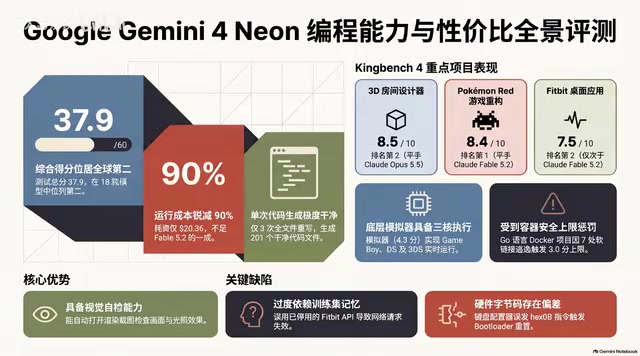
Gemini 4 Neon Hands-On: Value King or Confident Catastrophe?
Gemini 4 Neon review: 1M-token context, four thinking levels, 201 files in one KingBench4 pass at one-tenth Fable 5.2's cost—but it hallucinates fake data, leaves 7 symlink escapes, and bricks keyboards.

Google Gemini 4 Neon Hands-On: 6 3D Works That Impress and Fail
Hands-on with Google Gemini 4 Neon on a 3060 laptop: 6 3D works tested. Sunshower Fishing Harbor and mechanical keyboard impress; soft-body physics and faces fall short.
Gemini 4 Neo Web Novel Writing Test: Faint AI Flavor, Textured Dialogue
Bilibili creator's first-look review of Gemini 4 Neo for Chinese web novel writing: testing a Three Kingdoms transmigration opening with faint AI flavor, emotionally textured dialogue, and strong crisis building, plus comparison of 4A/4H/4C models and full workflow demos.