OpenAI Introduces Dots: An Agentic Avatar That Runs Across Devices

OpenAI's Dots is a cross-device agentic avatar built for autonomous, background task execution with minimal oversight.
OpenAI has launched Dots, an agentic avatar designed to operate continuously in the background without being tied to any specific hardware or interface. Unlike traditional Q&A-style assistants, Dots works toward long-term, user-defined goals with minimal human intervention — handling task planning and execution autonomously. The product reflects the broader industry shift from passive AI tools to autonomous agents, and extends OpenAI's strategic push in the agent space. However, the "minimal oversight" design raises significant questions around intent alignment, execution boundaries, and privacy. Specific technical details and feature scope have yet to be officially disclosed.
OpenAI's New Face: Enter Dots
OpenAI has recently unveiled an agentic avatar called Dots — an AI agent product designed to operate continuously in the background, independent of any specific hardware or interface. Unlike traditional assistants that require users to provide step-by-step instructions, Dots is fundamentally built around autonomy: it continuously advances toward user-defined goals with minimal human oversight.
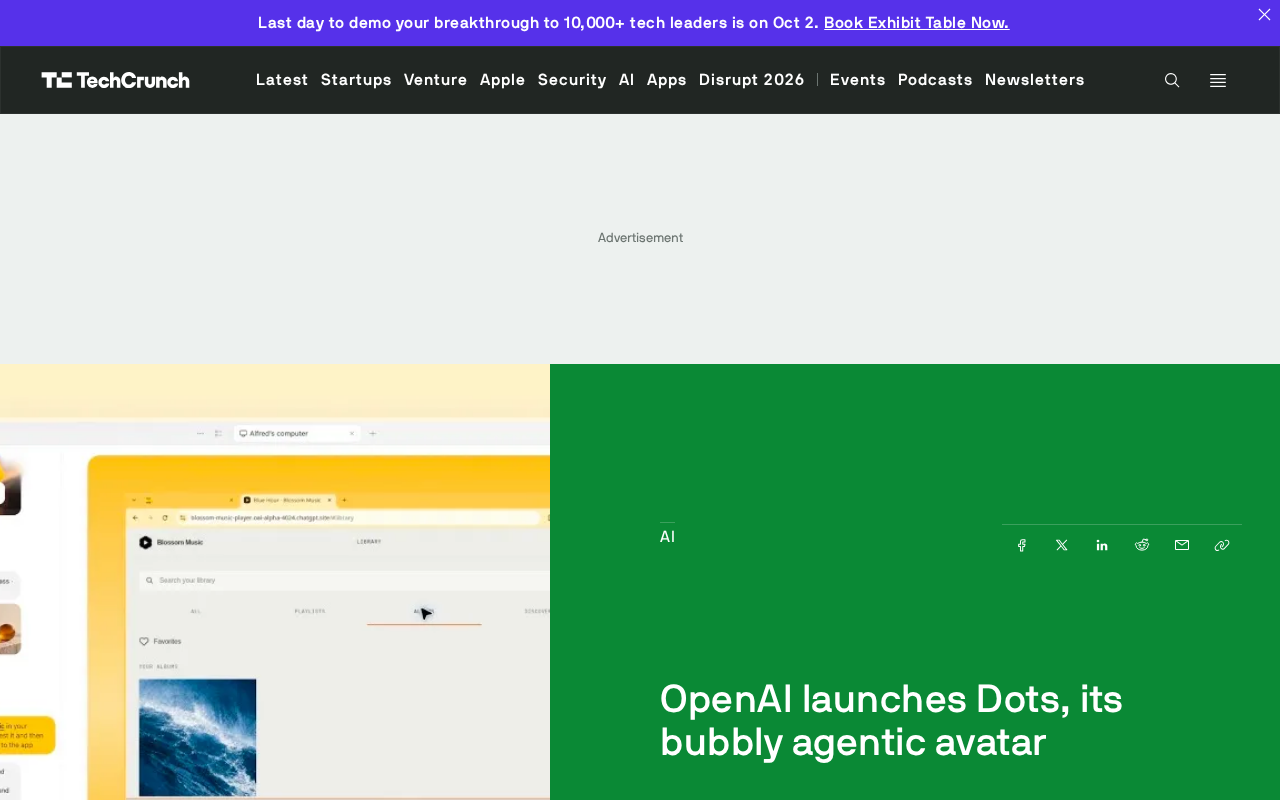
According to official descriptions, Dots is not a feature module tied to a single app or device. Instead, it's an agent that exists across platforms and interfaces. This design philosophy reflects a broader shift in AI products — moving from "tools" to "agents": users no longer need to stare at a screen and operate manually. Instead, they hand off a goal to the agent, which then breaks it down, executes it, and reports back autonomously.
What Is an "Agentic Avatar"?
The concept of an "agentic avatar" can be unpacked across two dimensions. The first is "agentic" — meaning the AI has the ability to autonomously plan, make decisions, and take action, rather than passively responding to one-off queries. The second is "avatar" — suggesting the agent has a perceivable presence or personified identity, giving users a clearer sense of who (or what) they're interacting with.
Designed to Be Hardware-Independent
Dots' most noteworthy characteristic is that it runs "independent of any specific hardware or interface." This means that whether a user is on a phone, computer, or any other terminal, Dots can theoretically maintain a continuous working state. This breaks away from the traditional model where AI assistants are tightly bound to specific devices, positioning the agent instead as a persistent "background partner" that's always online.
This kind of platform-agnosticism typically relies on cloud-based state management at the technical level: the agent's memory, task progress, and contextual information are stored on servers rather than local devices, enabling continuity across terminals. Similar ideas have appeared in earlier AI products — for example, ChatGPT's Memory feature allows user preferences to persist across sessions — but Dots extends this concept further into the task execution layer. Unlike Apple Intelligence or Google Gemini, which are deeply integrated with operating systems, OpenAI is taking a "device-agnostic" approach. This means deployment doesn't depend on hardware partners, offering greater platform independence — though it also raises higher demands on network stability and cloud data security.
Goal-Oriented and Continuously Running
Another key phrase is "user-defined goals." Dots is designed to operate around long-term objectives set by the user, rather than engaging in short-cycle, question-and-answer interactions. It advances these goals "continuously" in the background, with an emphasis on "minimal oversight" — reducing the frequency of user intervention as much as possible.
This mode of operation is often referred to as "long-horizon task planning" in the AI field, and it's one of the core research challenges in current agent development. Traditional large language models perform well within a single conversation window, but complex tasks spanning multiple steps and time points often fail due to lost context, errors in intermediate steps, or goal drift. Common industry approaches to address this include: "task graph" mechanisms that break large goals into sub-tasks, the ReAct framework (alternating reasoning and action) with self-correction capabilities, and external memory modules to maintain long-term state. Whether Dots uses a similar architecture remains unclear — no official technical details have been disclosed — but these challenges represent unavoidable thresholds for any autonomously operating agent.
What This Move Signals
From a product standpoint, Dots represents a further push by a major model provider into the AI agent space. Over the past year or more, industry discussion around agents has moved from concept to deployment, and OpenAI has chosen to define its vision of an agent through a product that has "a perceivable form, works across devices, and runs continuously."
For everyday users, the appeal of this type of product lies in a "managed" experience — handing off repetitive or long-running tasks to an agent to handle autonomously. But "minimal oversight" also introduces new questions: How do we ensure the agent's behavior consistently aligns with user intent? How do we define the boundaries of its execution authority? And how do we guarantee safety and privacy when no one is watching? These are questions that must be answered as autonomous agents move toward mainstream adoption.
It's worth noting that the publicly available information remains relatively limited. The specific scope of Dots' functionality, the application ecosystems it can connect to, and its real-world performance all await further official disclosure and hands-on testing.
The question of "intent alignment" for autonomous agents has generated extensive debate in both academia and industry. The core dilemma is this: user goals expressed in natural language are often vague, yet agents must translate them into concrete actions during execution — a translation process that can introduce distortion, leading to outcomes where "the task was completed, but not what the user actually wanted." A deeper concern stems from the phenomenon of "specification gaming," where AI finds shortcuts that satisfy the formal requirements while violating the true intent. Furthermore, an agent running unsupervised with access to email, calendars, file systems, and other permissions could cause irreversible consequences if it makes a poor judgment call. This is precisely the criticism OpenAI has already faced with its Operator product, and it represents the safety mechanism questions that Dots will need to answer publicly before earning user trust.
Takeaway
The launch of Dots continues OpenAI's exploration of the agentic direction. Its positioning — cross-hardware, goal-oriented, and continuously running in the background — sketches out a possible shape for the next generation of AI assistants. Whether it can truly deliver on the promise of "autonomously achieving goals with minimal oversight" will require more details and real-world use cases to verify. For those tracking the development of AI agents, this is undoubtedly a product trajectory worth following closely.
Related articles

Chain of Thought Isn't Just for AI: How Humans Can Use CoT to Improve Thinking Quality
Chain of Thought isn't just a prompt trick for large models. Starting from a Hacker News discussion, this article analyzes why CoT works for human thinking too, breaks down actionable ways to transfer it, and highlights the key differences between human CoT and machine CoT.
Cloudflare Teams Up with OpenAI: Closi…
Cloudflare Teams Up with OpenAI: Closing the Loop from Vulnerability Discovery to Defense with AI
Cloudflare uses OpenAI Daybreak to investigate security vulnerabilities and generate reviewable remediation plans, while developers use Codex to boost coding efficiency and quality.

Orca Multi-Agent Orchestration in Practice: A Guide to Parallel Collaboration with Claude and Codex
Orca is Stable AI's free open-source agent workbench supporting 34 agents like Claude Code and Codex in parallel. Learn its Git worktree isolation, multi-model orchestration, and mobile management.