OpenAI Invests $1 Billion in Daybreak Initiative: Using AI to Protect Critical Infrastructure
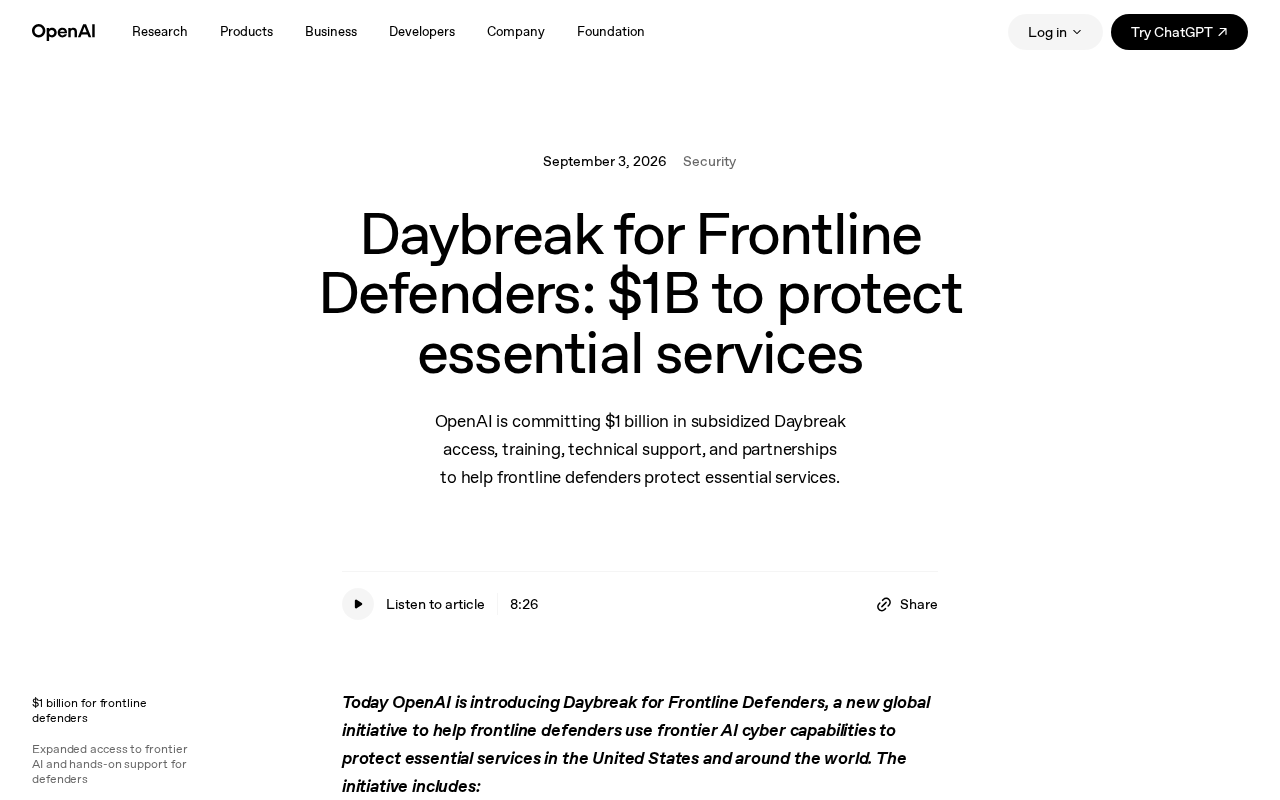
OpenAI pledges $1B to defend critical infrastructure like hospitals and power grids with AI cybersecurity tools.
OpenAI has launched the Daybreak for Frontline Defenders initiative, committing $1 billion to equip cybersecurity professionals at hospitals, utilities, and government agencies with cutting-edge AI defense tools, training, and ongoing technical support. The plan aims to close the growing gap between increasingly AI-powered cyberattacks and the under-resourced defenders of critical infrastructure.
OpenAI's $1 Billion Cybersecurity Commitment
OpenAI recently announced a major initiative called "Daybreak for Frontline Defenders," pledging $1 billion to provide frontline defenders of critical services with cutting-edge cyber AI capabilities, training, and technical support. This move marks OpenAI's formal extension of its AI capabilities into the core battleground of cybersecurity defense.
The term "Frontline Defenders" refers to cybersecurity professionals who protect hospitals, water systems, power grids, schools, local governments, and other critical public infrastructure. These organizations often face high cybersecurity risk due to limited budgets and talent shortages. According to IBM's 2024 Cost of a Data Breach Report, the healthcare industry has been the most expensive sector for data breaches for 13 consecutive years, with average losses per breach approaching $11 million — yet most small and mid-sized healthcare organizations have annual IT security budgets that are less than a tenth of that figure. By directing resources toward these "defense gaps," OpenAI aims to bridge the widening capability gap between cyber attackers and defenders.
Why Critical Infrastructure Is a Cybersecurity Focal Point
In recent years, cyberattacks targeting critical infrastructure — including healthcare, energy, and public utilities — have surged dramatically. Ransomware, supply chain attacks, and infiltration by nation-state APT groups have repeatedly brought systems directly tied to public safety to the brink.
These are not abstract threats but painful lessons already learned. In 2021, Colonial Pipeline, the largest fuel pipeline operator in the United States, was hit by the DarkSide ransomware group, disrupting nearly 45% of fuel supply to the U.S. East Coast for six days and ultimately resulting in a ransom payment of approximately $4.4 million. That same year, Ireland's Health Service Executive (HSE) suffered a Conti ransomware attack that forced the entire national public healthcare IT network offline for weeks, delaying treatment and surgeries for tens of thousands of patients. In 2023, the UK's Royal Mail suspended international parcel services due to a LockBit ransomware attack. These incidents reveal a harsh reality: when critical infrastructure is breached, the impact goes far beyond data security — it directly threatens people's daily lives and even their safety.
APT (Advanced Persistent Threat) groups are hacker organizations backed by nation-states or possessing nation-state-level resources. Their attacks are characterized by extreme stealth, long duration, and highly specific targets. Unlike ordinary hackers, APT groups may lurk within a target network for months or even years, continuously stealing intelligence or waiting for the right moment to launch a devastating attack. Well-known APT groups such as APT28 (linked to Russia), APT41 (linked to China), and Lazarus Group (linked to North Korea) have long targeted critical infrastructure as their primary objective.
The core dilemma facing defenders is this: attackers only need to find one vulnerability, while defenders must patch every single one. This asymmetry is known in cybersecurity as the "Defender's Dilemma," and it fundamentally places defenders at a structural disadvantage in the attacker-defender equation.
Making matters worse, the rise of generative AI is rapidly lowering the barrier to launching cyberattacks. Malicious actors can leverage AI to generate phishing emails, write malicious code, and automate vulnerability scanning, dramatically boosting attack efficiency. Specifically, large language models can generate highly customized, grammatically flawless phishing emails in seconds and even mimic a specific person's writing style (so-called "deepfake social engineering attacks"). AI tools can help analyze security vulnerabilities in open-source code and automatically generate exploits. AI-enhanced automated fuzzing techniques have seen efficiency gains of several dozen times over. Security firm SlashNext reported in 2024 that since the launch of ChatGPT, phishing email volume has increased by approximately 1,265%.
In this new paradigm of "AI versus AI," if defenders cannot access cutting-edge AI tools at the same pace, the security balance will tip further in favor of attackers.
The Reality of Unequal Cybersecurity Resources
Large tech companies and financial institutions may have the means to build in-house security teams and deploy advanced defense systems, but hospitals, local governments, and public schools often lack the funding and expertise. The global cybersecurity talent gap has been a longstanding issue — according to ISC² (International Information System Security Certification Consortium), the global cybersecurity workforce shortage reached approximately 4.8 million in 2024. Against this backdrop, public service organizations that are already resource-strapped find it even harder to compete with tech giants and financial institutions for scarce security talent. Many small and mid-sized hospitals don't even have a dedicated cybersecurity team; their day-to-day security operations rely entirely on part-time management by their IT departments, leaving them virtually defenseless against sophisticated cyberattacks.
OpenAI's Daybreak initiative targets precisely this structural imbalance — by making cutting-edge AI capabilities broadly accessible so that under-resourced organizations can also benefit from top-tier cybersecurity protection. This approach aligns with the "Democratization of Security" philosophy that the cybersecurity industry has championed in recent years: using technology to lower the barriers and costs of security protection, so that high-quality security capabilities are no longer the exclusive domain of large organizations.
The Three Core Pillars of the Daybreak Initiative
According to OpenAI, this $1 billion cybersecurity commitment revolves around three key areas:
First, expanding access to cutting-edge cyber AI. OpenAI will make its most advanced AI model capabilities available at lower cost — or even free — to eligible critical service organizations for security use cases such as threat detection, incident response, and vulnerability analysis.
On the technical level, AI has already demonstrated enormous potential in these security scenarios. In threat detection, traditional rule-based and signature-based detection systems (such as conventional antivirus software and intrusion detection systems, or IDS) can only identify known threat patterns and are often helpless against zero-day vulnerabilities and novel attack variants. In contrast, detection systems powered by machine learning and large language models can identify previously unseen attack techniques by analyzing anomalous patterns in network traffic, user behavior, and system logs. For example, AI can establish baseline models of normal network behavior, and once it detects activity deviating from the baseline — such as large-scale data exfiltration in the middle of the night or unusual lateral movement — it can trigger real-time alerts. In incident response, AI can automatically trace the attack kill chain after a security event, helping security teams quickly pinpoint the attack entry point, the scope of impact, and the attacker's lateral movement path, compressing analysis work that traditionally takes hours or even days down to minutes. In vulnerability analysis, AI can perform both static and dynamic analysis on massive codebases, identify potential security flaws, and automatically prioritize remediation based on exploitability and business impact.
Second, providing systematic AI security training. No matter how powerful the tools, people are needed to wield them. The initiative will offer AI security skills training for frontline security personnel, helping them master how to effectively leverage AI to enhance defense capabilities — avoiding the predicament of having tools but not knowing how to use them.
The importance of this pillar cannot be overstated. There is a widely shared consensus in the cybersecurity industry: "The weakest link in the security chain is often the human." Even with the most advanced AI security tools deployed, if operators don't understand the meaning of AI outputs, don't know how to act on AI recommendations, or aren't even aware of the tool's potential for false positives and false negatives, the value of those tools will be severely diminished. AI security training is still in its early stages across the industry, and traditional cybersecurity certification programs (such as CISSP, CEH, etc.) have not yet incorporated AI-related content at scale. If the Daybreak initiative can establish a standardized AI security training curriculum, it would serve as a model for the entire industry.
Third, establishing an ongoing technical support system. In the face of constantly evolving cyber threats, a one-time tool deployment is far from sufficient. OpenAI has committed to providing long-term support and collaboration, creating a sustainable cyber defense ecosystem.
This point addresses a core pain point in cybersecurity: cyber threats are dynamically evolving, and defense systems must continuously iterate. Attackers constantly adjust their TTPs (Tactics, Techniques, and Procedures), and a defense strategy that works today may be bypassed tomorrow. Cybersecurity is therefore not a "deploy and done" project — it's an ongoing operational process requiring continuous investment. OpenAI's commitment to long-term technical support means it's not merely offering a one-time AI tool drop, but building a defense ecosystem capable of evolving alongside the threat landscape.
Industry Significance and Deeper Considerations of the Daybreak Initiative
The significance of this initiative extends far beyond a charitable allocation of resources. From a strategic perspective, OpenAI's move carries several layers of deeper meaning.
First, it represents a practical response to the question of "AI safety responsibility." As a provider of frontier AI capabilities, OpenAI itself faces public scrutiny over potential misuse of its technology. Proactively applying AI to the defensive side serves both as corporate social responsibility and as a demonstration to regulators and the public of its clear-eyed awareness of AI's double-edged nature. Notably, the timing of this announcement coincides with a critical period of accelerating global AI regulatory frameworks — the EU AI Act has already taken effect, the U.S. White House's AI Executive Order is being implemented, and regulators worldwide are closely watching how AI companies act on safety. OpenAI's proactive move — acting before regulatory pressure crystallizes into compliance requirements — is a strategic choice worth noting.
Second, this helps build an AI security ecosystem that favors defenders. If only attackers can skillfully wield AI while defenders are left behind, the security foundation of the entire digital society will be undermined. Through its $1 billion investment, OpenAI is essentially paving the way for the emerging field of "AI-driven cyber defense," pushing the attacker-defender balance back toward equilibrium. This strategy also complements the "Zero Trust Architecture" philosophy that the industry has championed in recent years. The core principle of zero trust is "never trust, always verify" — regardless of whether a request originates from inside or outside the network, it must undergo rigorous identity verification and permission checks. AI technology can play a critical role in zero trust architectures by continuously analyzing user behavior and access patterns in real time, providing more precise decision-making inputs for zero trust policies.
Key Questions to Watch During Implementation
Of course, an initiative of this scale still leaves many open questions as it moves toward implementation. How will the $1 billion be allocated? Which organizations will qualify for support? How effective will AI tools prove in real-world attack and defense scenarios? And will partially entrusting the security of critical infrastructure to a single AI vendor introduce new centralization risks? These questions will need to be answered progressively as the initiative unfolds.
The last question in particular deserves deeper examination. In cybersecurity, "vendor lock-in" has always been a major concern for organizational decision-makers. If critical infrastructure security becomes overly dependent on OpenAI's models and platform, and OpenAI itself were to experience a security incident, a service outage, or a strategic pivot, the organizations relying on its services would face a significant security vacuum. This is precisely why the open-source security tool ecosystem (such as the MITRE ATT&CK framework, Suricata intrusion detection system, OSSEC host-based intrusion detection system, etc.) continues to hold an important position in the industry — open source means freedom from single-vendor control, and the community-driven model ensures continuous tool evolution. How the Daybreak initiative balances "providing powerful AI capabilities" with "avoiding excessive ecosystem centralization" will be a key governance challenge.
Additionally, there is a potential technical risk that warrants attention: AI security tools themselves could become attack targets. If attackers can deceive or manipulate AI detection models through adversarial attacks — for example, by crafting inputs that cause the AI to classify malicious traffic as normal — then blind trust in AI tools could actually be more dangerous than having no AI at all. This means the Daybreak initiative must also establish security protections and monitoring mechanisms for the AI systems themselves alongside deploying AI tools.
Conclusion
OpenAI's Daybreak initiative is a microcosm of AI technology's evolution from "general-purpose capability" to "deep application in critical domains." In an era where cyberattacks are increasingly AI-powered, using AI to protect the critical infrastructure of the AI age is both an inevitable trend and a battle that must be won. Whether $1 billion can truly deliver a "dawn" moment for frontline defenders remains to be seen, but the direction is undoubtedly one worth affirming and anticipating.
From a broader perspective, the Daybreak initiative also sets an important precedent for the AI industry: frontier AI companies should not merely be exporters of technological capability — they should also be bearers of safety responsibility. In an era of exponential AI growth, if the dividends of technology are enjoyed only by a few while the security risks are borne by all of society, that imbalance will ultimately undermine technological progress itself. Regardless of the ultimate outcome, the step OpenAI has taken provides a practical case study well worth tracking and studying for the proposition of "AI for good."
Related articles

Amphibious Transforming Drone: Beyond 100x Power Savings, What Are the Real Needs?
Is the amphibious transforming drone just a gimmick? Starting from the 100x power difference of the M4 Morphobot, explore real application scenarios and thesis topic ideas, analyzing boundary conditions where pure drones and pure ground robots both fail.

Warhound Raises $200 Million: Genetically Engineered "War Dogs" Paired with Anduril Gear
Warhound raises $200M, backed by Ben Lamm and Palmer Luckey, to genetically engineer dogs for military and law enforcement use and equip them with Anduril gear. This article analyzes its technology direction, funding logic, and ethical controversy.

Claude API Comes to Google Cloud: IAM Integration and SDK Access Guide
Anthropic hosts the full Claude API on Google Cloud with IAM-controlled permissions and unified billing. This guide covers the Vertex AI and Anthropic-hosted entry points, IAM role configuration, and SDK access.