Abliteration.ai: Turning the Removal of AI Safety Guardrails into a Business — A Crisis for Open-Source Model Safety Alignment
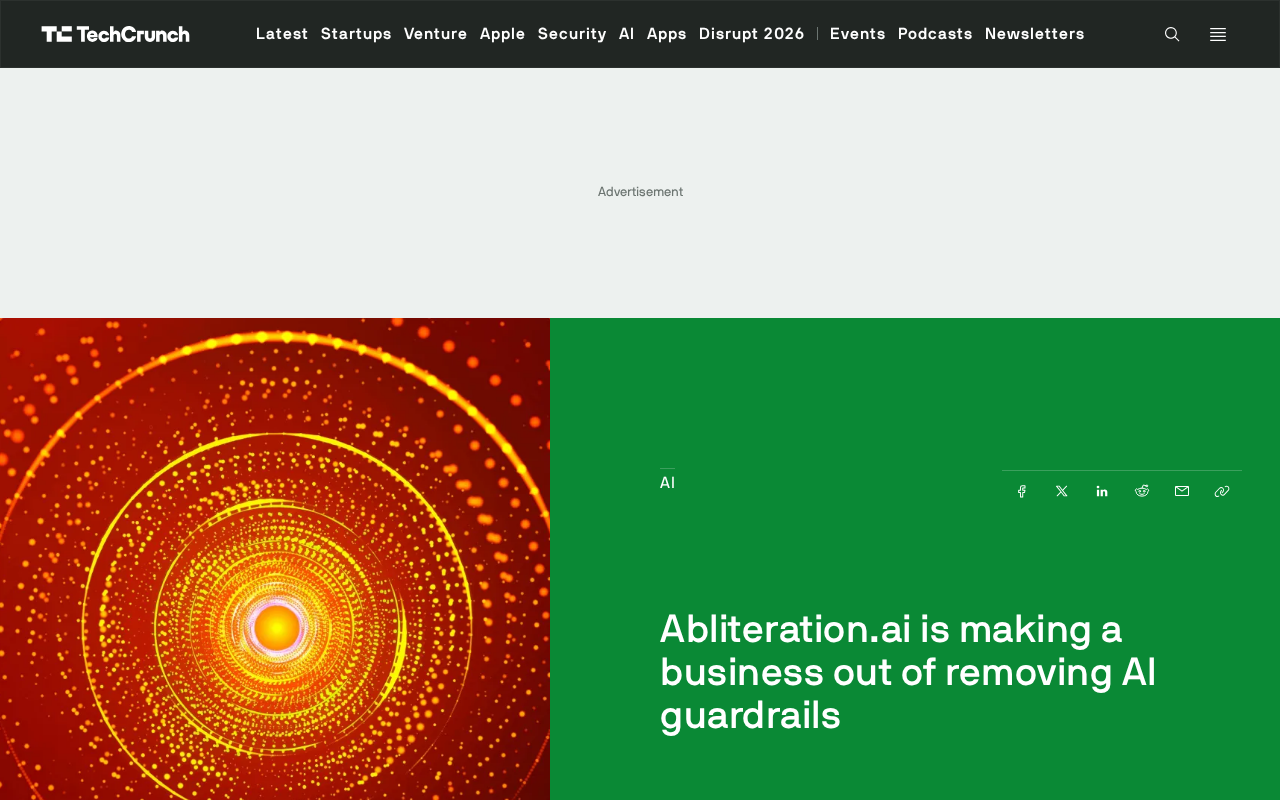
Abliteration.ai turns removing AI safety guardrails into a commercial service, exposing deep flaws in model alignment.
Abliteration.ai commercializes the removal of AI model safety guardrails by suppressing internal refusal vectors — a low-cost technique that strips alignment from open-source LLMs in minutes. While the company argues it empowers defenders, the indiscriminate nature of its commercial service raises serious concerns about enabling low-skilled attackers. The case exposes a fundamental fragility: current alignment methods modify behavior, not capability, making them inherently easy to reverse.
A Business Dedicated to Dismantling AI Safety Guardrails
At a time when mainstream AI companies are doubling down on content safety, alignment, and compliance, a company called Abliteration.ai has chosen to go in the exact opposite direction — turning "removing AI model safety guardrails" into a legitimate business.
The term "guardrails" refers to the suite of safety mechanisms that LLM providers put in place to prevent models from generating harmful content — such as refusing to answer questions about weapons manufacturing, malicious code, or cyberattacks. More specifically, these guardrails are not a single mechanism but a multi-layered defense system built from overlapping technical measures. The most fundamental layer is data cleaning during training, where obviously harmful content is filtered out of pretraining corpora. The second layer consists of alignment techniques like RLHF (Reinforcement Learning from Human Feedback) or DPO (Direct Preference Optimization), which teach models to prefer rejecting harmful requests based on human annotator preferences. The third layer involves system prompts and output filters at inference time, which perform secondary review after the model generates content. Some providers also deploy dedicated classifier models for real-time risk detection of both inputs and outputs. These nested mechanisms together form what we call "guardrails" — but as we'll reveal later, the alignment signals embedded within model weights may be far easier to surgically remove than one might imagine.
Abliteration.ai's core business is making these powerful, "uncensored" models more accessible and usable for ordinary users.
This positioning is undeniably controversial. It touches the most sensitive nerve in the AI industry: when safety alignment is systematically stripped away, are we empowering defenders or paving the road for attackers?
What Is Abliteration Technology?
"Abliteration" is a term that originated in the open-source AI community to describe a specific technical operation on large language models. Rather than retraining the model, it works by identifying and suppressing the directional vectors associated with "refusal behavior" within the model's internal representations, thereby preventing the model from triggering safety-related refusals.
The technique is grounded in a key machine learning discovery: large language models encode semantic concepts as specific directional vectors in their high-dimensional representation space. Researchers found that a model's "refusal behavior" also corresponds to an identifiable direction — when a model is about to output something like "I'm sorry, I can't help you with that...", its internal activations shift along a particular direction. The abliteration process works roughly as follows: first, collect a batch of prompts that trigger refusals and another batch that don't, feed them through the model, and capture the intermediate layer activations; then use methods like Principal Component Analysis (PCA) to compute the difference direction between the two sets of activations — the "refusal direction"; finally, subtract this directional component from the model weights, permanently suppressing refusal behavior. The entire process involves no gradient descent or backpropagation, requires minimal computation, and can typically be completed in minutes on a consumer-grade GPU.
Low Cost and High Reproducibility
Compared to training an uncensored model from scratch, abliteration has an extremely low technical barrier:
- It doesn't require massive compute for retraining — just targeted intervention on existing open-source model weights;
- The processed model retains virtually all its general capabilities while losing most safety constraints;
- Because the workflow can be standardized, it naturally lends itself to scaling and commercialization.
It's precisely this "low-cost, reproducible" nature that enables Abliteration.ai to package it as a mass-market service, rather than leaving it as an experimental toy for the geek community.
"Giving Defenders the Same Weapons" — A Dangerous Yet Seductive Argument
Abliteration.ai's core defense rests on this logic: If attackers already have access to unguarded AI capabilities, then giving defenders equivalent tools actually improves overall cybersecurity.
Where the Argument Has Merit
This "symmetric armament" argument isn't entirely without merit. In cybersecurity, red teams (attackers) and blue teams (defenders) have always needed to use the same techniques for adversarial exercises. Red Team / Blue Team is a cybersecurity methodology originating from military exercises that has become standard practice in enterprise security testing. The red team plays the attacker role, using real attack techniques to penetrate target systems and discover vulnerabilities and weak points; the blue team plays the defender role, responsible for detecting, responding to, and remediating attacks. In AI security, red team testing has become a critical method for evaluating LLM safety — OpenAI, Anthropic, Google, and other companies all conduct large-scale red team assessments before model releases.
If security researchers can only access models wrapped in layers of restrictions, they'll struggle to realistically assess potential threats or build effective defenses. From this perspective, unguarded models can indeed serve as powerful tools for penetration testing, vulnerability research, and malicious sample analysis.
Where the Argument Falls Apart
However, this logic carries clear slippery-slope risks:
- The beneficiaries of lowered barriers are asymmetric. Professional security defenders already have the ability to obtain or build such tools on their own. Those truly being "empowered" are often low-sophistication attackers who previously lacked the technical capability. It's worth noting that traditional red team activities are conducted under strict scope definitions and legal authorization, not offered as an indiscriminate commercial service to the general public — this is the critical distinction between Abliteration.ai's service model and legitimate security testing.
- Commercialization means indiscriminate proliferation. Once offered as a public service, anyone who pays can use it, and the platform cannot effectively verify users' identities or intentions.
- "Attackers already have it" doesn't mean "everyone should have it." Using the status quo as justification for abandoning constraints is essentially a transfer of responsibility.
The Deep Tension Between Open-Source Models and Safety Alignment
The emergence of Abliteration.ai is, in reality, the concentrated eruption of a long-standing contradiction within the open-source LLM ecosystem.
The core value of open-source models lies in their transparency, controllability, and customizability. But it's precisely this openness — where weights are accessible and behavior is modifiable — that makes any safety alignment potentially easy to circumvent. The substantial alignment efforts that providers invest before releasing a model can be completely erased downstream by what amounts to a code-level operation.
To understand the root of this fragility, one must recognize that today's mainstream alignment methods — RLHF and DPO — operate at the behavioral level, not the capability level. This means an aligned model hasn't lost its ability to generate harmful content; it has simply been trained to "choose not to generate it." It's like giving someone an ethics class rather than physically removing their ability to commit a crime. The model's underlying knowledge and capabilities remain fully intact within its weights; alignment merely overlays a layer of "preference" on top of those capabilities. The academic community refers to this as the "superficiality" problem of alignment — alignment modifies the model's output distribution, not its intrinsic knowledge structure. This fundamental limitation is the deep reason why abliteration techniques work.
This raises a pointed question: When safety mechanisms can be removed this easily, what is the real purpose of safety alignment? Is it a genuine safety barrier, or merely a "compliance posture" that providers adopt to mitigate legal and reputational risk?
The Security Reality the AI Industry Must Confront
Whether or not we agree with Abliteration.ai's business model, it reveals several unavoidable truths:
- Model-level safety alignment is fragile. The real line of defense may need to shift from inside the model to systemic measures at the deployment environment, access control, and usage audit levels.
- Open-source model governance remains a blank slate. Existing regulatory frameworks mostly target closed-source API services and are nearly powerless against open-source weights that can be freely downloaded and modified. The EU AI Act primarily imposes obligations on AI system deployers and providers, with partial exemptions for the free distribution of open-source model weights — unless the model is classified as a "general-purpose AI model with systemic risk." In the United States, the 2023 executive order requires safety evaluations for large-scale trained models, but primarily constrains the trainers and lacks effective jurisdiction over downstream users' modifications. The core challenge is this: once model weights are publicly released (e.g., via platforms like Hugging Face), anyone can download, modify, and deploy them anywhere in the world with sufficient compute — traditional territorial jurisdiction and licensing regimes are technically almost impossible to enforce. The widespread distribution of Meta's Llama series, Mistral, and other open-source models makes this governance vacuum increasingly stark.
- The "double-edged sword" narrative needs more serious scrutiny. The legitimacy of commercializing uncensoring tools cannot be self-absolved with a simple "helping defenders" — it should be subject to more rigorous ethical and legal evaluation.
Conclusion
Abliteration.ai has thrust what was once a technical gray-area operation into the commercial spotlight. It is both a stark exposure of the fragility of AI safety alignment and a test of the entire industry's governance capabilities.
"Giving defenders the same weapons" sounds righteous enough, but when those weapons can be purchased by anyone at a listed price, perhaps the more pressing question is: In an era where AI capability proliferation is irreversible, where should truly effective security actually be built?
Related articles
The Boundaries of LangGraph: When Does an Agent Become a Distributed Application?
Explore the capability boundaries of Agent orchestration frameworks like LangGraph, and learn when AI Agent systems cross the line from workflow orchestration into distributed application architecture.

Zhipu Open-Sources GLM-5.3-Flash 320B Model as Alibaba's Qwen4 Architecture Preview Launches Same Day
Zhipu open-sources GLM-5.3-Flash native multimodal model (320B total/18B active params) while Alibaba launches Qwen3.8-Flash-Next as Qwen4 architecture preview, both redefining LLM efficiency.
Instagram's New Rule: AI Accounts That Don't Disclose Their Identity Will Be Throttled
Instagram mandates AI identity disclosure — accounts that refuse will be throttled. Explore the enforcement challenges, detection limits, and industry impact.