OpenAI Launches ChatGPT Office Suite, Taking Direct Aim at Microsoft Office

OpenAI launches a ChatGPT office suite, directly challenging Microsoft's long-standing dominance in productivity tools.
OpenAI's newly released suite of ChatGPT-powered productivity features signals a strategic shift from foundational model provider to full-stack product vendor. Viewed by many as a "ChatGPT office suite," it directly targets the document, collaboration, and productivity market Microsoft has long dominated. Since Microsoft is both a major OpenAI investor and compute supplier — with its technology already deeply embedded in Copilot and Office 365 — the move further strains their delicate "ally and rival" dynamic. While office software markets are highly sticky due to user habits and enterprise IT policies, OpenAI's AI-native design approach may offer a meaningful competitive edge over traditional software with AI bolted on.
OpenAI Enters the Office Software Arena
OpenAI's latest release of a suite of productivity features marks a more direct phase of competition between AI companies and traditional software players. The set of office capabilities built around ChatGPT looks less like a scattering of individual features and more like a full-blown "ChatGPT office suite" — signaling that OpenAI is no longer content to remain a conversational AI platform, but is now pushing into the core market of documents, collaboration, and productivity that Microsoft has long dominated.
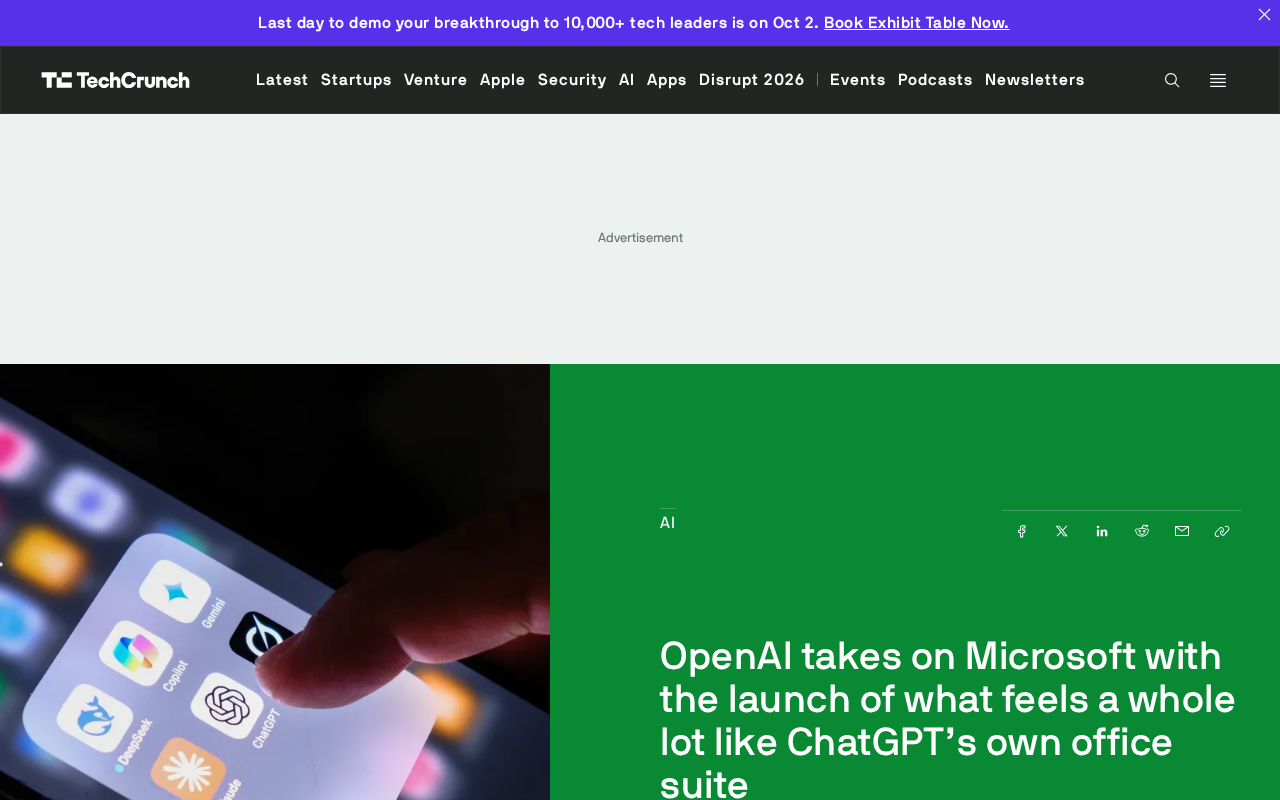
The strategic signal here is bigger than any single feature. Over the past few years, Microsoft built a powerful AI productivity ecosystem by deeply integrating OpenAI's models into Copilot and Office 365. Now that OpenAI has chosen to enter the arena directly — delivering office capabilities straight to end users — it is, in a sense, competing with its most important partner for the same users and use cases.
From Partnership to Competition with Microsoft
The relationship between OpenAI and Microsoft has always been one of the most nuanced in the tech industry. Microsoft is OpenAI's major investor and compute provider, while simultaneously embedding OpenAI's technology into its own products. When OpenAI rolls out features that overlap heavily with office productivity scenarios, the tension in this "ally and rival" dynamic is amplified further.
For users, this competition isn't necessarily a bad thing. Traditional office software companies have been accustomed to bundling features into suites and subscription packages, while AI-native products tend to start from a conversational interface and reimagine the workflows of document creation, editing, and collaboration from the ground up. As ChatGPT becomes capable of directly handling drafting, organizing, and analyzing documents, the choice users make between "opening Office" and "opening ChatGPT" may begin to quietly shift.
Microsoft's partnership with OpenAI dates back to 2019, with Microsoft having invested over $13 billion in OpenAI and securing exclusive rights to deploy its models on the Azure cloud platform. This triple-binding structure — as investor, compute supplier, and technology licensee — is remarkably rare in business history. Microsoft integrated the GPT model series into Copilot (embedded across Word, Excel, Outlook, and other Office apps) and GitHub Copilot (for developers), allowing OpenAI's capabilities to reach hundreds of millions of enterprise users. Yet this deep entanglement is inherently a double-edged sword: OpenAI depends on Microsoft for compute and distribution, but that also means Microsoft controls the traffic gateway to AI-powered office capabilities. By delivering office products directly to end users, OpenAI is now attempting to bypass Microsoft as an intermediary — taking ownership of user relationships and the data loop itself. This creates a structural conflict of interest with Microsoft's business at its core.
Impact on the Productivity Tools Landscape
Office software is an exceptionally sticky market. User habits, file format standards, and enterprise IT policies together form very high barriers to switching. For OpenAI to genuinely challenge Microsoft's position, AI capabilities alone won't be enough — sustained investment in file compatibility, enterprise-grade security, and collaborative experience will be essential.
That said, an AI-native approach to office productivity does offer a genuine path to differentiation. Compared to "bolting on" an AI assistant to existing software, a workflow designed from scratch with AI at the center may offer meaningful advantages in information integration and automation. This is precisely why OpenAI's latest move deserves attention — it represents the direction in which office software could be fundamentally reimagined.
The concept of "AI-native" productivity tools refers to products designed from the outset with large language models as the core interaction logic, rather than layering AI plugins onto traditional software interfaces. The limitation of the traditional approach (such as Microsoft Copilot) lies in the need to accommodate existing menu structures, file format standards, and permission management architectures — AI capabilities are typically embedded as an "assistant," with users still required to initiate actions manually. AI-native products, by contrast, can make intent understanding, content generation, and multi-source information synthesis the default workflow. For example, a user simply describes what they need, and the system automatically handles information retrieval, draft generation, and formatting. This architectural difference may produce a significant experiential divide in terms of automation and contextual coherence — though it also raises additional concerns among enterprise users around data sovereignty and audit compliance.
Conclusion
OpenAI's launch of office suite-like capabilities marks a pivotal evolution for AI companies — from foundational technology providers to full-stack product and service vendors. This both intensifies direct competition with traditional software giants like Microsoft and could accelerate the AI transformation of the entire productivity tools market. For users and enterprises alike, the key question to watch going forward is whether these AI-native office capabilities can genuinely replace or complement existing tools in real-world work environments.
(Note: This article is based on limited publicly available information. Specific feature details are subject to further official disclosure.)
Related articles

Workbuddy for Absolute Beginners: How a Desktop AI Agent Fits Into Real Workflows
A beginner's guide to the Workbuddy desktop AI agent: installation, claiming credits, file management, and building automated workflows—compared with CodeX for fit and cost, helping professionals shift from AI question-askers to AI managers.

OpenAI's New Agent Stack: Computer Use, Decisions API, and Ultra-Fast Workflows
OpenAI Dev Day unveiled a new agent stack: Computer Use outperforms humans, Decisions API delivers ultra-low-latency classification via Luna, Agents API opens the same Computer Use capabilities, and GPT-6.1 Sol costs only one-seventh of Astra. Core updates, benchmark data, and developer insights.

Liang Wenfeng Open-Sources DeepInfo Inference Framework, Takes On U.S. Ban
DeepSeek open-sources its DeepInfo inference framework after its models, featuring GPU/CPU cross-pipelining, small-model prediction with large-model verification, and full Huawei Ascend and NVIDIA chip support—facing the U.S. federal ban head-on. This article analyzes its significance for AI deployment and open-source strategy.