OpenAI Launches Dots: An Always-On AI Assistant Taking Aim at Meta Muse

OpenAI launches Dots, an always-on agentic AI assistant powered by GPT-6 Astra, directly rivaling Meta Muse.
OpenAI unveiled Dots at DevDay — a persistent, always-on AI assistant that autonomously executes tasks across connected apps and continuously learns user preferences, powered by the GPT-6 Astra model. Unlike traditional conversational assistants, Dots represents a shift from passive Q&A to proactive agency, and is seen as a direct answer to Meta Muse. The launch signals intensifying competition for the agentic AI entry point, though key questions around privacy, user control, and real-world reliability remain unresolved.
OpenAI Doubles Down on Agentic AI
OpenAI officially unveiled a product called Dots at its DevDay keynote, positioning it as a persistent AI assistant capable of "doing almost anything." The move has been widely interpreted as a direct response to Meta's recently buzzed-about Muse AI, signaling that competition between the two tech giants in the agentic AI space — AI systems capable of taking autonomous action — has officially reached a fever pitch.
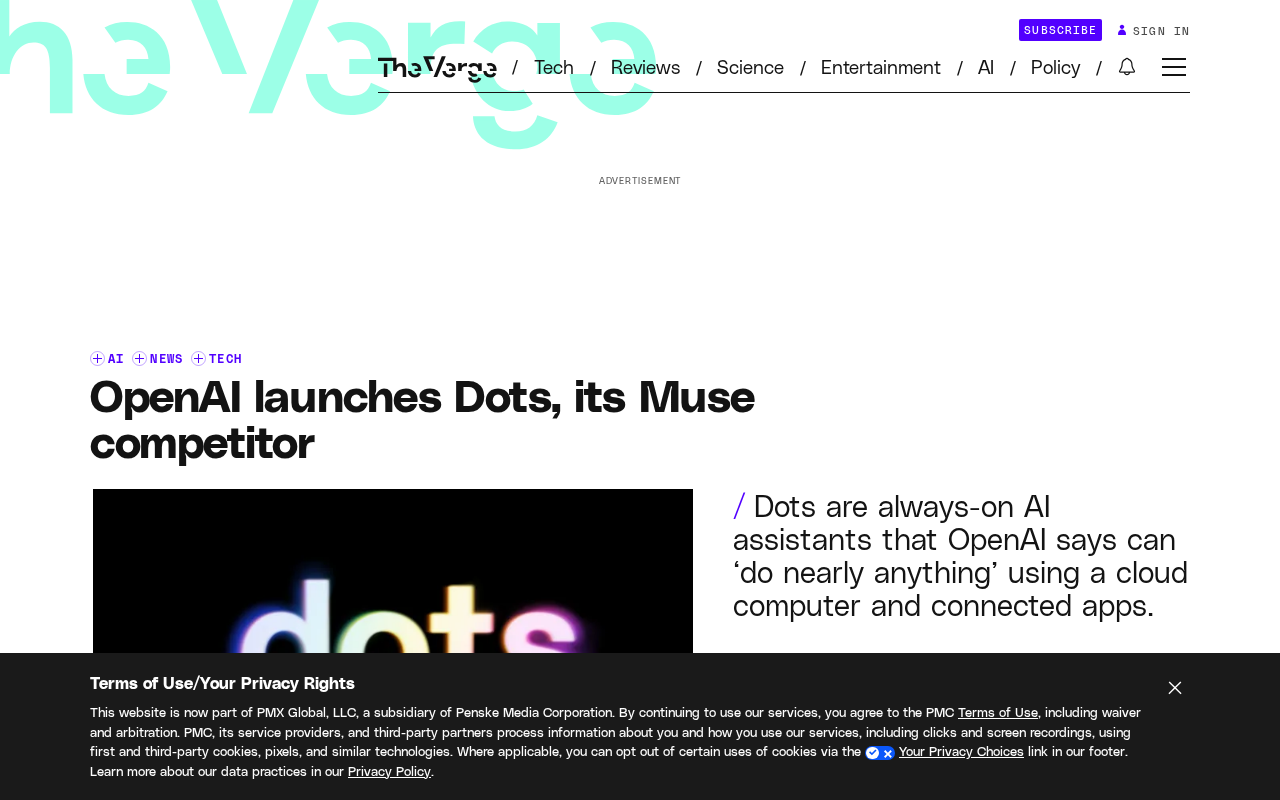
According to OpenAI, Dots is fundamentally different from traditional conversational assistants: rather than waiting for user input before responding, it operates as an always-on background agent, running continuously across multiple connected apps while progressively learning user preferences. This design philosophy represents a paradigm shift in AI assistants — from "passive responder" to "proactive agent."
Core Capabilities and Technical Foundation
Cross-App Autonomous Execution
Dots' biggest selling point is its ability to operate across applications. It can complete tasks in the background across all of a user's connected apps without requiring step-by-step manual intervention. This "agentic" working model means users can delegate a series of tedious operations to the AI, which independently judges and executes them.
For everyday users, the value of this capability lies in reducing repetitive work — from organizing emails and scheduling appointments to cross-platform information retrieval and processing, all of which can theoretically be handed off to an assistant that continuously learns your habits.
From a technical architecture perspective, cross-app autonomous execution relies on a "Tool Calling / Function Calling" mechanism — the AI model no longer just generates text, but can invoke pre-registered external interfaces (APIs) to trigger real-world actions. There are currently two mainstream implementation approaches in the industry: one involves connecting through each app's official API (with clear permissions but limited coverage), while the other uses computer vision and UI automation to literally "read the screen and click buttons" (broader coverage but lower stability). Based on what has been publicly disclosed, Dots appears to favor the former — relying on an ecosystem of apps that users actively authorize and connect, rather than indiscriminately controlling any arbitrary interface. This choice represents a tradeoff between privacy compliance and capability breadth, meaning its practical scope will initially be constrained by the number of integrated apps.
Powered by the GPT-6 Astra Model
Underpinning Dots is what OpenAI calls the GPT-6 Astra model. Positioned as the engine behind Dots, this model is described as a highly capable foundation model that provides the computational and intelligence backbone for the assistant's autonomous reasoning and multi-step task execution.
Model capability directly determines the real-world performance of an agentic assistant — whether it can accurately understand user intent, make sound decisions in complex environments, and maintain stability over long-running sessions all depend heavily on the underlying model. The introduction of GPT-6 Astra signals that OpenAI aims to establish a differentiated advantage in this space through stronger model capabilities.
It's worth noting that the "GPT-6 Astra" naming has not yet been systematically explained in any official OpenAI documentation, and the industry remains unclear on its relationship to existing models like GPT-4o and the o-series. The term "Astra" previously appeared in Google DeepMind's multimodal Agent project naming; OpenAI's use of a similar name may be intended to emphasize that the model features continuous perception and multimodal understanding. For agentic AI scenarios, beyond single-pass reasoning ability, models also need "Long Context" memory and "Multi-step Planning" capabilities — the former determines whether an assistant can remember cross-session preferences, while the latter determines whether it can decompose complex goals into executable subtask sequences. These two factors often set a harder ceiling on product experience than standard Q&A benchmark scores.
A Direct Confrontation with Meta Muse
The launch of Dots is clearly aimed at Meta's previously released Muse AI, which had already generated significant discussion. Both products focus on the emerging category of "persistent AI assistants," reflecting an industry-wide consensus on the promise of agentic AI: the competitive battleground for the next generation of AI products is shifting from pure question-answering capability toward the ability to truly "get things done" on behalf of users.
The significance of this competition extends beyond the products themselves — it could reshape how users interact with operating systems and app ecosystems. When an AI assistant can take autonomous action across applications, whoever controls that entry point could become the hub of digital life going forward.
At its core, the race for agentic AI entry points is a fight for control over the "super-app layer." In the mobile era, iOS and Android controlled app distribution through their operating systems. But when an AI assistant can act across apps on a user's behalf, this layer could supersede the operating system itself — user needs are absorbed directly by the AI, and which underlying app handles the work becomes transparent, even irrelevant. This explains why Apple, Microsoft (Copilot), Google (Gemini), Meta, and OpenAI are all doubling down on this direction almost simultaneously: losing this entry point means being reduced to a "pipe" rather than a "platform" in the next paradigm of human-computer interaction.
Questions Worth Watching
As compelling as Dots' vision is, a persistent, cross-app autonomous assistant also raises a number of questions that remain unanswered:
- Privacy and data security: A background assistant that continuously learns preferences and accesses multiple apps inevitably involves the collection and processing of vast amounts of user data — how to protect privacy is an unavoidable issue.
- Controllability and trustworthiness: When AI is autonomously executing tasks in the background, how users can monitor, correct, or reverse its actions remains a challenge the entire industry is grappling with.
- Real-world performance: "Able to do almost anything" is an extremely high promise — stability and accuracy in real-world scenarios are what ultimately validate the product.
Publicly available information is still limited, and the specific launch timeline, supported app ecosystem, and pricing strategy for Dots have yet to be disclosed by OpenAI. What is certain is that with both OpenAI and Meta now in the arena, agentic AI assistants will be one of the most closely watched product directions in the months ahead.
Related articles

How Big Can Stars Really Get? The Physical Limits of the Largest Stars
Red supergiants are the largest stars by volume, with radii up to 2,000 times the Sun, engulfing the inner solar system. But there is no precise upper limit on stellar size—models predict up to 15,000 solar radii. The most massive blue stars are far smaller than red supergiants—biggest and heaviest are two different things.

Apple HomeView Smart Display Full Feature Breakdown: Wall-Mount or Desktop, $299
Apple launches HomeView, a $299 smart display with wall-mount and desktop options, 12MP camera for facial recognition, smart home control, music playback, and recipe step-by-step cooking. Full breakdown of watch faces, apps, privacy, and cooking integration.

Where Did the Promised New Studio Go? Craft Computing Answers After Five Years
Craft Computing's host responds to viewer questions: the new studio promised five years ago was shelved as construction costs soared from $30,000 to $75,000, and was replaced by a 168-square-foot garage conversion.