OpenAI Launches GPT-6 Sol and Luna: Prices Slashed in Half, Frontier Capabilities Go Mainstream

OpenAI releases GPT-6 Sol and Luna with halved prices and improved reliability to scale frontier AI into production workflows.
OpenAI has officially launched GPT-6 Sol and GPT-6 Luna, completing the tiered GPT-6 product lineup. Sol targets coding and complex automation at $2 input / $10 output per million tokens — roughly half the previous generation's price — while Luna handles lightweight, high-frequency tasks at an aggressive $0.10 input / $0.50 output. GPT-6 Sol cuts factual error rates roughly in half compared to its predecessor, with reliability approaching the flagship Astra, though overall benchmark gains remain modest. The release's core significance is not a capability leap, but a dramatic reduction in the cost of calling frontier models, making batch document processing, real-time Q&A, and automated pipelines economically viable at scale.
OpenAI quietly completed its GPT-6 product lineup late at night, officially releasing two new models: GPT-6 Sol and GPT-6 Luna. If the previously announced Astra was about pushing the ceiling of raw capability, Sol and Luna are aimed at a far more pragmatic question: how to bring GPT-6 into everyday workflows, rather than keeping it confined to flagship demos. The clearest signal from this release is a dramatic reduction in the cost of calling frontier-level models.
How the Two Models Divide the Work
In terms of positioning, GPT-6 Sol and Luna follow a differentiated approach. Sol targets coding, professional work, and complex automation scenarios — tasks that demand deep reasoning and high reliability. Luna is built for high-frequency, lightweight tasks like summarization, information extraction, and quick Q&A, prioritizing speed and cost efficiency.
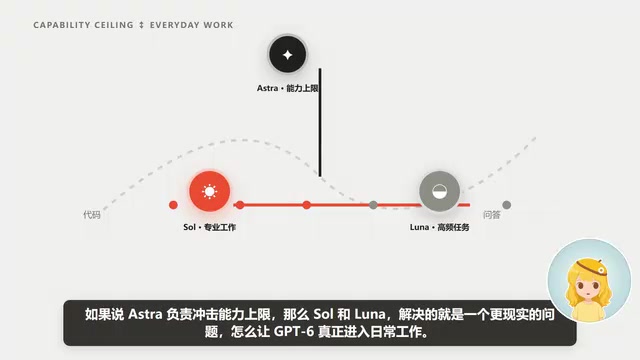
This tiered design isn't new, but it reflects an increasingly clear product philosophy among large model providers: use a cost-effective smaller model to handle the bulk of simple requests, and reserve compute budget for the tasks that truly require heavy reasoning. For developers, this means flexible model selection based on task complexity, rather than routing everything through the most expensive model in the pipeline.
The "flagship model + lightweight model" tiering strategy has gradually become standard practice across the AI industry. Anthropic pairs Claude Haiku with Claude Opus; Google pairs Gemini Flash with Gemini Ultra — both follow similar architectures. The underlying technical approaches typically include knowledge distillation (using a large model's outputs to train a smaller one), model pruning, and task-specific fine-tuning. Lightweight models aren't simply "downgraded" versions with fewer parameters — they make deliberate trade-offs along specific capability dimensions, preserving what's needed for high-frequency tasks while compressing deep reasoning paths that rarely activate in real-world use. For enterprise deployments, a well-designed model routing strategy — automatically selecting which model to call based on request complexity — can often reduce overall API costs by 40–70% without sacrificing user experience.
The Biggest Story Is the Price Drop
What's really turning heads is the pricing. According to the video walkthrough, GPT-6 Sol is priced at $2 per million input tokens and $10 per million output tokens via API — roughly half the cost of the previous generation. The lighter-weight GPT-6 Luna goes even further: just $0.10 per million input tokens and $0.50 per million output tokens.
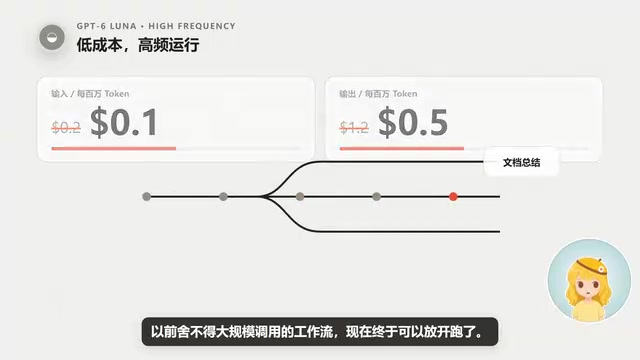
The significance of this pricing tier is that it unlocks workflows that were previously economically unviable at scale. Use cases that require high-frequency model calls — batch summarization of large document sets, real-time Q&A for user queries, or repeatedly triggering a model within an automated pipeline — were often forced into compromises due to token costs. Luna's pricing means these kinds of tasks can now run freely, with cost no longer being the primary bottleneck.
For teams building AI products, the value of low-cost lightweight models is often underestimated. In real-world business scenarios, simple requests typically account for a far larger share of total volume than complex ones — a cheap, capable small model can meaningfully lower overall operating costs.
Zooming out, the rapid decline in large model API pricing has been one of the defining trends of the past two years. From GPT-3.5 to GPT-4o Mini, models at comparable capability levels have dropped in price by more than 90% in roughly 18 months. This is driven by a combination of model compression, inference optimizations (such as KV cache sharing and speculative decoding), and the large-scale deployment of purpose-built inference chips. For developers, shifts in per-token pricing directly reshape product economics: when input costs fall to $0.10 per million tokens, the marginal cost per call becomes nearly negligible. This fundamentally changes how AI features get designed into products — developers can more boldly embed models into parts of the product they once considered "too expensive," such as real-time streaming processing, per-record content review, or high-frequency user interactions.
Cheaper Doesn't Mean Weaker
Price cuts naturally raise concerns about capability trade-offs, but OpenAI's internal benchmark data aims to address those doubts. According to official claims, GPT-6 Sol produces roughly half as many factual errors as GPT-5.6 Sol, with reliability approaching the more expensive Astra.
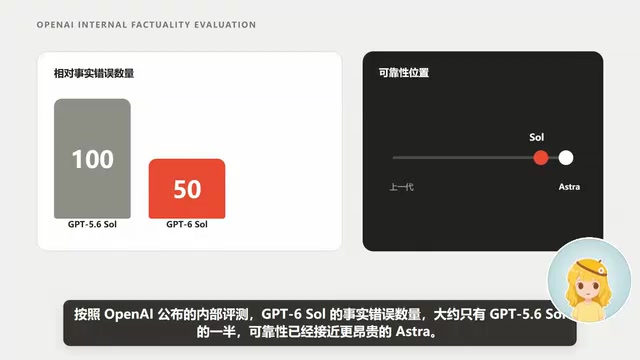
This deserves a nuanced read. Cutting error rates in half is a genuine, meaningful improvement — especially for coding and professional work scenarios, where reliability often matters more than peak benchmark performance. That said, the presenter also acknowledged that in terms of overall benchmark scores, the improvement over GPT-5.6 Sol and Luna is actually fairly modest.
In other words, the core narrative here isn't a capability leap — it's about maintaining or slightly improving capability while bringing the price down significantly, and making targeted improvements to reliability, which has historically been a key weakness. For practitioners, the combination of better reliability and lower cost may deliver more real-world value than a jump in benchmark scores.
Rollout for Subscribers
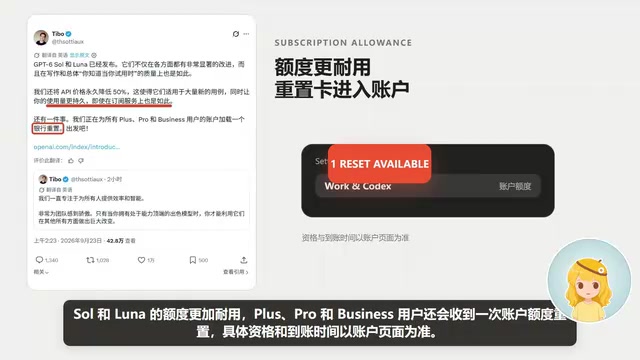
Beyond API pricing, subscribers will also notice changes. Sol and Luna reportedly come with more durable usage quotas, and Plus, Pro, and Business users will receive a one-time quota reset. However, specific eligibility and timing will depend on individual account pages — no unified rollout schedule has been announced.
In terms of rollout pace, both models are being gradually made available to ChatGPT Work, Codex, and API users. Luna has a broader reach and will also extend to desktop users and Free and Go tier subscribers. This phased release approach is consistent with OpenAI's typical gradual rollout strategy.
Takeaway
The launch of GPT-6 Sol and Luna looks more like a structural completion of the GPT-6 product lineup than a major capability breakthrough. Its real significance lies in dramatically lowering the barrier to calling frontier-level models, making high-frequency and large-scale workflows economically viable.
For developers and enterprise users, the story worth following isn't just the price drop itself — it's the trajectory of Sol's reliability converging toward Astra. Comparable capability at half the price is what actually moves AI from demo to production. Whether the limited benchmark gains translate into meaningful real-world differences remains to be seen through actual deployment.
Related articles

Understanding DeepSeek in 3 Minutes: The Rise from a Quant Hedge Fund to an Open-Source AI Leader
DeepSeek's history in 3 minutes: from High-Flyer Quant's compute build-up to V2's MLA inference cost cuts, V3's $5.576M training bill, R1's open-source global shock, and V4 with a $7B Series A.

Local Creative Writing Model Showdown: Fine-tuned Qwen3.8 27B Wins, DeepSeek v4.1 Underwhelms
Bilibili creator tests seven local creative writing models: Hemingway and HumanLike Chat based on Qwen3.8 27B perform best, DeepSeek v4.1 is plain, Dongfang Shuo ranks last with confused characters. Includes three test prompts, scores, and usage advice.

Liang Wenfeng's Three Big Bets: Why Did DeepSeek Open-Source Its 82% Gross Margin?
Why did DeepSeek open-source DeepInfer, its 82% gross margin inference framework, and then launch a hundred-billion funding round? An analysis of Liang Wenfeng's three big bets and the open-source strategy.