OpenAI Launches GPT-6 Sol & Luna: API Costs Cut in Half, Redefining Frontier Model Value

OpenAI, Xiaomi, and Tencent slash AI model costs in a single day, rewriting the frontier model value equation.
A single day brought sweeping cost reductions across the AI landscape. OpenAI's GPT-6 Sol and Luna cut API prices 50% while Sol matches near-flagship performance at 9% of a competitor's cost. Xiaomi open-sourced MiMo VL 6, with Flash-tier cached calls at just ¥0.02/1M tokens — claimed to be 60x more cost-efficient than overseas alternatives. Hugging Face Transformers now natively supports GGUF quantization, while Ollama bridges local and cloud compute. Tencent's 2K image generation dropped to ¥0.15 with no charge for failed outputs. The signal is clear: capability gaps are narrowing, cost gaps are widening, and model selection logic must now treat cost as a core variable.
OpenAI's Dual-Model Entry: Bringing Flagship Capability to Accessible Price Points
OpenAI has officially introduced two new members of the GPT-6 family — GPT-6 Sol and GPT-6 Luna. Rather than pushing the capability ceiling higher, these models are designed to bring the real-time responsiveness, coding ability, computer-use features, and alignment quality of the flagship Astra model down to a price point that ordinary teams can actually afford.
According to a roundup from Bilibili's AI Daily, the new models' API pricing has dropped another 50% from the already-discounted previous-generation rates, while also improving the default Prompt Cache hit rate. For high-frequency production environments, a better cache hit rate often delivers more real-world savings than a lower list price — because repeated system prompts and context can be served directly from cache without recomputation.
Performance numbers are equally notable: in automated business process benchmarks, Sol outperformed Claude Opus 5 while costing only about 9% as much per task; on the software engineering benchmark DeepSweep, Sol scored 68.8% — just ~1.1 percentage points behind top-tier flagship models — at roughly 80% lower cost.
Both models are now live on ChatGPT, Codex, and the official API. The takeaway is straightforward: teams currently using GPT-5.6 or Claude should immediately run their existing workflows through Sol for a comparison test, especially for cost-sensitive, high-volume automation use cases.
Prompt Cache is a cost-optimization mechanism in large model API services. When two API calls share the same prefix text (such as a fixed system prompt or long context), the server can retain that prefix's KV Cache (key-value cache) in VRAM for a period of time. Subsequent calls that hit the cache don't need to rerun attention computation for those tokens — they're typically billed at a steep discount or even free. For automation workflows with long system prompts and high context repetition, cache hit rate directly determines the gap between your actual bill and the list price. The higher the hit rate, the lower the marginal call cost — and the savings from caching strategy can actually exceed the savings from a price cut alone.
Xiaomi's MiMo VL 6 Goes Open Source: The World's Strongest Open Model at Disruptive Prices
If the major labs' price cuts seemed measured, the open-source community went further. Xiaomi officially released and open-sourced its next-generation multimodal large model, MiMo VL 6, launching both Pro and Flash versions as native full-multimodal models in one go.
On the Artificial Analysis comprehensive intelligence index, the Pro version scored 46 points — surpassing Kimi K3 and QWen3.8-Max to claim the top spot among open-source models globally. The pricing is the real headline: the Flash version's cached input is just ¥0.02 per million tokens, and Pro is only ¥0.025, which the company claims represents roughly 60x better cost-efficiency than comparable overseas models.
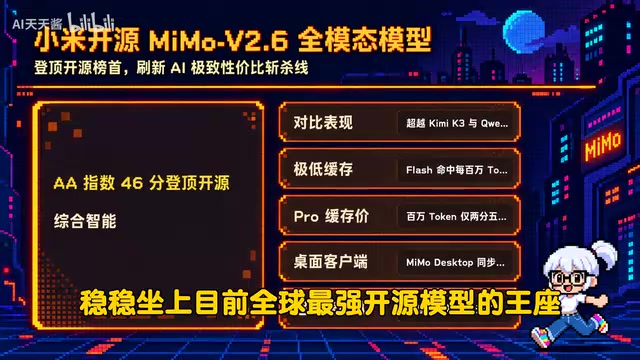
Xiaomi also launched a desktop client alongside these models, and introduced an ultra-high-speed mode for Pro that offers up to 20x acceleration. For developers building high-concurrency real-time interactions or working under extremely tight budgets, this combination is essentially impossible to ignore. Open source plus ultra-low pricing continues to erode the premium that closed-source models have historically commanded.
Local Deployment Ecosystem Unified: Transformers Natively Supports GGUF
While the model layer is competing on efficiency, the toolchain layer hit its own milestone today. Hugging Face officially announced that the Transformers core library now natively supports running llama.cpp's GGUF quantized format.
Previously, developers wanting to run large models on a thin-and-light laptop had to constantly shuffle between the Python ecosystem and compiled command-line tools, dealing with format conversions at every step. Now, using the familiar from_pretrained interface, developers can directly pull and load GGUF-format weights from the community hub, with automatic access to GGML's high-performance backends like Metal — enabling CPU and GPU to work in concert.
For developers doing local model evaluation, fine-tuning validation, or small-scale prototyping, upgrading to the new version means leaving behind the hassle of format conversion for good.
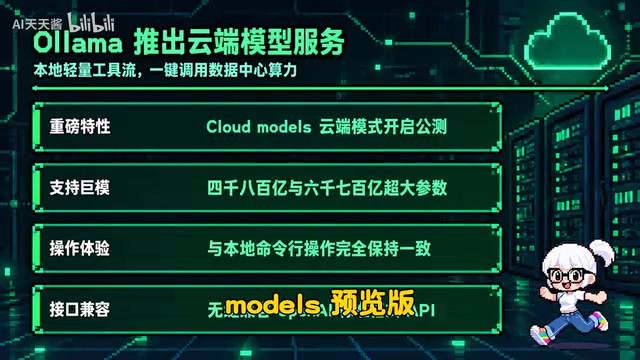
On a parallel front, Ollama is extending its reach to cloud compute with the launch of a Cloud Models preview. After upgrading, developers can seamlessly invoke data center compute from the terminal with a single command — running 480B-parameter Qwen3 Coder or 670B-parameter DeepSeekAd Logic V1 exactly as they would a local model. The list, pull, and run workflow is identical to local operation, the OpenAI-format API is fully compatible, and the company promises no interaction data is retained on the cloud side.
GGUF (GPT-Generated Unified Format) is the quantized weight storage format led by the llama.cpp project, succeeding the earlier GGML format. Quantization works by compressing model parameters from 32-bit or 16-bit floating point down to lower-precision integers like 4-bit or 8-bit, shrinking model weights from tens of gigabytes to just a few GB so they can run on consumer CPUs or integrated graphics — at the cost of slight accuracy loss. GGML (Georgi Gerganov Machine Learning) is the underlying tensor computation library, with built-in Metal GPU backend optimization for Apple Silicon and AVX instruction set optimization for x86, enabling CPU and GPU to share the compute load. Previously, the Transformers ecosystem (built around PyTorch) and the llama.cpp ecosystem (built around compiled C++ binaries) were completely siloed — migrating models between the two required tedious format conversion steps. Native GGUF support tears down this barrier, making the tens of thousands of GGUF-format community models on Hugging Face Hub directly accessible within Python workflows.
Image Generation & Vertical Agents: Costs Keep Falling
The generative image space has new developments too. Tencent released a preview of its Image 3.5 model, with overall generation quality up roughly 30% over the previous generation. It specifically addresses one of the biggest pain points in Chinese image generation models — text rendering and lettering — with significantly more accurate Chinese character reproduction. Image editing supports up to 5 reference images for multi-element composite edits, with output resolution up to 2K.
The pricing remains the most aggressive part: generating one 2K high-resolution image via the Tencent Cloud API costs just ¥0.15, and you only pay for images you're satisfied with — failed generations are free. For teams doing poster design, self-media illustrations, or film storyboarding, this cost structure essentially removes the constraint on batch generation volume.
The developer workflow for vertical operating systems has also gained a dedicated AI agent. Huawei Cloud's Mate upgrade for the HarmonyOS ecosystem launched in one shot: a HarmonyOS coding large model, Mate HarmonyOS Agent, and a development model — officially claimed to be the world's first AI coding agent purpose-built for the HarmonyOS ecosystem.
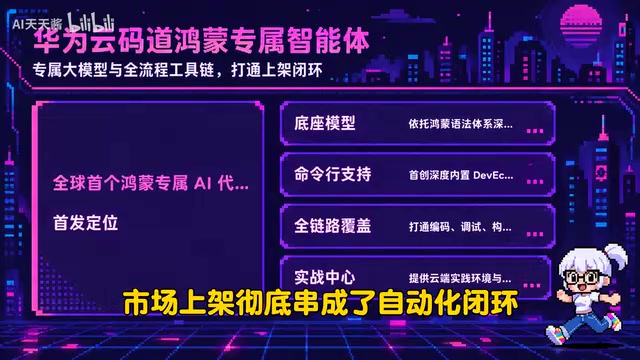
The core model underwent deep reinforcement training on HarmonyOS-specific language features and native frameworks, improving code generation quality and compilation pass rates. The agent has built-in DevEco command-line tool support, stringing together requirements decomposition, code debugging, package building, and App Gallery submission into an automated closed loop. For teams pivoting to native HarmonyOS development, this should meaningfully cut down the time spent hitting undocumented pitfalls and reading through docs.
On the enterprise side, Alibaba's DingTalk unveiled an enterprise-grade agent suite at the Yunqi Conference, introducing Enterprise Context technology that structures dynamic information scattered across instant messaging and enterprise systems. Agents are upgraded to "digital employees" with organizational attributes — department affiliation, responsible parties, and authorization boundaries — enabling them to collaborate with human colleagues in the same workspace. Combined with sandbox isolation and full-chain audit trails, high-risk operations can be blocked and rolled back. This type of solution is best suited for enterprises already deeply integrated with DingTalk for workplace operations.
NVIDIA DLSS 5: Client-Side Graphics Enters the Neural Rendering Era
Finally, a foundational breakthrough for game and hardware developers. NVIDIA officially released DLSS 5, introducing three-dimensional guided neural rendering technology.
Unlike previous iterations that relied primarily on super-resolution upscaling, DLSS 5 uses the raw frames rendered by the game engine as an absolute structural skeleton, employing a strict "one frame in, one frame out" temporal model to locally generate per-frame lighting and material detail in real time on RTX 50-series GPUs — with stable 4K output supported. Developers also get fine-grained control over structural strength, tone, and semantic masking.
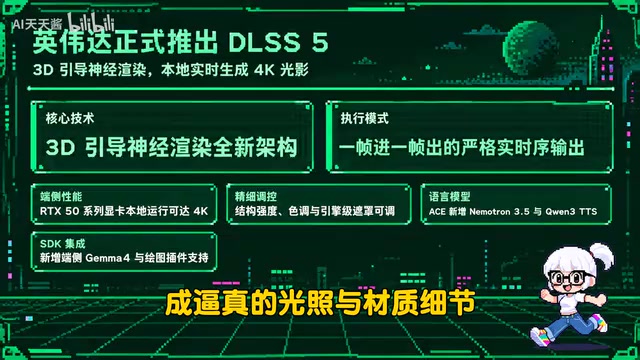
The digital human development kit ACE received a simultaneous upgrade, adding low-latency speech recognition and high-quality speech synthesis, with the SDK natively integrating local on-device models. This marks the official entry of client-side graphics into the neural rendering era — game developers should begin evaluating engine integration now.
DLSS (Deep Learning Super Sampling) is NVIDIA's AI-assisted rendering technology powered by dedicated Tensor Core units. Its original core task was super-resolution — rendering natively at a lower resolution, then using a neural network to upscale to the target resolution, achieving near-native image quality while dramatically reducing GPU rendering load. DLSS 3 introduced Frame Generation, inserting AI-synthesized frames between two real rendered frames to boost frame rate. DLSS 5's "three-dimensional guided neural rendering" goes further: it uses the engine's G-Buffer data — geometry, depth, motion vectors — as structural constraints, with the neural network filling in lighting, reflections, and material detail in real time on top of that foundation, rather than pure image-space interpolation. The "one frame in, one frame out" temporal model means each output frame strictly corresponds to one input frame, avoiding temporal artifacts and added input latency that multi-frame stacking can cause — which is critical for the responsiveness required in competitive games.
One Clear Throughline: The Pace of Cost Reduction Is Exceeding Expectations
Looking at today's moves together, one throughline is unmistakable — the pace at which frontier technology is getting cheaper is far beyond what anyone anticipated. OpenAI's dual-model launch brings flagship capability to accessible price points; Xiaomi's open-source ultra-low pricing compresses overseas models' premium by dozens of times; Hugging Face and Ollama eliminate deployment barriers between local and cloud; Tencent drops 2K image generation to ¥0.15 per image.
For developers, this means the logic of model selection is shifting: capability gaps are narrowing while cost gaps are widening. Whoever can compress per-task cost furthest at equivalent quality is increasingly likely to become the default choice in production environments. Teams should consider running a fresh round of model selection benchmarks in the near term — and making cost a core decision variable.
Related articles

MCP Protocol in 60 Seconds: A Real Session, Message by Message
Dissecting a real MCP session message by message: how an Agent dynamically discovers tools, forwards call requests, and has an MCP server execute them — all in just 9 JSON messages, with the model and reasoning loop untouched.

n8n 40-Minute Masterclass: Build Your First AI Automation Workflow from Scratch
Distilled from a 40-minute n8n masterclass: the core differences between automation, AI, and AI Agents, a comparison of n8n's four deployment methods, and a complete guide from dashboard to your first workflow.

Why Does a 35GB Quantized Model Blow Up an 80GB GPU? The Truth About KV Cache VRAM
Why does a 35GB 4-bit quantized LLM still blow up an 80GB GPU? This article breaks down the four components of inference VRAM, provides precise KV Cache formulas, compares GQA vs DeepSeek MLA memory, and offers production-grade OOM prevention like FP8 KV Cache.