OpenAI-Linked Super PAC Funds AI-Generated News Site to Attack Industry Critics

OpenAI-linked Super PAC reportedly funds AI fake news site to attack industry critics.
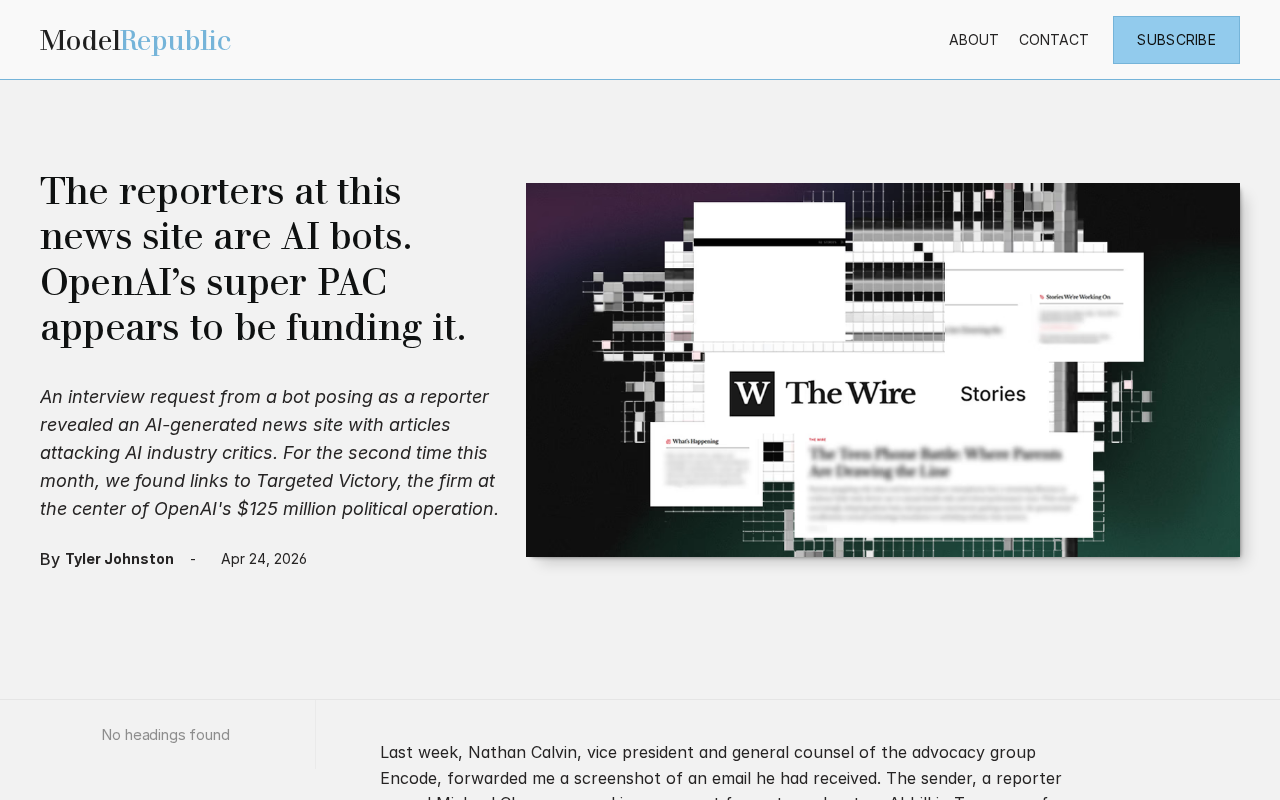
A Super PAC linked to OpenAI has been exposed for funding an AI-generated news website designed to attack industry critics. This incident reveals dangerous intersections between political dark money, AI content generation at scale, and corporate self-interest, raising urgent questions about transparency, platform responsibility, and the erosion of public trust in media during the AI era.
The Core Issue: A Dangerous Convergence of Political Money and AI Content
A recent report from the Hacker News community has drawn widespread attention in the tech world: a Super PAC linked to OpenAI has been exposed for funding an AI-generated news website whose primary purpose is to attack industry critics. While the story is still in its early stages, the issues it reveals touch upon the sensitive intersection of AI ethics, media credibility, and political lobbying.
A Super Political Action Committee (Super PAC) is a type of organization in the U.S. political system that can raise and spend unlimited amounts of money on political advocacy, though it is legally prohibited from coordinating directly with a candidate's campaign. The full name of a Super PAC is "Independent Expenditure-Only Committee," originating from the landmark 2010 U.S. Supreme Court decision in Citizens United v. FEC. That ruling determined that restricting independent political expenditures by corporations and unions violated the First Amendment's free speech protections. Since then, Super PACs can raise unlimited funds from individuals, corporations, unions, and other groups for independent political advocacy. Unlike traditional PACs, the only legal constraint on Super PACs is that they must not "coordinate" with candidates or their campaigns — yet in practice, the definition of "coordination" is extremely vague, with many Super PACs operated by former staffers of candidates, creating what amounts to a "shadow campaign" mechanism. As of the 2024 election cycle, Super PACs have collectively spent billions of dollars, making them one of the most influential dark money channels in American politics. When such a well-funded, purpose-driven political tool is combined with AI content generation technology, its potential for opinion manipulation cannot be underestimated.
Why an OpenAI-Linked PAC Funding AI Fake News Should Raise Alarms
Scalable Production and Low Cost of AI Content
Traditional opinion shaping requires hiring writers, editors, and media channels — it's expensive and difficult to scale quickly. AI-generated content has fundamentally changed this landscape: a single website can produce massive volumes of seemingly professional "news" reports in an extremely short time. Current AI content generation technology, represented by large language models (LLMs), can produce grammatically fluent, logically coherent, and stylistically varied text in seconds. GPT-4, for example, generates articles that are frequently mistaken for human-written content in blind tests, with identification accuracy only slightly above random chance. More critically, through API calls and automation scripts, a small team can produce thousands of "customized" articles targeting different topics and audiences within 24 hours. The cost of this scalable production is extremely low — generating a 1,000-word article via API typically costs no more than a few cents, far less than what traditional content farms pay cheap writers. This means AI-driven information manipulation faces virtually no economic barriers.
When this capability is used to systematically target industry critics, it means that any scholar, journalist, or policymaker who questions AI companies could face the risk of systematic smear campaigns. The danger of this model lies in its difficulty to trace and identify. AI-generated articles often have the appearance of legitimate news — with headlines, bylines, and citations — making it difficult for ordinary readers to immediately recognize the political motivations and funding sources behind them.
The use of AI technology in information warfare and opinion manipulation already has several documented cases. In 2023, Meta released a report stating that it detected multiple state-level actors using AI-generated content for Coordinated Inauthentic Behavior on its platforms. That same year, the Stanford Internet Observatory discovered multiple cross-platform influence operation networks using AI-generated text and images. At the corporate level, so-called "reputation attack as a service" has formed a gray market industry chain — clients pay fees, and service providers use AI to batch-generate negative content targeting specific individuals, then use SEO optimization to make it prominently visible in search results. If confirmed, the OpenAI-linked PAC case would mark the first time this AI weaponization model has appeared within the ecosystem of a top-tier AI company, representing a qualitative shift from external threat to internal abuse.
The Self-Preservation Logic of Stakeholders
What deserves deeper reflection is the contradiction of identity. As a global leading AI company, OpenAI has long publicly championed "responsible AI" and "AI safety," with CEO Sam Altman repeatedly calling for AI regulation at congressional hearings. However, if a political organization aligned with the company's interests is using AI technology to suppress those who call for regulation and raise criticism, this undoubtedly constitutes a profound hypocrisy.
Understanding this contradiction requires reviewing OpenAI's unique organizational structure. OpenAI was originally founded in 2015 as a nonprofit with the mission of "ensuring artificial general intelligence benefits all of humanity." In 2019, to attract large-scale investment, OpenAI created a "capped-profit" for-profit subsidiary, with investor returns limited to 100 times their investment. Under this dual-layer structure, the nonprofit board theoretically maintains ultimate control over the for-profit entity. However, the November 2023 CEO firing and reinstatement drama exposed the fragility of this governance structure — the board's independent oversight capacity proved virtually powerless against commercial pressure. This context makes the existence of an "OpenAI-linked Super PAC" even more intriguing: an organization claiming to serve all of humanity has developed typical commercial interest protection mechanisms within its surrounding ecosystem.
This isn't just about a single company's PR strategy — it reflects the broader challenge facing the AI industry during rapid commercialization: how to manage the conflict between external oversight and self-interest.
Long-Term Impact of AI Fake News on the Media Ecosystem
Ongoing Erosion of Public Trust
The core value of news media lies in its independence and credibility. When AI-generated "news" infiltrates information streams with clear political and commercial purposes behind it, public trust in all online information suffers collateral damage. People will find it increasingly difficult to judge whether the article before them is an independent journalist's investigation or a carefully orchestrated propaganda piece by an interest group.
The decline in public media trust did not begin in the AI era, but AI is causing this trend to accelerate dramatically. According to Gallup's long-term tracking survey, the proportion of Americans who have "a great deal or fair amount of trust" in mass media has dropped from 72% in the 1970s to 32% in 2023. The "fake news" wave of the social media era — from Macedonian content farms during the 2016 U.S. election to the infodemic during COVID-19 — has already severely weakened the health of the public information environment. Research shows that when people are in a state of "cognitive overload," they are more likely to rely on heuristic judgments (such as the superficial authoritativeness of a source), and AI happens to excel at mimicking authoritative expression. This creates a vicious cycle: the more AI-generated false content circulates, the less the public trusts information sources; the less they trust, the more they rely on simple judgment criteria; and those simple criteria are precisely what AI can easily exploit.
Once this "trust deficit" forms, the cost of repair is extremely high. It can lead the public to distrust even legitimate media, ultimately falling into a "believe nothing" cynicism that paradoxically creates more space for actual manipulators.
Regulatory Lag and Dilemmas in AI Content Governance
Currently, disclosure requirements for AI-generated content are still in their infancy worldwide. The EU AI Act, officially passed in 2024, is the world's first comprehensive legislation regulating AI. The act adopts a risk-based tiered regulatory framework, classifying AI systems into four levels: "unacceptable risk," "high risk," "limited risk," and "minimal risk." For AI-generated content, the act requires deployers to clearly label deepfake content involving public interest. However, the full implementation timeline spans two years, and enforcement depends on each member state's domestic legislative transposition.
In the United States, there is no comparable comprehensive federal AI legislation — only several state-level laws and executive orders providing a fragmented regulatory framework. The AI executive order signed by the Biden administration in 2023, while proposing transparency requirements, lacks enforcement power. This global regulatory asymmetry provides opportunities for cross-border AI information manipulation. Especially in political advocacy, how to distinguish between "AI-assisted" and "AI-fabricated" content, and how to trace funding flows, remain unresolved challenges.
This incident exposes precisely a regulatory vacuum: when technology providers are themselves participants in political games, industry self-regulation alone is clearly far from sufficient.
Industry Observations and Deeper Reflections
From a broader perspective, this incident is yet another example of AI technology's "double-edged sword" nature. The same generative capabilities can be used to boost productivity and assist creation, but can also be weaponized as tools for opinion manipulation and suppression of dissent. Technology itself is neutral, but the intent and power structures behind its use determine its social impact.
For practitioners and observers following AI development, this incident raises several questions that urgently need consideration:
- Transparency mechanisms: Should AI-generated political content be required to disclose funding sources and generation methods? Current legal frameworks primarily set disclosure requirements for human-created political advertising (such as the "paid for by..." labels in the U.S.), but these rules appear seriously outdated in the AI era. Some researchers have proposed technical solutions such as "algorithmic audits" and "content provenance" — the C2PA standard, for instance, attempts to trace the complete creation chain of content through cryptographic signatures, but large-scale deployment still faces technical and institutional barriers.
- Platform responsibility: Do content distribution platforms have an obligation to identify and label this type of mass-produced AI content? In the U.S., Section 230 of the Communications Decency Act has long provided platforms with liability protection, freeing them from responsibility for third-party content. But with the explosive growth of AI-generated content, discussions about amending or reinterpreting Section 230 are intensifying.
- Industry ethical boundaries: How should leading AI companies draw the line between commercial competition and public responsibility?
It should be noted that this article is based on preliminary reporting from the Hacker News community, and related details still await further verification from more authoritative sources. But even as a cautionary case, it is sufficient to remind the entire industry: the more powerful AI becomes, the more vigilant we must remain against its abuse.
Conclusion
When an AI company that proclaims itself dedicated to "benefiting all of humanity" has its affiliated political funds used for AI-driven opinion attacks, what we see is not merely a specific controversy but a structural challenge facing the entire information ecosystem of the AI era. Technological progress should not come at the cost of healthy public discourse. As AI increasingly permeates the arena of public opinion, how we safeguard the space for independent criticism and maintain information credibility will become the key measure of whether this industry is truly "responsible."
Related articles

Felix Rieseberg Personal Homepage
Felix Rieseberg's personal homepage sparks attention on Hacker News. This article covers the Slack engineer's technical background, the rise and fall of nativefier, and the value of a developer homepage as a tech calling card.

@ai-sdk/vue 3.0.306 Patch Release Syncs with [email protected] Update
@ai-sdk/vue 3.0.306 released, synced with [email protected]. A routine patch release for the Vercel AI SDK ecosystem with no public API changes; the Vue adapter layer stays version-aligned with the core package.

Gemini 4 Argon API Launches: The Era of Million-Token Output Begins
Google launches Gemini 4 Argon with sparse MoE architecture, up to 1M output tokens, and a 68.90% Vals Index score, available across API, AI Studio, and the Gemini app.