OpenAI Models Are Coming to Google Cloud: A New Shift in Multi-Cloud Strategy

OpenAI models are coming to Google Cloud, breaking Azure exclusivity and pushing AI model distribution toward multi-cloud.
According to Hacker News, OpenAI models are coming to Google Cloud. Although official details are lacking, the news has prompted the industry to re-examine AI model distribution. OpenAI has long been deeply tied to Microsoft Azure; if this partnership materializes, it will break the original camp divisions and move AI models from cloud vendor exclusivity toward cross-cloud availability. For enterprise customers, this means they can invoke GPT-series models on Google Cloud without migrating infrastructure, lowering the adoption barrier. For Microsoft Azure, its exclusivity advantage will be weakened, and cloud competition will shift toward comprehensive service capabilities and ecosystem. For Google itself, introducing a competitor's models enhances platform appeal but also risks diluting promotion of its own Gemini. Because the range of available models, pricing, and launch timing remain unclear, the actual impact still awaits official disclosure.
Event Overview
According to information from the Hacker News discussion forum, OpenAI models are coming to Google Cloud. The news was shared by a user on Hacker News and quickly attracted attention. Although the comment count is modest, it is enough to prompt the industry to re-examine the landscape of AI model distribution and cloud platform competition.
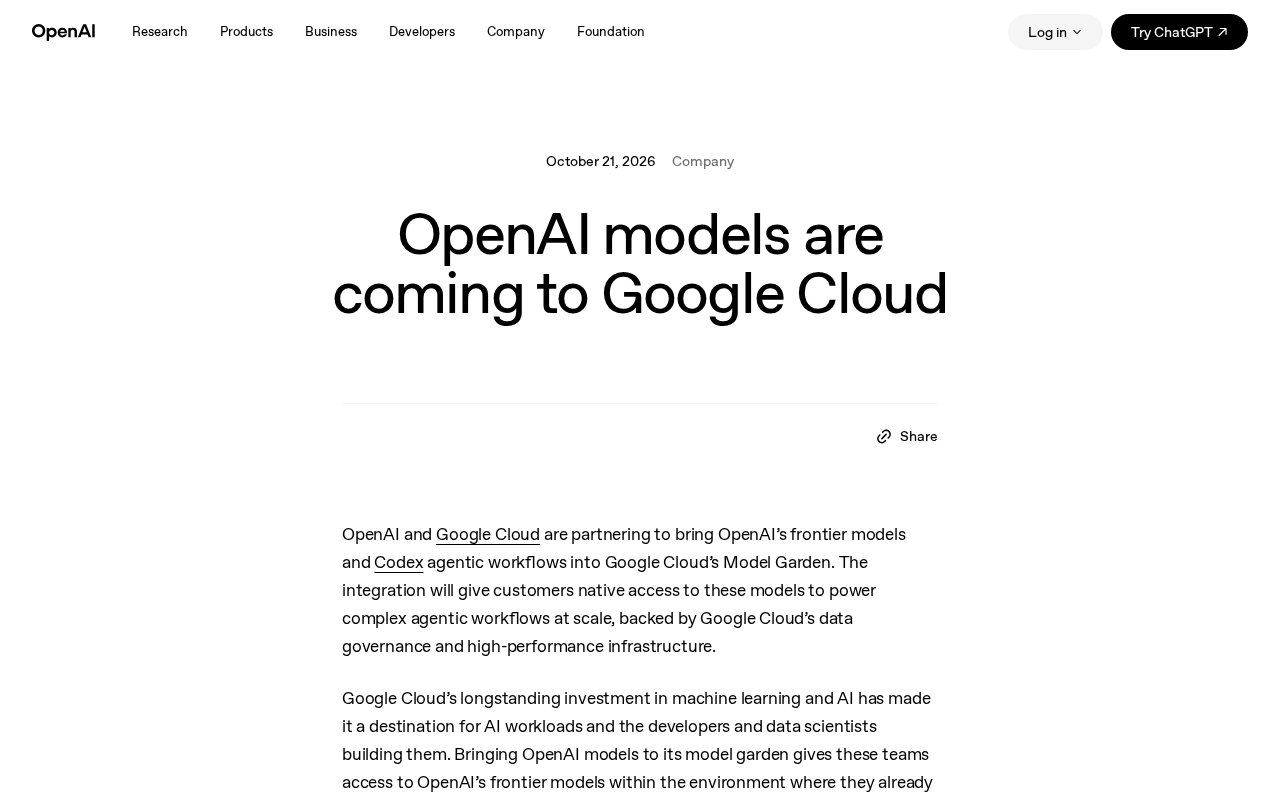
For a long time, OpenAI's deep ties with Microsoft Azure have been regarded as a model example of AI cloud services. As Microsoft's main competitor in the cloud market, Google Cloud's introduction of OpenAI models undoubtedly breaks the original camp divisions. This move suggests that the partnership between AI model providers and cloud infrastructure is shifting from exclusivity toward openness.
OpenAI's partnership with Microsoft Azure dates back to 2019, when Microsoft invested billions of dollars in OpenAI and became its exclusive cloud service provider. Under the agreement, most of OpenAI's model training and inference workloads run on Azure infrastructure, and Azure also gained priority access to OpenAI models and commercialization rights. This deep binding gave Azure a significant differentiation advantage in the enterprise AI market—customers who wanted to use GPT-series models typically had to choose Azure. However, this exclusivity arrangement was never permanent. As OpenAI seeks broader commercialization paths and compute sources, and as cloud market competition intensifies, the relationship between model providers and cloud platforms is loosening. Understanding this background helps grasp why OpenAI models coming to Google Cloud is seen as an important signal of changing industry dynamics.
AI Model Distribution Under the Multi-Cloud Trend
The most direct impact of OpenAI models coming to Google Cloud is that customers can invoke OpenAI capabilities in their preferred cloud environment. For enterprises already deeply invested in Google Cloud services, this means they can access GPT-series models without migrating infrastructure, lowering the barrier to adoption.
From an industry trend perspective, AI models are moving from "cloud vendor exclusivity" toward "cross-cloud availability." Model providers want to expand their reach, while cloud vendors want to enrich their AI service portfolios—these needs converge on this point. Google Cloud introducing a competitor's models also reflects cloud vendors' pragmatic attitude in the AI era: rather than letting customers churn to other platforms, it is better to offer more choices on their own platform.
Multi-cloud refers to an architectural strategy in which enterprises use two or more cloud service providers simultaneously, typically to avoid vendor lock-in, meet data residency compliance requirements, optimize costs, or leverage differentiated capabilities across cloud platforms. In the context of AI model distribution, multi-cloud means model providers no longer confine model capabilities to a single cloud platform but reach customers through multiple cloud channels. For model providers, this model can expand market coverage; for cloud vendors, it can enrich service portfolios and improve customer retention. However, cross-cloud distribution also brings technical challenges, including model version consistency, integration of billing and identity authentication, and cross-cloud network latency. The industry already has similar practices—for example, some open-source models are offered through managed services on multiple cloud platforms—while cross-cloud distribution of closed-source models is still in its early stages. If OpenAI models officially launch on Google Cloud, it will become a landmark case for this trend.
Subtle Changes in the Competitive Landscape
This partnership is a signal worth watching for Microsoft Azure. Azure previously gained a first-mover advantage in the enterprise AI market through its close relationship with OpenAI. If OpenAI models become available on Google Cloud, Azure's exclusivity advantage will be weakened, and customers will weigh price, existing architecture, and specific service capabilities more heavily when choosing a cloud platform—rather than simply choosing one because "OpenAI models are here."
For Google itself, this step has both pros and cons. The upside is that it enhances Google Cloud's appeal, especially for customers who favor OpenAI models but do not want to use Azure. The downside is that it may dilute the promotion of Google's own Gemini models, since customers will have more options to compare on Google Cloud.
Gemini is a family of multimodal large models developed by Google DeepMind, covering modalities such as text, images, audio, and code, and is Google's core product in the generative AI space. Gemini models are offered to enterprise customers through Google Cloud's Vertex AI platform and are an important part of Google Cloud's AI service portfolio. Google Cloud introducing OpenAI models means that competing models such as Gemini and the GPT series will coexist on its platform. This "model marketplace" strategy is not unfamiliar in the cloud industry—AWS's Bedrock platform likewise offers models from multiple vendors including Anthropic, Meta, and Mistral. For Google, the key is how to maintain Gemini's technical iteration and ecosystem promotion while introducing third-party models, avoiding its own models being marginalized in customer choices. This balance will directly affect Google Cloud's competitive positioning in the AI era.
Practical Implications for Developers and Enterprises
For developers, having one more cloud platform to choose from means more flexible architectural design space. Enterprises can choose deployment locations based on data residency requirements, cost budgets, and existing technology stacks, without being locked into a single cloud. At the same time, cross-cloud invocation of OpenAI models may also spawn new toolchains and integration patterns, such as unified API gateways and cross-cloud cost monitoring.
As a supplement, as of now the news consists only of a brief title and a small amount of discussion on Hacker News, lacking detailed official announcements from OpenAI or Google. Key information such as the specific range of available models, pricing strategy, regional coverage, and official launch timing remains unclear. Therefore, the above analysis is more of an inference based on industry logic, and actual implementation details still await official disclosure.
Data residency refers to the practice of enterprises storing data in specific geographic regions to meet local legal and regulatory requirements—for example, the EU's GDPR and China's Data Security Law both impose constraints on cross-border data flows. For enterprises using AI models, data residency requirements directly affect the deployment location of model inference—if a model is available only on a specific cloud platform or in a specific region, enterprises may be forced to adjust their architecture or abandon its use. If cross-cloud invocation of OpenAI models can cover more regions, it will help enterprises meet compliance requirements. In addition, cross-cloud invocation also involves unified API gateways and cost monitoring tools, which are currently mostly built by third parties or in-house by enterprises. As multi-cloud AI invocation becomes normalized, the relevant toolchains are expected to mature further.
Conclusion
OpenAI models coming to Google Cloud marks a new stage in AI model distribution, and the relationship between cloud vendors and model providers is being redefined. For enterprise users, the flexibility brought by multi-cloud choices is worth anticipating; for cloud vendors, the focus of competition will shift from "exclusive models" to "comprehensive service capabilities and ecosystem." The subsequent developments of this event deserve continued attention.
Related articles

Chain of Thought Isn't Just for AI: How Humans Can Use CoT to Improve Thinking Quality
Chain of Thought isn't just a prompt trick for large models. Starting from a Hacker News discussion, this article analyzes why CoT works for human thinking too, breaks down actionable ways to transfer it, and highlights the key differences between human CoT and machine CoT.
Cloudflare Teams Up with OpenAI: Closi…
Cloudflare Teams Up with OpenAI: Closing the Loop from Vulnerability Discovery to Defense with AI
Cloudflare uses OpenAI Daybreak to investigate security vulnerabilities and generate reviewable remediation plans, while developers use Codex to boost coding efficiency and quality.

Orca Multi-Agent Orchestration in Practice: A Guide to Parallel Collaboration with Claude and Codex
Orca is Stable AI's free open-source agent workbench supporting 34 agents like Claude Code and Codex in parallel. Learn its Git worktree isolation, multi-model orchestration, and mobile management.