OpenAI Officially Lands on AWS: Models, Codex, and Managed Agents Now in Preview

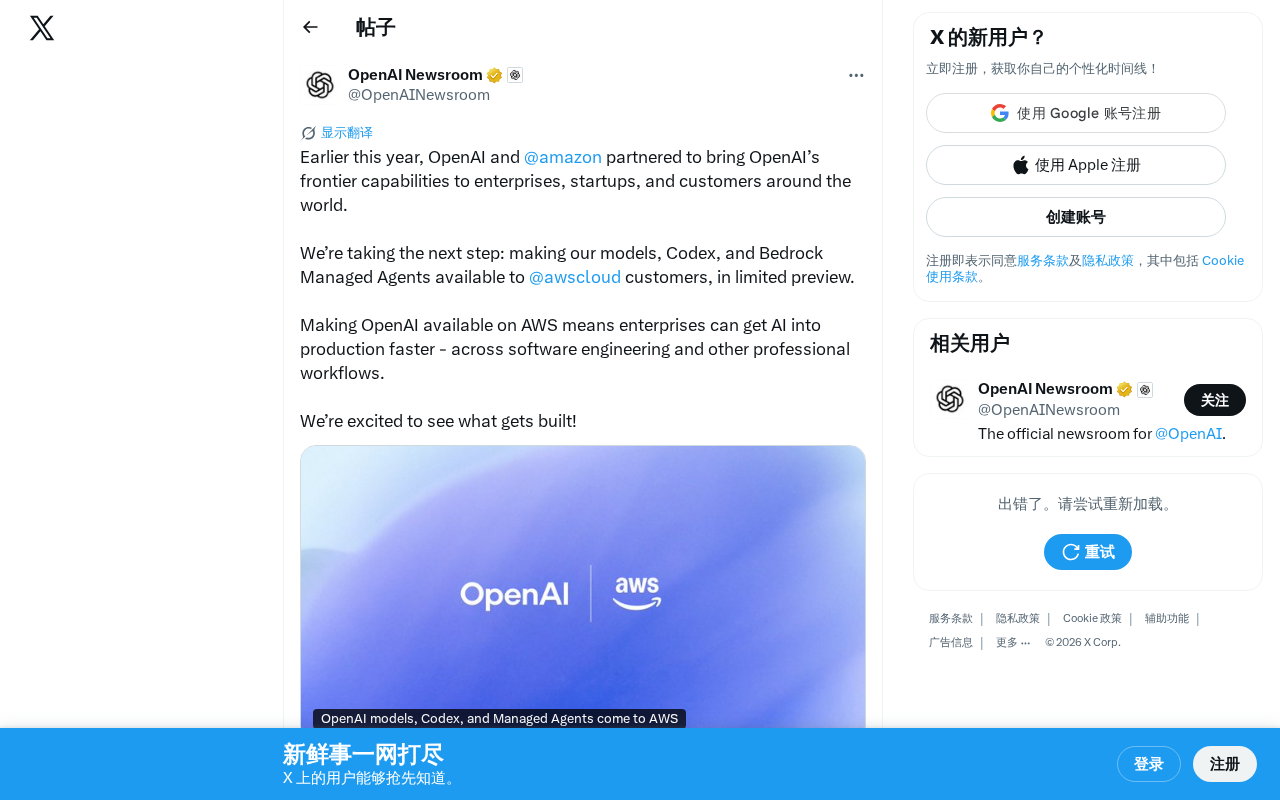
OpenAI models, Codex, and Managed Agents officially launch on AWS in limited preview.
OpenAI's partnership with Amazon AWS has entered the product delivery phase, with its frontier models, Codex programming tool, and Bedrock Managed Agents now available to AWS customers in limited preview. Enterprises can call OpenAI capabilities directly within existing AWS infrastructure without data migration, reducing compliance risk and accelerating AI from proof of concept to production deployment. This move also breaks OpenAI's exclusive arrangement with Microsoft Azure, marking its shift toward a multi-cloud distribution strategy.
OpenAI has announced a key milestone in its partnership with Amazon AWS — its frontier models, Codex programming tool, and Bedrock Managed Agents are now available to AWS customers in limited preview. This marks the formal launch phase of deep integration between two tech giants in the enterprise AI services space.
Background: From Strategic Agreement to Product Delivery
Earlier this year, OpenAI and Amazon announced a strategic partnership aimed at bringing OpenAI's frontier AI capabilities to enterprises, startups, and end users worldwide. The news drew widespread industry attention — AWS is the world's largest cloud computing platform, and OpenAI is the leader in generative AI. Their combination represents enormous market potential.
Now, this partnership has moved from a framework agreement to substantive product delivery. OpenAI confirmed on social media that its models, Codex, and Amazon Bedrock-based Managed Agents have entered the limited preview stage, and AWS customers can begin applying for access.
Three Core Products Explained
OpenAI Models on Amazon Bedrock
Amazon Bedrock, officially launched in 2023, is AWS's core strategic product in the generative AI wave. It's essentially a "model-as-a-service" managed platform that allows enterprises to call foundation models from different providers through a unified API, without managing underlying compute and inference infrastructure. Bedrock's differentiated positioning lies in its deep integration with the AWS ecosystem — enterprises can seamlessly connect S3 data lakes, Lambda functions, and IAM permission systems with AI model calls, making it extremely attractive to organizations that have already built data assets on AWS.
Previously, Bedrock had integrated models from Anthropic Claude, Meta Llama, Mistral, and others. The addition of OpenAI models means enterprise users can now call virtually all mainstream large language models on the market from a single platform, without separately integrating different APIs. For enterprises that need to compare multiple models or use different models for different business scenarios, this is a tremendous convenience.
Codex: Enterprise Deployment of an AI Programming Assistant
Codex originally debuted in 2021 as the underlying model for GitHub Copilot, a model specifically trained by OpenAI on code scenarios based on GPT-3. In 2025, the new generation of Codex was re-released in agent form, capable of autonomously executing multi-step software engineering tasks in sandbox environments, including reading and writing files, running tests, and committing code changes. It has evolved from a "code completion tool" to a "software engineering agent" that can understand natural language instructions and generate code, debug programs, and execute complex software engineering tasks.
Bringing Codex into the AWS ecosystem means enterprise development teams can use this tool directly on their existing AWS infrastructure without setting up a separate environment. For teams looking to accelerate their software development workflows, Codex's availability on AWS will deliver direct efficiency gains.
Bedrock Managed Agents: AI Productivity Beyond Conversation
Bedrock Managed Agents is a product form that deserves special attention. It combines OpenAI's model capabilities with AWS's Agent framework, enabling enterprises to build AI agents that can autonomously execute multi-step tasks. These agents can call internal enterprise tools, query databases, and execute workflows — far more productive than simple chat conversations. Unlike traditional single-turn Q&A, Managed Agents have task planning, tool invocation, and state memory capabilities, enabling automation of complex business processes. This is a critical step in moving enterprise AI from "assistive tool" to "autonomous executor."
What This Means for Enterprise Users
OpenAI particularly emphasized a key message in its announcement: enabling enterprises to put AI into production faster. This statement reveals the core pain point of enterprise AI deployment today — it's not a lack of model capability, but rather the enormous gap between proof of concept (PoC) and production deployment.
The "PoC to production" gap is the core challenge of enterprise AI deployment, often referred to in the industry as the "last mile problem." Gartner data shows that over 85% of enterprise AI projects stall at the proof-of-concept stage, with primary obstacles including: data sovereignty and compliance constraints, integration complexity with existing IT systems, unpredictability of model inference costs, and lack of enterprise-grade SLA guarantees. Embedding AI capabilities directly into enterprises' existing cloud infrastructure is the key path to solving this problem.
Many enterprises have already built complete data pipelines, security policies, and compliance frameworks on AWS. If using OpenAI's services required exporting data to another platform, it would not only increase technical complexity but could also trigger data compliance issues. Now that OpenAI provides services directly on AWS, enterprises can use state-of-the-art AI capabilities within their existing security boundaries, significantly lowering the deployment barrier.
For enterprises already running workloads on AWS, this means:
- No data migration needed: Call OpenAI models directly within existing infrastructure
- Unified management: Manage calls and billing for multiple AI models through the Bedrock console
- Compliance peace of mind: Data stays within the enterprise's existing AWS security boundaries, reducing compliance risk
Subtle Shifts in the Cloud Computing and AI Competitive Landscape
This partnership also reflects an interesting evolution in the competitive landscape of cloud computing and AI. AWS has invested up to $4 billion in Anthropic, and the Claude model series has long been the flagship product on the Bedrock platform. Introducing competitor OpenAI's models in this context reflects AWS's core strategic logic of "platform over model" — AWS's true moat lies in its cloud infrastructure, data services, and enterprise customer relationships, rather than betting on any specific model provider. This stands in stark contrast to Microsoft's strategy of deeply binding Azure with OpenAI, with the two approaches representing fundamentally different competitive philosophies for cloud giants in the AI era.
For OpenAI, entering the AWS ecosystem means access to a channel reaching millions of enterprise customers. Although OpenAI has its own API platform, many large enterprises' IT procurement and deployment revolve around AWS, and providing services directly on AWS is the most efficient path to opening up the enterprise market.
Notably, OpenAI's exclusive cloud partnership with Microsoft began in 2019, with Microsoft investing over $13 billion cumulatively, and Azure was once the only official cloud deployment platform for OpenAI models. While this deep binding helped OpenAI rapidly acquire compute resources, it also limited its ability to reach non-Azure customers. From late 2024 to 2025, as OpenAI's valuation exceeded $300 billion and it sought broader commercialization paths, its strategic focus began shifting from "single-cloud dependency" to multi-cloud distribution. This opening to AWS, while still in limited preview, undoubtedly breaks the exclusive arrangement with Azure and signals that OpenAI is moving toward a more open distribution strategy. This shift will have profound implications for the competitive dynamics of the entire cloud computing AI market.
Future Outlook and Recommendations for Enterprises
The service is currently still in limited preview, with no timeline announced for general availability. However, from an industry trend perspective, multi-platform distribution of AI models has become an irreversible direction.
For enterprise users, now is the time to monitor this integration progress, evaluate how to introduce OpenAI capabilities into existing AWS architectures, and prepare for the upcoming general availability. IT teams are advised to proactively identify business scenarios suitable for AI enhancement and follow AWS's official preview application channels to secure early access.
Key Takeaways
- OpenAI models, Codex, and Bedrock Managed Agents are officially available to AWS customers in limited preview
- Enterprises can use OpenAI capabilities directly on existing AWS infrastructure, accelerating AI production deployment
- The Codex programming tool enters the AWS ecosystem, providing AI acceleration for enterprise software engineering workflows
- This move breaks the exclusive partnership between OpenAI and Microsoft Azure, shifting toward a multi-cloud distribution strategy
- AWS strengthens its model-neutral platform positioning by adding OpenAI after Anthropic
Related articles
 Tech Frontiers
A Rare Quiet Day in AI: Recursive Self-Improvement Stirs Beneath the Surface
A rare quiet day in AI sees multiple sources go silent simultaneously. Behind the calm, Recursive Self-Improvement (RSI) research continues. What this means for the industry.
 Tech Frontiers
Reve 2 vs. Ideogram 4: A Deep Dive into Layout Control in AI Image Generation
A deep comparison of Reve 2 and Ideogram 4's layout control capabilities, covering technical approaches, real-world use cases, and industry trends for designers and creators.
 Tech Frontiers
In the Weights: Check Your Influence Score in the AI World
In the Weights is an AI influence search engine that quantifies your presence in the AI world with a score. Explore how it evaluates practitioners and what it means for digital identity.