OpenAI Open-Sources Codex Plugin: Call Codex for Code Review Inside Claude Code

OpenAI open-sources a plugin to invoke Codex for code review and task management inside Claude Code
OpenAI open-sourced the Codex Plugin for Claude Code project, using the MCP protocol to enable Codex code review and task management within Claude Code. The plugin earned 5K Stars in 12 hours, with core features including code review (supporting background execution and branch targeting), task dispatch, and status management. This reflects OpenAI's "capability-as-a-service" ecosystem infiltration strategy, extending Codex's capabilities into competitors' toolchains.
Introduction
OpenAI recently open-sourced a project called Codex Plugin for Claude Code (codex-plugin-cc), which garnered 5K Stars on GitHub within just 12 hours of launch. The plugin's core functionality allows users to invoke Codex directly within the Claude Code environment for code review and task management, creating a "nesting doll" combination of two major AI programming tools.
This reflects a strategic move by OpenAI: infiltrating Codex's capabilities into every development scenario, including competitors' toolchains.
Technical Positioning of the Two Tools
To understand this plugin's value, you first need to understand the technical background of each tool. OpenAI Codex is an AI system based on GPT-series models specifically fine-tuned for code tasks, originally released in 2021 and powering early versions of GitHub Copilot. The new version of Codex relaunched in 2025 is a cloud-based AI programming agent capable of autonomously executing multi-step programming tasks in a sandbox environment—writing code, running tests, fixing bugs—rather than merely providing code completion suggestions. Claude Code is Anthropic's terminal-native AI programming assistant that runs directly in developers' local command-line environments, capable of reading and writing files, executing commands, and understanding entire codebase context. The core difference: Codex leans toward cloud-based asynchronous task execution, while Claude Code leans toward local real-time interactive development—which is precisely why the two complement rather than simply replace each other.
Installation and Configuration
Three Steps to Initialize
This plugin is built on the MCP (Model Context Protocol)—an open-source standardized protocol released by Anthropic in late 2024 that allows AI assistants to connect to external tools and services through a unified interface. Its design philosophy is similar to USB port standardization: any tool that implements an MCP Server can be invoked by any AI assistant that supports MCP Client. OpenAI's choice to develop the plugin based on MCP rather than building a proprietary integration solution itself demonstrates a strategy of embracing open standards and proactively integrating into competitors' ecosystems.
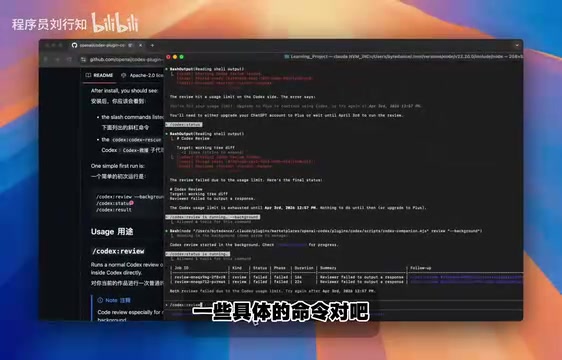
Using this plugin is straightforward—just execute three commands sequentially in Claude Code:
- Install the plugin: Install codex-plugin-cc via the package manager
- Reload: Reload the Claude Code environment after installation
- Run initialization: Execute the
codex-setupcommand to establish the connection with Codex
After initialization, you'll need to log in to your Codex account. Once logged in successfully, all Codex tasks can be viewed and managed within Claude Code.
Core Features Explained
Code Review
The most essential command is /codex:review, which performs a code review of the entire project. Unlike reviewing a single file, this command scans your Git commit history, analyzes recent code changes, and provides comprehensive review feedback.
This involves the core technical approach to AI code review: traditional static analysis tools (like ESLint, SonarQube) check code based on rule engines, while Codex's review system analyzes git diff output—the contextual differences of code changes—to understand "what this code changed, why it was changed this way, and whether the change is reasonable." Codex doesn't just check syntax and style issues; it can also assess logical correctness, potential edge cases, and security vulnerabilities based on the entire codebase's context.
Specific usage methods include:
/codex:review— Standard review mode/codex:review background— Run review in the background (suitable for large projects without blocking current work)/codex:review base:branch-name— Review against a specific branch
Supporting the base:branch-name parameter means it can simulate Pull Request review scenarios, which is particularly important for CI/CD pipeline integration—developers can automatically trigger AI reviews before merging code, embedding it into existing DevOps workflows. You can also execute more granular review commands, such as specifying a particular folder in a branch to review, or asking it to check whether a specific design logic is sound.

Task Dispatch and Management
Beyond code review, the plugin supports dispatching tasks directly to Codex for execution. This means you can delegate certain subtasks to Codex for processing within Claude Code's conversation flow, enabling collaborative work between two AIs.
Status Monitoring and Result Retrieval
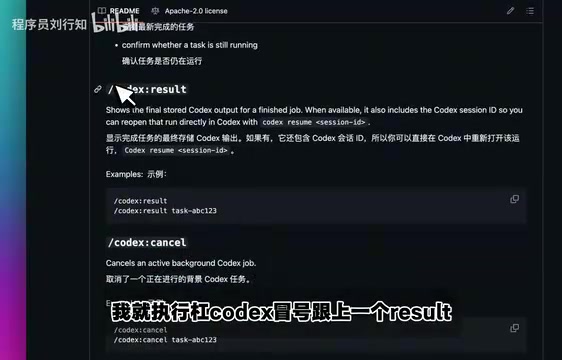
The plugin provides a complete set of task management commands:
/codex:stats— View the current status of all tasks, returning a clear table containing Task ID, running status, and other information/codex:result <task-ID>— View detailed results of a specific task, including failure reasons or review suggestions/codex:cancel— Cancel a running Codex task
Practical Usage Demo
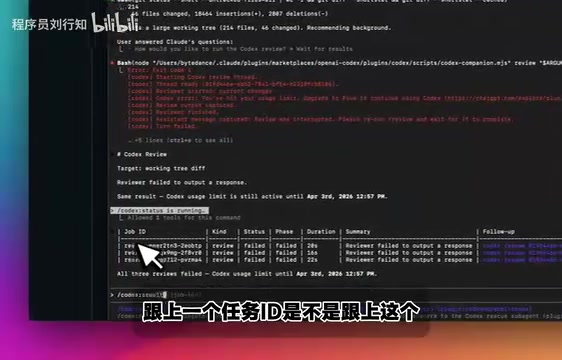
In actual testing, executing /codex:stats returns a status table clearly showing the number of active review tasks and each task's status. For example, you might see a task with a "Fail" status, indicating code issues were found.
Then by using /codex:result with the corresponding task ID, you can see exactly what caused the issue, including the Session ID and other detailed information for further tracking on the Codex platform.
Why Do We Need This Plugin?
Some might ask: Codex already has review and scanning capabilities, so why develop a plugin to support it in Claude Code?
There are several key considerations:
- Unified workflow: For heavy Claude Code users, there's no need to switch tools to access Codex's review capabilities
- Complementary strengths: Claude Code excels at code generation and conversational development, while Codex excels at code review and task execution—combining them creates a closed loop
- OpenAI's ecosystem strategy: Extending Codex's reach into all development environments, even competitors' toolchains
The Competitive Landscape of AI Programming Tools
The AI programming tools market in 2025 has entered a phase of intense competition, with major players including GitHub Copilot (Microsoft/OpenAI), Claude Code (Anthropic), Cursor (AI IDE based on VSCode), Windsurf (Codeium), and Google's Gemini Code Assist. The gap in underlying model capabilities between these tools is narrowing, and the competitive focus is gradually shifting toward workflow integration depth and ecosystem openness.
OpenAI's move to open-source Codex Plugin for Claude Code breaks the conventional wisdom that "AI tools must be mutually exclusive," instead adopting a "capability-as-a-service" infiltration strategy—as long as Codex's code review capabilities are strong enough, it doesn't matter which IDE or AI assistant users invoke it from. This strategy mirrors AWS's logic of selling cloud services to competitors, and signals that "interoperability" between AI tools will become a core competitive dimension in the next phase.
Summary
This plugin is essentially a bridge that lets you control Codex through the command line within Claude Code. For developers who enjoy both Claude Code and Codex, a single MCP protocol-based plugin enables seamless collaboration between the two tools.
The 5,000 Stars in 12 hours also demonstrates the developer community's enthusiasm for this kind of "AI tool combination" approach.
Related articles
 Product Reviews
The Programmer's Desk Setup Guide: Building a Workspace That Feels Like Home
Discover how programmers build productive, comfortable workspaces. From multi-monitor setups to ergonomic design, explore the desk philosophy that drives focus and flow.
 Product Reviews
Qoder vs Cursor Real-World Comparison: Which $20/Month AI IDE Is Better?
Hands-on comparison of Qoder vs Cursor AI IDEs: Agent autonomy, human interaction count, and architecture decisions. Qoder needed only 2 interactions vs Cursor's 8.
 Product Reviews
Cursor Cloud Agent Demo: Eliminating Bottlenecks Across the Entire Software Development Lifecycle
Deep analysis of Cursor's Cloud Agent demo showing how cloud VMs, automated test artifacts, and a full-chain control plane systematically eliminate human bottlenecks across the software development lifecycle.