OpenAI Open-Sources GPT-OSS: Run O4-Level Models on 16GB VRAM — Complete Deployment Guide

OpenAI open-sources GPT-OSS models, enabling O3-level reasoning on a single RTX 4090.
OpenAI officially released the open-source GPT-OSS series (20B and 120B), featuring MOE architecture and native FP4 mixed precision, requiring only 16GB VRAM for the 20B model. The 120B version matches O4 mini performance while surpassing Qwen3 with less than half the parameters, establishing a new open-source SOTA. The model supports controllable reasoning intensity, function calling, and other enterprise features, with deployment options including Ollama, Transformers, vLLM, and more.
OpenAI Finally Truly Embraces Open Source: GPT-OSS Officially Released
On August 5th, OpenAI officially announced the open-source release of its new-generation conversational model series GPT-OSS, including 20B and 120B variants. This marks the first time OpenAI has open-sourced a conversational model since GPT-2 in 2019, signaling that the company once mockingly dubbed "Close AI" by the industry has finally taken a truly meaningful step toward open source.
What's even more exciting is that GPT-OSS is far from a "token open-source gesture" — its performance rivals their own closed-source flagship O4 model, yet the hardware requirements are surprisingly low: a single RTX 4090 can run an O3-level model comparable to DeepSeekAd R1, and a single A100 can run the most powerful O4-level reasoning model available today.

GPT-OSS Core Technical Analysis: MOE Architecture and FP4 Mixed Precision
MOE Architecture + FP4 Mixed Precision: Performance and Efficiency Combined
GPT-OSS employs a MOE (Mixture of Experts) architecture combined with Grouped Multi-Query Attention (GQA), achieving an excellent balance between model performance and actual response efficiency. Although GPT-OSS is a reasoning model, its response efficiency is on par with mainstream conversational models.
The MOE (Mixture of Experts) architecture is a sparsely-activated neural network design paradigm. Its core idea is to split the model into multiple "expert" sub-networks, activating only a small subset of experts to process the input during each inference pass. This means that although the total parameter count may be enormous, the actual computation required for each forward pass is far less than a dense model of equivalent parameter scale. A key component in this architecture is the "Router," which dynamically determines which experts should process the data based on the input token's characteristics. Well-known models such as DeepSeek and Mixtral adopt this architecture, and its advantage lies in achieving the expressive power of large-parameter models at lower computational cost.
Grouped Multi-Query Attention (GQA) is an efficient variant of the standard multi-head attention mechanism. In traditional multi-head attention, each attention head has independent Query, Key, and Value projection matrices. GQA groups the attention heads into several groups, with Key and Value shared within each group. This significantly reduces memory overhead and latency during inference (especially during long sequence generation) while retaining model expressiveness close to the original multi-head attention. Mainstream models like Google's Gemma and Meta's Llama series all employ this mechanism.
The model natively supports FP4 mixed precision, dramatically compressing memory usage without additional quantization:
- GPT-OSS 20B: Only 16GB VRAM needed for inference, 24GB for fine-tuning
- Achieves approximately 40 tokens/s generation speed on an RTX 3090
- Reaches an impressive 200 tokens/s on an RTX 5090
FP4 (4-bit Floating Point) mixed precision is an extreme model quantization technique that compresses model weights from traditional FP16 (16-bit floating point) or FP32 (32-bit floating point) down to just 4-bit floating point representation. Traditional quantization is typically a post-processing step performed after model training, often resulting in varying degrees of precision loss. GPT-OSS's "native FP4" means the model already accounts for low-precision representation during the training phase, using techniques like Quantization-Aware Training to maintain near-full-precision performance at 4-bit precision. This approach compresses memory usage to roughly one-quarter of FP16, making it a key technical breakthrough for running large models on consumer-grade GPUs.
This is a truly high-performance open-source large model usable on consumer-grade graphics cards.
Three-Stage Training Pipeline Shared with O4
The reason GPT-OSS achieves such high performance is that it uses the exact same training pipeline as the O4 model:
- Model Pre-training: Building foundational capabilities on large-scale corpora
- Full Instruction Fine-tuning: Aligning human instruction comprehension
- RL Post-training: Enhancing reasoning and decision-making capabilities
Reinforcement learning post-training is the core technical approach for aligning large language models with human preferences. Its classic workflow (RLHF, Reinforcement Learning from Human Feedback) involves: first collecting human preference ranking data on model outputs, then training a Reward Model to simulate human judgment criteria, and finally using reinforcement learning algorithms like PPO (Proximal Policy Optimization) to optimize the language model's generation strategy using the reward model's scores as signals. In recent years, teams like DeepSeek have explored new methods such as GRPO (Group Relative Policy Optimization), further simplifying the training process. For reasoning models, RL post-training is particularly critical — it guides the model to learn "when to think deeply and when to respond quickly," making it the core training stage that gives the O-series models and DeepSeek R1 their powerful reasoning capabilities.
Compared to DeepSeek R1, GPT-OSS employs a stricter unsupervised COT (Chain-of-Thought) alignment method, making the model's reasoning process more efficient and rigorous. Chain-of-Thought is a technique that has models show their step-by-step reasoning process before giving a final answer. Proposed by Google researchers in 2022, it has become a standard method for improving model reasoning capabilities. The "unsupervised COT alignment" in GPT-OSS means the model doesn't rely on human-annotated reasoning steps during the reinforcement learning phase, but instead trains by self-generating and filtering high-quality chains of thought. Stricter COT alignment means the model more precisely controls the length and quality of reasoning chains — avoiding "overthinking" on simple problems with unnecessarily long reasoning, while also avoiding "underthinking" on complex problems by skipping steps — thus achieving a better balance between reasoning efficiency and accuracy.
Controllable Reasoning Intensity: Flexibly Balancing Speed and Depth
Similar to O3 and O4 models, GPT-OSS supports manually setting reasoning intensity through system prompts, which is highly practical in real-world applications:
- High reasoning intensity: The model spends more time on deep thinking, suitable for complex mathematical proofs, multi-step reasoning, and similar scenarios
- Low reasoning intensity: The model can complete its thinking and respond within a second, suitable for simple Q&A, everyday conversations, and similar scenarios
Additionally, GPT-OSS fully supports Function Calling, structured output, and other enterprise-grade features, providing a solid foundation for AI Agent development. Function calling capability means the model can autonomously decide when to invoke external APIs, database queries, code executors, and other tools during conversation, integrating tool-returned results into its responses. Structured output ensures the model can return data in predefined formats like JSON Schema, which is critical for integrating large models into enterprise software systems.
GPT-OSS Performance Benchmarks: New SOTA for Open-Source Models
According to official benchmark data, the GPT-OSS series delivers impressive results across multiple core benchmarks:
| Model | Positioning | Performance Level |
|---|---|---|
| GPT-OSS 20B | Lightweight | Between O3 mini and O4 mini |
| GPT-OSS 120B | Flagship | On par with O4 mini |
Whether in mathematical reasoning, coding ability, or the widely discussed "Humanity's Last Exam" and other evaluation metrics, GPT-OSS demonstrates extremely strong competitiveness.
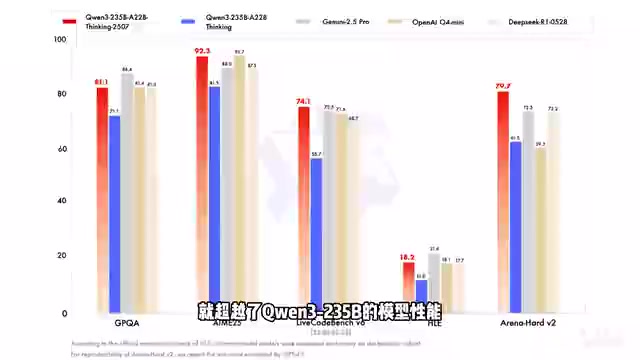
Particularly noteworthy is that compared to the recently open-sourced Qwen3 235B AR2B reasoning model, GPT-OSS 120B surpasses its performance with less than half the parameter count and hardware cost. This means the GPT-OSS series is the second tier of large models, just behind O3, and is the undisputed new SOTA for open-source models.
From practical testing, GPT-OSS excels in coding, reasoning, tool calling, Agent development, and other areas, demonstrating true industrial-grade usability.
GPT-OSS Local Deployment Tutorial: Four Approaches Explained
Approach 1: Ollama One-Click Deployment (Recommended for Beginners)
The simplest deployment method is using Ollama:
- Download and install the Ollama client
- Select GPT-OSS from the Ollama model library
- The system automatically downloads model weights and starts a conversation
Ollama is an open-source tool specifically designed for running large language models locally. It encapsulates complex steps like model downloading, quantization, and inference engines into simple command-line operations, similar to how Docker simplifies containerized deployment. Users can pull and run models with a single command, greatly lowering the technical barrier for local deployment.
Since GPT-OSS natively uses FP4 mixed precision, what you download through Ollama is the original-precision model without compression — no additional quantization processing is needed.
Approach 2: Transformers Library Deployment (Recommended for Developers)
For developers who need more customization control:
- Download model weights from Hugging Face or ModelScope
- Load the GPT-OSS model using the Transformers library
- Write inference code for calling and conversation testing
Approach 3: vLLM/SGLang Enterprise Deployment
For enterprise scenarios with concurrency and stability requirements, professional inference frameworks like vLLM or SGLang are recommended.
vLLM, developed by the UC Berkeley team, features PagedAttention as its core innovation — borrowing the paged memory management concept from operating system virtual memory to dynamically allocate KV cache by page. This solves memory fragmentation and waste problems in traditional inference, boosting throughput by several to tens of times compared to native HuggingFace inference. SGLang, also from UC Berkeley, builds on vLLM by introducing RadixAttention and other technologies, deeply optimized for multi-turn conversations, complex Agent calls, and other scenarios, particularly excelling at handling batch requests with shared prefixes. Both support OpenAI-compatible API interfaces and are the preferred solutions for enterprise-grade large model service deployment.

Approach 4: Online Service Calls (No Deployment Needed)
If you prefer not to deploy locally, there are multiple online options:
- Test conversations directly on the Hugging Face model page
- Call through online model service providers like OpenRouter
- Use API Keys for remote calls, supporting Agent development
OpenRouter is a unified large model API aggregation platform that integrates hundreds of models from OpenAI, Anthropic, Google, Meta, the open-source community, and more under a single standardized API interface. Developers only need one API Key to freely switch between different models without separately integrating with each provider. This model greatly reduces integration costs for AI application development and allows developers to conveniently compare model performance and optimize costs. With the release of high-performance open-source models like GPT-OSS, these platforms can provide inference services approaching closed-source model levels at extremely low costs, further highlighting their value.
GPT-OSS's Profound Impact on the Open-Source LLM Landscape
The explosive popularity of DeepSeek R1 earlier this year demonstrated to global LLM technology companies the enormous power and commercial value of the open-source community. DeepSeek R1 is an open-source reasoning model released by the Chinese AI company DeepSeek. It achieved reasoning capabilities comparable to OpenAI O1 at training costs far below those of contemporary closed-source models, triggering a global reassessment of the open-source LLM approach and even temporarily affecting U.S. tech stock market performance. Sam Altman publicly acknowledged in a January 31st interview that "closed-source is the wrong direction for historical development."
Compared to other Silicon Valley tech giants' "limited open-source" strategies — Google only open-sources smaller models, Musk only open-sources outdated models, and Meta's Llama models have licensing controversies (the Llama series, while offering open weight downloads, has license restrictions on commercial applications with over 700 million monthly active users and prohibits use for training competing models, so strictly speaking it's not a fully open-source license) — OpenAI's GPT-OSS release can truly be called an industrial-grade usable open-source large model.
This move not only raises the ceiling for open-source model capabilities but is expected to accelerate the development of the entire open-source LLM community. When top-tier closed-source model capabilities are released in open-source form, developers and enterprises will gain unprecedented technological dividends, and the democratization of large model applications will accelerate significantly.
Summary: 16GB VRAM Ushers in a New Era of O3-Level Reasoning
The release of GPT-OSS is one of the most important open-source events in the LLM field in 2025. It proves one fact: open source and top-tier performance are not mutually exclusive.
For developers everywhere, an O3-level reasoning model that runs on just 16GB of VRAM means the barrier to AI application development has been dramatically lowered. Whether you're an individual developer or an enterprise technical team, GPT-OSS is worth trying out immediately.
Related articles
 Tutorials
ChatGPT Plus Subscription Guide: Are GPT-5.5, image-2, and Codex Worth the Upgrade?
A detailed look at ChatGPT Plus features — GPT-5.5, image-2, and Codex — with a Plus vs Pro comparison and a complete step-by-step subscription guide for users outside the US.
 Tutorials
Harness AI Engineering in Practice: Using Claude Code to Master Enterprise-Level E-Commerce Development
Deep dive into Harness AI Engineering: master enterprise e-commerce development with Claude Code using the Rules, Skills, Wiki, and Changes framework.
 Tutorials
Cursor + Codex Dual-IDE Collaboration: A Practical Methodology for Open-Source Project Customization
A complete methodology for open-source project customization based on real-world experience, detailing the Cursor+Codex dual-IDE workflow, seven-stage process, MVP validation, and AI source code reading techniques.