OpenAI Pando: The Git Backend Built for Codex-Scale Pushes
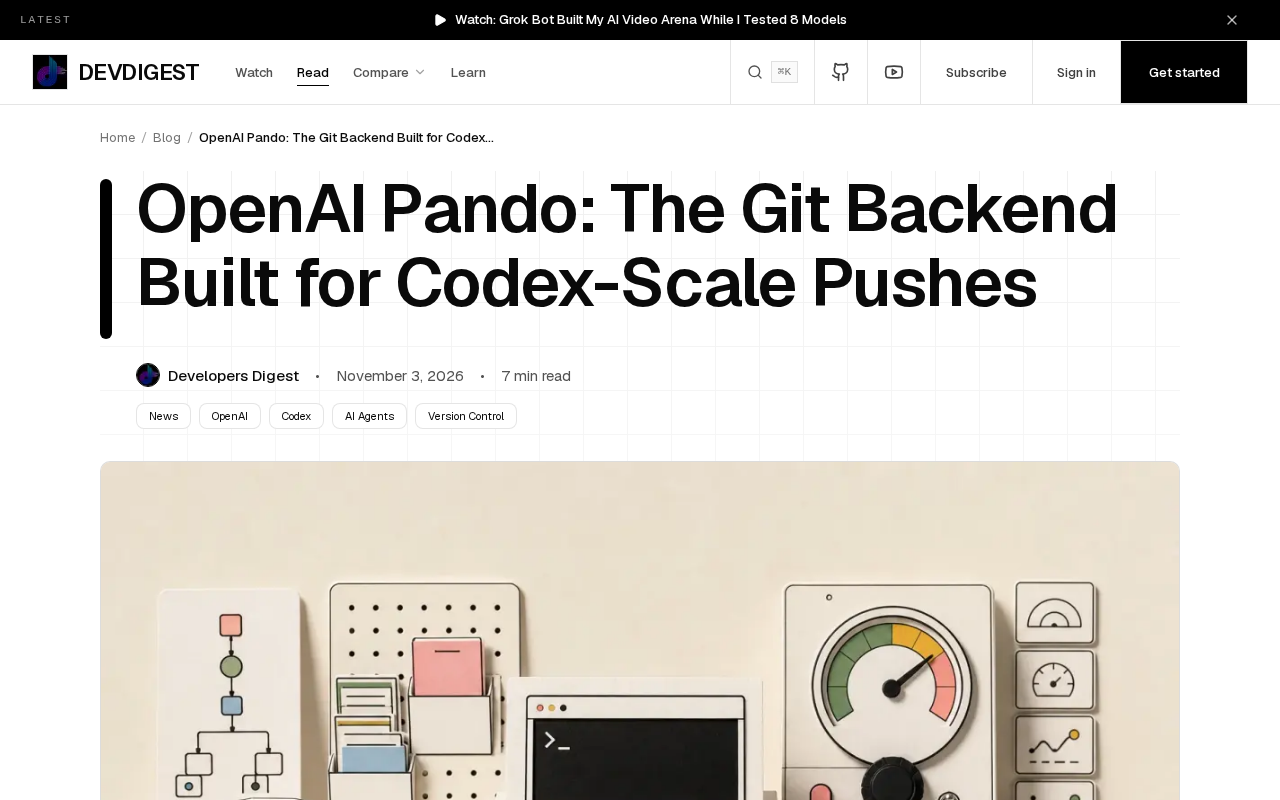
OpenAI built Pando, a Git-compatible backend, to handle high-concurrency push pressure from Codex agent fleets.
After integrating AI coding agents like Codex, OpenAI's internal giant monorepo faced unprecedented push traffic, overwhelming traditional Git backends due to lock contention and object storage write bottlenecks. OpenAI built Pando—a Git protocol-compatible backend that optimizes the push path internally to support large-scale concurrent writes from agent fleets. Its "externally compatible, internally innovative" approach reduces migration costs while addressing high-concurrency scenarios, offering a reference for teams facing similar push storms.
When AI coding agents began pushing changes to code repositories at speeds far beyond human capability, the bottlenecks of traditional Git infrastructure were laid bare. OpenAI built Pando—a Git-compatible backend system designed specifically to handle the massive push pressure generated by agent tools like Codex. Based on publicly available information, this article examines Pando's design motivations, technical trade-offs, and implications for future agent fleets.
Why Codex Overwhelms the Monorepo
OpenAI internally uses a massive monorepo to manage a large amount of code. As AI coding agents like Codex were brought in, the frequency and concurrency of code pushes surged. Traditional Git backends showed clear performance bottlenecks when handling such intensive writes. According to the original report, Codex's push traffic "flooded" the repository's capacity, forcing OpenAI to rethink the architecture of its Git backend.
This phenomenon is not an isolated case. As agent fleets scale up, each agent may independently initiate commits, branches, and merge operations, putting unprecedented pressure on Git's locking mechanisms and object storage model. Pando was born precisely to solve these large-scale write pain points while maintaining Git protocol compatibility.
Monorepo refers to the practice of storing the code of multiple projects, services, and libraries in a single version-controlled repository. Major tech companies like Google, Meta, and Microsoft all adopt this model, and OpenAI also relies on a giant monorepo internally. Monorepos offer advantages such as unified dependency management, atomic cross-project commits, and simplified code sharing, but as repository size balloons (potentially containing tens of millions of files and TB-scale history), many Git operations become extremely expensive. Write operations are especially costly: every push requires updating refs, writing new objects, and maintaining indexes—operations that inherently contend on a single repository. When AI coding agents commit at machine speed and high frequency, lock mechanisms and object storage write paths designed for low-frequency human developer operations quickly become bottlenecks, leading to push queuing, timeouts, or even failures. Thus, the scale effects of the monorepo combined with agents' high-frequency writes are the root cause of Codex overwhelming traditional Git backends.
Pando's Core Changes and Design Trade-offs
Pando does not start from scratch; instead, it chooses to remain compatible at the Git protocol level. This means existing toolchains and clients can continue to work without major modifications, reducing migration costs. But to handle high-concurrency pushes, OpenAI made key adjustments to the internal implementation.
The report notes that Pando optimized the push path, which may involve improving ref updates, reducing lock contention, or restructuring the object storage write flow. Specific implementation details have not been fully disclosed, but what is certain is that these changes come at a cost. Compatibility means certain underlying constraints still exist, and Pando must find a balance between performance and protocol consistency. This trade-off is a common challenge engineering teams face when building large-scale code infrastructure.
For agent fleets, Pando's significance lies in providing a scalable write channel. When hundreds of agents simultaneously submit code to the repository, the backend can handle requests more smoothly rather than falling into queuing or timeouts.
Git protocol compatibility means Pando still follows Git's transport protocols (such as smart HTTP and SSH) and object model (blob, tree, commit, tag), allowing existing Git clients (such as command-line git, IDE plugins, and CI tools) to interact with Pando without modification. The main constraint this compatibility imposes is that Pando cannot arbitrarily change the repository's external representation—such as ref namespaces, object hash algorithms, or pack formats—otherwise client compatibility would break. However, compatibility does not require the internal implementation to be identical to native Git—Pando can restructure ref update logic on the server side, introduce finer-grained locks, or make object storage write paths asynchronous, as long as the externally exposed protocol behavior remains consistent. This "externally compatible, internally innovative" strategy allows OpenAI to deeply optimize for high-concurrency push scenarios without disturbing the vast toolchain, but it also means certain low-level Git semantics (such as strongly consistent ref updates) still require careful trade-offs between performance and correctness.
Impact on Agent Fleets and Development Workflows
Pando's emergence reflects a broader trend: AI agents are changing the collaboration model of software development. Traditional Git workflows assume committers are human developers with limited operation frequency; agents, however, can generate changes 24/7, imposing new requirements on code review, continuous integration, and repository management.
OpenAI's practice shows that infrastructure needs to be redesigned for "agent-first" scenarios. Although Pando currently primarily serves OpenAI internally, its approach may influence other teams facing similar pressures. For example, large open-source projects or enterprise monorepos may also encounter push storms after introducing AI coding assistants, at which point Pando-style backend optimizations could become a reference solution.
On the other hand, Pando's compatibility strategy also reminds us that not all problems require disruptive solutions. Targeted improvements on existing protocols are often easier to implement than complete replacements. Of course, the long-term scalability of this approach remains to be seen—especially as the number of agents grows further, whether Pando can continue to meet demand will require the test of time.
Agent fleet refers to a parallel working group composed of multiple AI coding agents that can simultaneously and independently execute tasks, generate code changes, and push them to repositories. Unlike human developers, agent fleets can easily reach hundreds or even thousands of instances, with each agent capable of producing commits, creating branches, or initiating merge requests at second-level frequency. This model imposes several new requirements on code infrastructure: first, write throughput must scale linearly to withstand burst push storms; second, ref updates need low conflict to avoid frequent retries due to branch contention among agents; third, code review and CI pipelines need to adapt to the flood of machine-generated changes, for example by introducing automated preliminary screening or tiered review mechanisms. Traditional Git workflows assume human committers with limited operation frequency, but agent fleets break this assumption, forcing teams to redesign every layer from repository backend to collaboration workflows. Pando is precisely a low-level response to the first requirement (write throughput), but the proliferation of agent fleets will continue to drive the evolution of upstream toolchains.
Conclusion
OpenAI Pando is a Git-compatible backend born for Codex-scale push pressure. It reveals the real impact of AI agents on code infrastructure and the engineering approach of addressing large-scale writes through protocol compatibility and internal optimization. As agent fleets become more widespread, low-level innovations like Pando may increasingly appear on our radar.
One-line Summary
OpenAI built Pando, a Git-compatible backend, to handle high-concurrency push pressure from Codex agent fleets.
Paragraph Summary
After integrating AI coding agents like Codex, OpenAI's internal giant monorepo faced unprecedented push traffic, overwhelming traditional Git backends due to lock contention and object storage write bottlenecks. To address this, OpenAI built Pando—a backend system that maintains Git protocol compatibility while optimizing the push path internally to support large-scale concurrent writes from agent fleets. Pando's design embodies an "externally compatible, internally innovative" engineering approach: it reduces migration costs while making targeted improvements for high-concurrency scenarios. This practice reveals the real impact of AI agents on code infrastructure and provides a reference for teams facing similar push storms, though its long-term scalability remains to be seen.
Related articles

World's First Humanoid Robot Company Agility Lists on Nasdaq: Buy or Not?
Agility becomes the world's first pure-play humanoid robot company to list on Nasdaq. This article analyzes what the landmark event means for the industry and investors, unpacking the commercialization test and investment framework for the pure humanoid robot sector.

Agent-Browser: A Browser Automation CLI for AI Agents
Vercel Labs open-sources agent-browser, a Rust-built browser automation CLI designed for AI agents, with over 45,000 GitHub stars and command-line-first browser control.

LZ4: The Open-Source Benchmark for Blazing-Fast Compression
Explore the LZ4 blazing-fast compression algorithm: its design philosophy, performance advantages, and wide use in the Linux kernel, databases, and more. How a 12k+ star open-source project became the speed benchmark.