OpenAI Pledges $5 Million to Help Mathematicians Understand AI Results

OpenAI donates $5M to the Simons Foundation to fund mathematicians verifying AI math results and to open its models and compute.
OpenAI announced a $5 million donation to a new Simons Foundation initiative to support mathematicians in verifying, understanding, and extending AI-generated mathematical research. The funds, managed by the Simons Foundation, will support workshops, conferences, and special projects, while OpenAI opens its models and compute to funded researchers. The article notes that AI-generated math results lack interpretability and need rigorous review. This collaboration offers AI companies an academic verification channel, lowers the barrier to advanced AI tools, and may serve as a model for industry-academia collaboration.
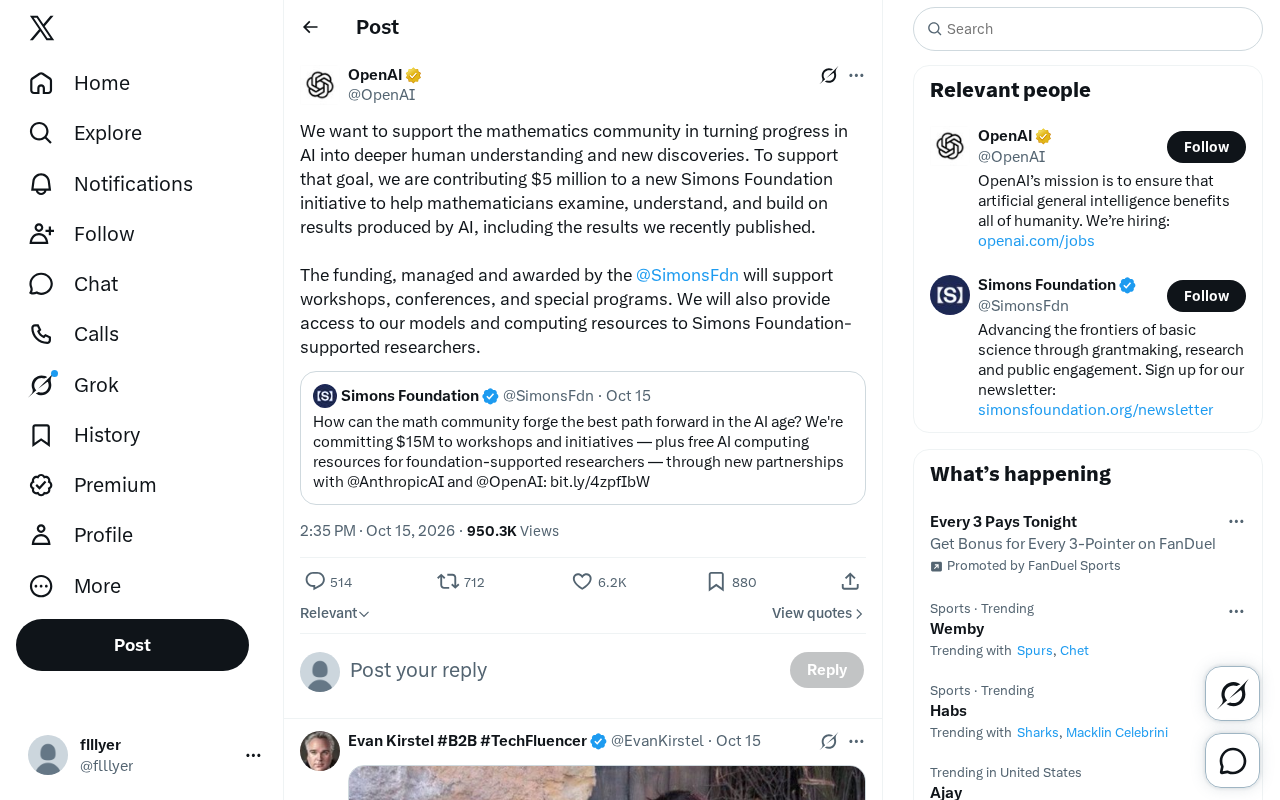
OpenAI recently announced it will donate $5 million to a new initiative by the Simons Foundation aimed at helping mathematicians verify, understand, and build upon research results produced by AI, including recent mathematical results released by OpenAI. The funds, managed and distributed by the Simons Foundation, will support workshops, conferences, and special projects. At the same time, OpenAI will open its models and computing resources to researchers funded by the Simons Foundation.
Collaboration Details: Funding, Resources, and Goals
According to OpenAI's statement on social media, the core of this collaboration is to "support the mathematics community in turning AI advances into deeper human understanding and new discoveries." The $5 million donation will be earmarked for academic exchange activities, while OpenAI's models and compute resources will be provided directly to relevant researchers. This means mathematicians will not only have access to advanced AI tools but also be able to verify and extend the outputs of OpenAI's models.
As the funder and administrator, the Simons Foundation will be responsible for the specific allocation of funds. The foundation has long supported mathematics and basic scientific research, and this collaboration is expected to establish a more standardized academic channel for the intersection of AI and mathematics.
Why Do Mathematicians Need to Get Involved in AI Results?
OpenAI recently released some AI-generated results in mathematics, but AI's reasoning process often lacks interpretability. Mathematicians need to rigorously review these results to determine their correctness, the rigor of the proofs, and their potential mathematical value. OpenAI explicitly stated that one purpose of the funding is to help mathematicians "verify, understand, and build on results produced by AI."
This collaboration model reflects AI companies' emphasis on academic verification. AI can rapidly generate conjectures or proof ideas, but peer review and logical checking within the mathematics community remain key to confirming the reliability of knowledge. By funding workshops and conferences, OpenAI hopes to build a platform where mathematicians can systematically evaluate AI outputs and integrate them into traditional mathematical research.
Results generated by AI in mathematics typically come from large language models or specialized theorem-proving systems. Their output is essentially probabilistic text generation or search-tree expansion and does not inherently come with human-readable proof structures. Even when AI presents a seemingly correct conclusion, there may be gaps in the proof, incorrect implicit assumptions, or validity only under specific conditions. The confirmation of mathematical knowledge relies on formal proofs and peer review, whereas current AI outputs often lack a complete chain of derivation that can be formally checked. Therefore, the core work of mathematicians involved includes: translating natural-language proofs into formal languages (such as Lean and Coq), checking the logical validity of each step of reasoning, assessing whether the conclusions are novel and worthy of generalization, and identifying whether the AI is engaging in "circular reasoning" or relying on existing results in its training data. This process is called the "verification loop for AI-assisted mathematics" and is a necessary step for AI-generated mathematical knowledge to enter the academic community.
Open Resources: Dual Support from Models and Compute
In addition to funding, OpenAI has promised to provide model access and computing resources to researchers supported by the Simons Foundation. This measure lowers the barrier for mathematicians to use advanced AI tools, especially for academic institutions lacking large-scale compute. Researchers can experiment directly on OpenAI's models, explore AI performance on mathematical problems, and conduct new research based on this.
This opening of resources also has strategic significance: by enabling mathematicians to deeply use and test its models, OpenAI can obtain feedback from the professional domain and thereby improve the models' capabilities in mathematical reasoning.
The performance of large language models on mathematical reasoning tasks is closely related to the amount of inference-time compute available. Inference-time compute refers to the length of the chain of thought, the number of samples, or the search budget the model is allowed to use when generating an answer. For complex mathematical problems, increasing inference compute can significantly improve accuracy, but it also means high compute costs. By opening models and computing resources to funded researchers, OpenAI is in effect enabling mathematicians to test model capabilities under higher inference budgets without having to bear the cost of training or deploying large models themselves. This access is typically implemented through API quotas, dedicated inference endpoints, or collaborative research agreements. For academic institutions, this bridges the compute gap with industrial laboratories, but it also raises issues that require attention, such as model version lock-in and reproducibility of results.
Potential Impact on the Mathematics Research Ecosystem
This funding may help drive the formation of a new research paradigm. Traditional mathematical research relies on individual inspiration and rigorous proof, while the addition of AI can accelerate conjecture generation and pattern discovery. Part of mathematicians' work will shift toward screening and proving AI outputs, which requires new skills and ways of collaborating. Workshops and special projects provide exactly the opportunity for exchange and learning during this transition.
In addition, the involvement of the Simons Foundation ensures the academic neutrality of fund allocation. Having a third-party foundation manage the funds helps safeguard the independence of academic research and avoid direct interference in research directions by commercial companies. This model may become a reference example for collaboration between AI companies and academia.
Conclusion: The Symbiotic Relationship Between AI and Mathematics
OpenAI's $5 million funding is not just financial support but also a repositioning of the relationship between AI and mathematics. Advances in AI require mathematical rigor for verification, while the development of mathematics can also use AI to expand its boundaries. By funding mathematicians to verify AI results, OpenAI is promoting the practical application of technology while also injecting new resources into academic research. Whether this collaboration can produce substantive mathematical breakthroughs in the future is worth continued attention.
One-line Summary
OpenAI donates $5 million to the Simons Foundation to fund mathematicians in verifying AI mathematical results and to open up models and compute.
Paragraph Summary
OpenAI announced a $5 million donation to a new Simons Foundation initiative to support mathematicians in verifying, understanding, and extending mathematical research results produced by AI. The funds will be managed and distributed by the Simons Foundation for workshops, conferences, and special projects, while OpenAI will open its models and computing resources to funded researchers. The article notes that AI-generated mathematical results lack interpretability and require rigorous review by mathematicians to assess their correctness and the rigor of proofs. This collaboration model provides AI companies with a channel for academic verification and lowers the barrier for mathematicians to use advanced AI tools. Having a third-party foundation manage the funds helps maintain academic neutrality and may serve as a reference example for collaboration between AI companies and academia.
Related articles

Chain of Thought Isn't Just for AI: How Humans Can Use CoT to Improve Thinking Quality
Chain of Thought isn't just a prompt trick for large models. Starting from a Hacker News discussion, this article analyzes why CoT works for human thinking too, breaks down actionable ways to transfer it, and highlights the key differences between human CoT and machine CoT.
Cloudflare Teams Up with OpenAI: Closi…
Cloudflare Teams Up with OpenAI: Closing the Loop from Vulnerability Discovery to Defense with AI
Cloudflare uses OpenAI Daybreak to investigate security vulnerabilities and generate reviewable remediation plans, while developers use Codex to boost coding efficiency and quality.

Orca Multi-Agent Orchestration in Practice: A Guide to Parallel Collaboration with Claude and Codex
Orca is Stable AI's free open-source agent workbench supporting 34 agents like Claude Code and Codex in parallel. Learn its Git worktree isolation, multi-model orchestration, and mobile management.